Chronicle Editor
Darlington Nyoni
[email protected]
INTELLECTUAL property (IP) has become one of the most renowned drivers of economic growth globally forcing individuals, firms and nations to gain interest in taking stock of what IP assets they possess and how they can economically benefit from them through exploiting their IP rights.
This consciousness has matched, if not overtaken the value that has been traditionally associated with
possession of physical assets like houses and cars. Individuals like Bill Gates and Steve Jobs have gained prominence across the whole world because of their inventive abilities. Firms have added on their asset records some types of IP as capital assets capable of being recorded on their balance sheets as intangible assets.
Subsequently, nations have been influenced to move from traditional resource-based economies to knowledge-based economies. Inspired by the miraculous economic development stories of the Western and Asian countries such as the United States and China of how IP helped spur development in these regions, developing countries are not leaving any stone unturned in exploring ways in which they can leverage IP to grow their economies.
IP laws have either been crafted (where they were nonexistent) or reviewed (where they have been overtaken by events owing to the proliferation of modern ways of doing business).
In addition, national IP policies and strategy measures have been formulated and implemented, awareness programs such as the World Intellectual Property Organisation (WIPO) IP day and WIPO IP clubs in schools have been initiated.
In addition to this, efforts have been made by a majority of these countries to join international and intergovernmental bodies dedicated to promoting IP services, policy, information and cooperation such as the African Regional Intellectual Property Organisation (ARIPO) and the World Intellectual Property Organisation (WIPO) through the signing of protocols and legal instruments they administer.
These organisations have been credited for having helped their members with providing technical support, training programs, creating IP data bases accessible to the public and raising awareness about IP over the years.
The potential that IP has been seen to possess has attracted not only individuals; firms and nations have been embroiled in fierce fights across the whole world over acts involving trespassing on these rights.
The mushrooming of these fights has created a need for designing strategies on how these disputes can be amicably resolved so as to give recourse to especially the offended parties. So special courts have been created dedicated to dealing with IP cases. These and other challenges such as the costs of creating IP, registering and maintaining IP rights have poured cold water on the zeal that has been exhibited in championing this field in the last years to spur creativity and innovation over the years.
There has been a tendency of late to adopt a calculative approach regarding weighing options of whether to invest or not in IP for individuals, firms and nations. These challenges have dampened spirits for continuing to invest in IP.
The stringent compliance rules that have been associated with membership to regional and international legal instruments have caused some countries, especially developing countries, to treat these with suspicion.
There is a general belief among these countries that the IP system is designed to benefit mostly developed countries.
What is IP
IP is all around us. Every product or service that we use in our daily lives is the result of a long chain of big or small innovation, such as new designs, or improvements that make a product look or function better.
The World Intellectual Property Organisation defines IP as creations of the mind, such as inventions; literary and artistic works; designs; and symbols, names and images used in commerce. IP covers a vast range of activities, and plays an important role in both cultural and economic life.
This importance is recognised by various laws which protect IP rights. IP law is complicated as there are different laws relating to different types of IP, and different national laws in different countries and regions of the world as well as international law.
IP laws can protect books, newspapers, films, recordings, paintings, photographs, sculptures, performances, broadcasts, computer programs, databases, etc. – by means of copyright and related rights brands and logos – by means of trademarks, products whose reputation derives from their place of origin – by means of Geographical Indications.
According to Article 2 of the WIPO– Central Organisation for the safety of IP Laws and the professional employer of the UN, “IP shall include the rights relating to literary, creative and scientific works, inventions in all fields of human endeavour, clinical discoveries, business designs, emblems, provider marks and commercial names and designations, safety in opposition to unfair opposition, and all of the different rights resulting from intellectual interest within the business, clinical, literary or medical fields.”
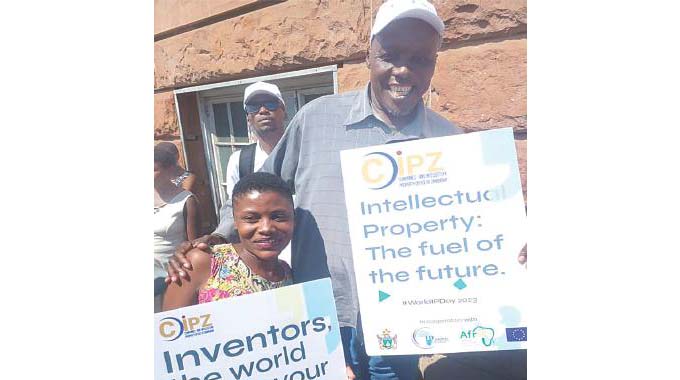
The World IP Day
The idea to have the World IP Day was born out of the need to spread word about IP far and wide. World IP Day takes place every year on April 26. It was established by the WIPO in 2000 and has since been celebrated every year without fail.
This year’s theme for the commemorations is “Women and IP: Accelerating Innovation and Creativity,” celebrating the “can do” attitude of women inventors, creators, and entrepreneurs around the world and their ground-breaking work.
The purpose of the holiday is to raise awareness about patents, copyright, and trademarks. It helps us to celebrate talent and creativity which makes us able to recognise the contributions that creators and inventors make to our world.
Over the years, the Companies and Intellectual Property Office of Zimbabwe has partnered different IP organisations and individuals to organise celebrations to commemorate this event. These organisations have included ARIPO, AfriPI, universities and certain law firms. Together these entities and individuals have contributed immensely towards the ensuring of the successful hosting of this event.
Such collaborative partnerships have proved to be effective in promoting understanding and respect for IP. In, Zimbabwe, universities as factories of knowledge have been mandated by the Government to shift from being mere factories of knowledge to being able to come up with products and services that will make it into the channels of commerce. Education 5.0 which has been adopted by the Government is a five-mission model of teaching, research, community service, innovation and industrialisation, established to move the nation forward towards an innovation-led and knowledge-driven economy.
The WIPO IP Day celebrations are a good platform for a country like the Companies and Intellectual Property Office of Zimbabwe (CIPZ) to correspondingly organise a national IP day with like-minded institutions across the country to concientise members of the public on the importance of IP in promoting economic development.
Darlington Nyoni is an IP practitioner, and writes in his personal capacity. He can be contacted on
0772524398 or [email protected].



 Online Reporter