

 Online Reporter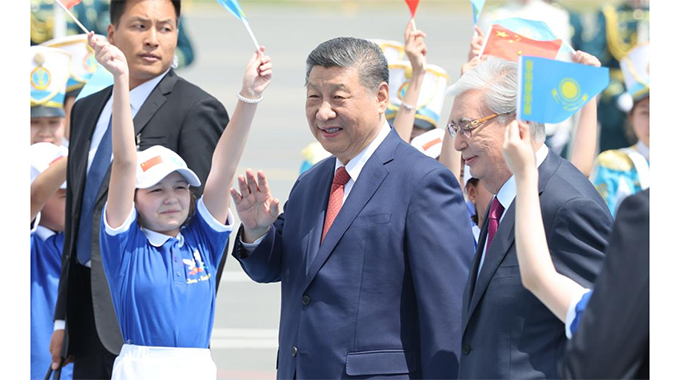
BEIJING. – For centuries, China and Central Asian nations have shared close bonds through mutual learning and exchanges underpinned by deep historical ties, solid public support and strong practical needs.
Two years ago, the inaugural China-Central Asia Summit was held in Xi’an, capital of northwest China’s Shaanxi Province. Since then, cooperation between China and Central Asian countries has yielded even more tangible and fruitful outcomes.
At the invitation of Kazakh President Kassym-Jomart Tokayev, Chinese President Xi Jinping is attending the second China-Central Asia Summit in Astana, capital of Kazakhstan. The summit is expected to take the six countries on a new journey toward building a closer China-Central Asia community with a shared future.
More than 2 100 years ago, Han Dynasty envoy Zhang Qian’s journey to western regions ushered in China-Central Asia friendly exchanges.
The legacy of the ancient Silk Road has evolved and acquired more profound significance nowadays.
Xi first proposed in Kazakhstan in 2013 the initiative to jointly build the Silk Road Economic Belt, an essential component of the Belt and Road Initiative (BRI).
With the launch of the China-Central Asia mechanism and the regular China-Central Asia Foreign Ministers’ Meeting mechanism in 2020, collaboration has deepened across sectors.
In January 2022, Xi chaired a virtual summit to commemorate the 30th anniversary of diplomatic relations between China and Central Asian countries. During the summit, the parties proposed upgrading the China-Central Asia mechanism to the level of heads of state.
Moreover, the decision to establish a mechanism for meetings among the heads of state of China and Central Asian countries was announced at the first China-Central Asia Summit held in May 2023.
Deepening China-Central Asia cooperation is in line with the prevailing trend of the world and the expectations of the people, said Xi when addressing a welcome banquet for Central Asian leaders attending the first summit held in Xi’an, capital of Shaanxi province.
With the upgrading of the all-around and multifaceted framework, efficient ministerial mechanisms now support cooperation in trade, investment, agriculture, customs, public security and more.
Today, China has established comprehensive strategic partnerships, signed Belt and Road cooperation documents and implemented the vision of building a community with a shared future at the bilateral level with all five Central Asian countries.
Ismail Dairov, director of Kyrgyzstan’s think tank the Regional Mountain Centre of Central Asia, noted that Central Asia and China share a thousand-year history of exchanges. – Xinhua.


