admin
admin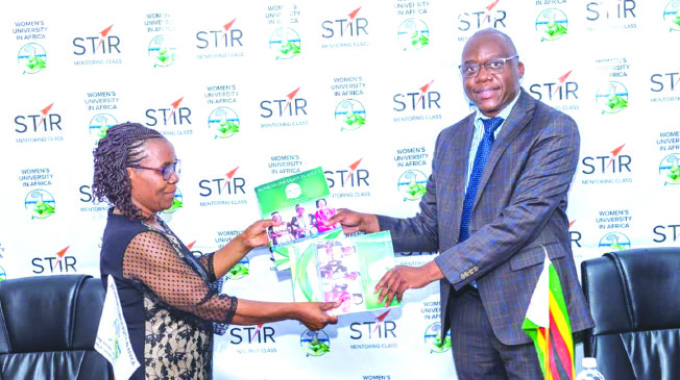
Youth Interactive Writer
Young women and students have hailed the STIR (Strategy, Transformation, Incubation and Release) programme that was recently launched in a bid to promote education and careers among others.
The founders said there had been a tendency to create job seekers rather than job creators, hence the need to transform.
On November, 1, the Women’s University in Africa signed a Memorandum of Understanding (MoU) with Stir Zimbabwe, an entrepreneurial and business development trust which will offer capacity building, training and business incubation for the university students. The partnership between STIR and WUA is aimed at bridging the gap between academic curriculum offered by WUA and opportunities in the market.
The two institutions will work together to provide learners with a platform to connect what they learn in their various disciplines with opportunities existing in the market.
Speaking at the signing ceremony, chairman of STIR, Mr Nicholas Bhero said, the partnership will go a long way in developing the career paths of youths.
“The STIR mentorship programme is an entrepreneurial curriculum developed specifically to create sustainable linkages between students and leading captains of industry who are the creators and decision makers of the global business infrastructure,” he said.
“Through a step by step practical approach, the curriculum is designed to inspire, start, accelerate and grow initiatives by participants.
Giving them skills and means to develop ideas around their fields of studies and the global environment at large, skills to raise capital and develop ingenious means to utilise locally available resources to start their initiatives and businesses, skills to market themselves, their initiatives and their products and services, and most importantly skills to grow and scale up their operations to fully occupy their niches and ensure survival of their projects.”
He said entrepreneurs are also taught strategic ways and importance of finding ways to launch themselves into the corporate world other than Job seeking, ways like volunteering, working general jobs, building from welcoming industries like small scale farming and mining, sales agency, and emigrant employment.
“Besides learning from those who have done it before, STIR will leave participants with the necessary alumni networks that are merged with the market leadership. The programme will build a culture of shared opportunities in markets, investment and partnerships thereby strengthening intra-trade amongst existing and emerging brands,” explained Bhero.
He added that this was a huge step for the country varsity students, who will now leave the university with not only their academic qualifications, but fully prepared to curve their own opportunities out of the vastness of the country’s resources.
“Having noted that industrial attachment exposes students to departmental experience and line management, a gap was identified in which students never get to know the tools, techniques, approaches and models used in the creation of such entities.”
“STIR believes all fields of knowledge and skill can be converted into multi-billion-dollar profit or social enterprises, hence the need to equip learners with the tools, environment, and guidance on how they can start and grow themselves into the next big brands,” said the entrepreneur.
However, according to the STIR program, another attention is given to sustainability of initiatives learners may embark on.
STIR also has a relationship with some of the leading innovators in various fields of science such as Artificial Intelligence and
Robotics.
Henceforth, learners will also be prepared to sync their various fields of learning and participate in the innovation and introduction of latest tech advances, ensuring their acquired skills and initiatives will not be easily rendered obsolete and redundant.
After participating in the STIR WUA program, students will not graduate and just wait for jobs.
Even when they do look for and find those jobs, they will not work 8 to 5 hours just for salaries but have a work ethic cut above rest of their global peers which is purposely designed to connect to the visions of the institutions and contribute to the sustainability and growth of such institutions.



 Online Reporter