Don Makanyanga-CheckPoint Desk
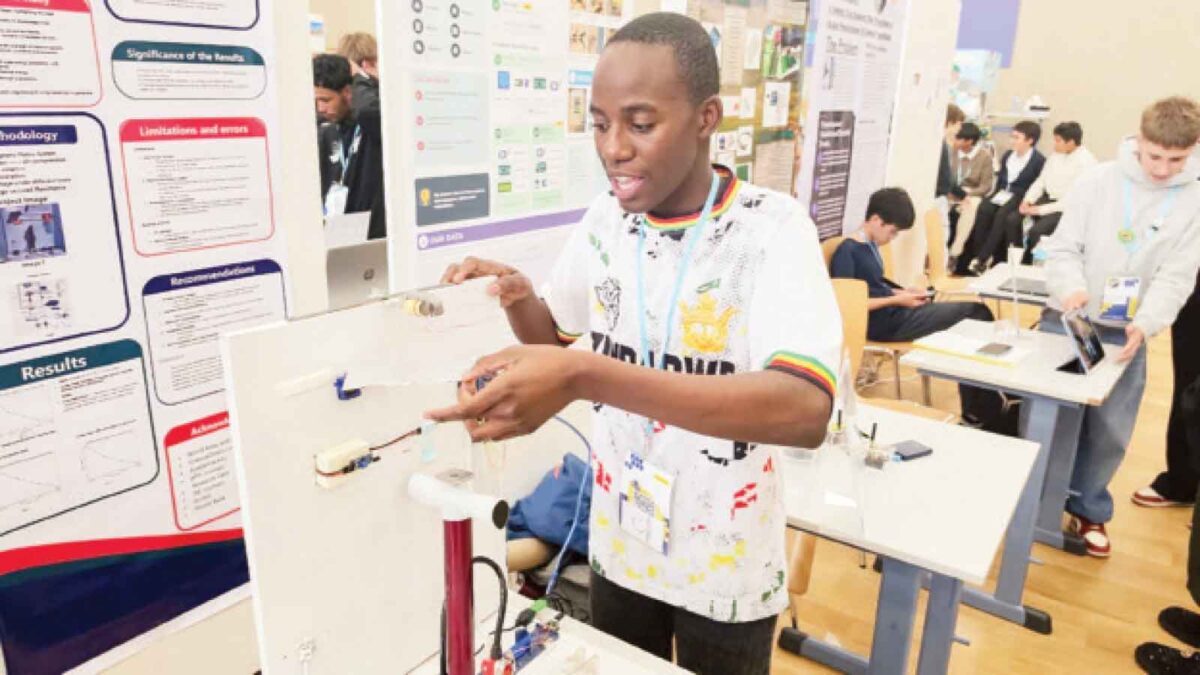
A 17-year-old Zimbabwean student has developed a prototype electricity generator powered by magnetic force and compressed air, earning international recognition at science exhibitions in China and Luxembourg.
Leon Tanaka Jonasi, a pupil at Marist Brothers High School in Nyanga, designed the magnetic force-driven high-pressure air electricity generator to address chronic power shortages in developing nations. Jonasi said his research into global energy deficits inspired the project.
“Before I made my project, through my research I saw that over eight million people globally lack access to electricity, while many others suffer from frequent and unpredictable power outages,” he said.
In Zimbabwe and other developing countries, unreliable power supply disrupts schools, hospitals, industries and overall economic productivity.
“I decided to go on an adventure of looking for renewable sources of energy which can cater for those energy-concerned societies present on Earth right now,” Jonasi said.
Assembled using locally available materials, the system uses magnetic forces to drive a piston, which compresses air into a storage chamber. The pressurised air is then released to spin a turbine connected to a generator, converting mechanical energy into electricity through electromagnetic induction.
Under no-load conditions, the prototype generates between nine and 10 volts of direct current (DC). While the concept is viable for micro-generation, Jonasi noted that efficiency improvements are required before the technology can be scaled up.
The project won a silver medal at the Zimbabwe Science Fair in February, earning Jonasi a spot at the China Association for Science and Technology (CASTIC) exhibition. He subsequently placed ninth overall at the global STEM Choice Awards — becoming the only African entrant in the top 10 — and represented Zimbabwe at the 16th Luxembourg International Science Expo in October.
“Personally, it felt like a milestone achieved, having to represent my country twice on an international stage. It helped me realise that my background doesn’t define my limits and that when you channel the necessary hard work, every goal can turn into a reality. Every dream can be made possible,” Jonasi said.
He credited his family, particularly relatives working in engineering, for fostering a supportive environment, and praised the integration of Science, Technology, Engineering and Mathematics (STEM) under Zimbabwe’s Education 5.0 framework. “I saw that technology can really take us very far in terms of development. I see how other countries and how other students out there are doing it, how they are going really far in terms of technology and science. When you see something good, it is always nice for you to emulate the standard,” he said.
“They (family) have provided a positive working space and a positive environment for me to grow up and also emulate their standards. When they go out there, they are getting enough knowledge and enhanced exposure to also plough back and bring back to where they came from,” he added.
“STEM is important because we are moving towards an era where everything is being operated by technology,” he said, urging fellow young innovators to persevere despite their circumstances. “I just want to advise all the young inventors not to be put down by any boundaries. The sky is the limit, and sometimes it is no longer the limit because we are now going beyond the stars.”