Chronicle Editor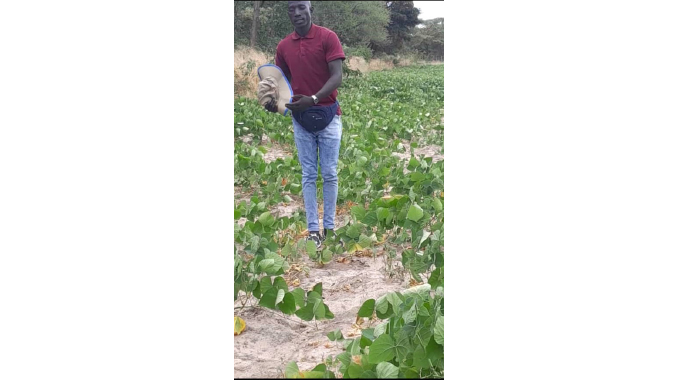
Judith Phiri, Features Reporter
In the sprawling Lupane District of Matabeleland North Province, Ntuthuko Mpofu, a 25-year-old small-scale youth farmer from Malunku Ward has taken fodder production to greater heights.
Mpofu is one of the young farmers in the country excelling in various aspects of agriculture, ensuring that the nation is well fed. Young farmers have positively transformed the agriculture sector, one of the backbones of Zimbabwe’s economy. The sector provides employment and income for 60 to 70 percent of the population, supplies 60 percent of raw materials required by the industrial sector and contributes 40 percent of total export earnings.
Of late, young agriculture entrepreneurs have emerged in Zimbabwe, taking up farming as a viable career option over white-collar jobs. Years before, most of these youths shunned the sector complaining that agriculture is hard and less attractive.
Under the Second Republic, youth empowerment programmes have featured more prominently with the goal of investing in young people and increasing their participation in the economy.
The Government has been consistent in placing the youths at the core of the country’s development agenda given that youths constitute 60 percent of the country’s population.
Notable initiatives that sought to increase the participation of youths in decision-making include setting up of youth focal desks in all ministries.
Last week, Cabinet said youth focal desks must be exploited by the public in order to identify and promote youth-led interventions. To date, all line ministries have appointed Youth Focal Persons and established Focal Desks at national and provincial levels, as required by section 20 paragraph 1 of the Constitution.
Carrying on the family tradition, Mpofu, a youth lead farmer adopted fodder production from his family. “My late grandfather Cowden Mpofu was one of the Beef Enterprise Strengthening and Transformation (BEST) project pioneer lead farmers. As a family, we adopted fodder production to greater heights at the inception of the BEST project in 2019,” said Mpofu.
The BEST project is one of the six projects that were supported by the European Union (EU) under the Zimbabwe Agricultural Growth Programme (ZAGP).
Implemented in Manicaland, Masvingo, Mashonaland Central, Midlands and Matabeleland North, the project sought to create a robust, competitive beef value chain that promotes enhanced trade, employment creation, food security, and inclusive green economic growth by 2023 for 25 000 small to medium as well as commercial cattle farmers.
Mpofu said his family has been on the forefront of fodder production and conservation in the past years, as a result, he carried over fodder production to his own new homestead to provide supplementary feed for his herd of 18 cattle.
“Through the Lead farmer approach, I was trained and technically empowered to disseminate acquired fodder technology to my peers using the stepdown trainings. Recently, I hosted a fodder field day to showcase my fodder crops to other farmers and also encourage other youths to venture into forage crops,” said Mpofu.
During the 2022/23 farming season, Mpofu planted 0,75 hectares of fodder such as velvet bean and lablab, as well as maize for silage. He harvested 79 bales and the reminder was conserved as silage.
“I learnt production of lablab and velvet bean from my grandparents. In the past three years, my family never lost cattle to poverty death due to supplementary feeding using on-farm feed formulations and in the market, the cattle would fetch lucrative prices with the improved condition and quality,” said Mpofu.
He said the BEST project widely promoted the production of fodder crops to assist farmers alleviate recurring droughts’ cattle deaths and ridiculous prices of stockfeed.
Mpofu said most small to medium-scale communal farmers have adopted their own fodder production and this has seen a reduction in cattle deaths especially during the lean season.
“However, production of forage crops among the youths remains low, despite the fact that they contribute 60 percent of the national population and 86 percent of livestock labour. As one of the few youths who have tapped into fodder production, I intend to adopt it as an enterprise,” he said.
Nationwide, farmers are adopting fodder production for supplementary feeding as one of the best-bet technologies on livestock feed.
Best-bet technologies in the agriculture sector are said to be addressing climate change and variability while spurring agricultural transformation to help countries achieve productivity and profitability in farming.
Among the drought-prone areas in Zimbabwe, the National Drought Risk Index (NDRI) indicates that the south-western provinces of Matabeleland North and South show high levels of drought risk and vulnerability, which negatively affects both cropping and livestock production.
Livestock farmers in such areas have adopted fodder production as a direct response to this challenge which is exacerbated by the climatic change pressures. As efforts to resuscitate the livestock sector continue to gather traction, the Government is implementing several measures aimed at boosting production to satisfy national demand for both human consumption and industrial use.
The Ministry of Lands, Agriculture, Fisheries, Water and Rural Development has said this year’s focus is on increasing productivity and livestock quality, while the main objectives are to improve or address challenges in the key areas of animal health, animal genetics, animal nutrition and other related parameters.
For the beef sector, the Government is targeting to reach a figure of 5,7 million as well as improve nutrition, pasture and fodder production and feed formulation.
The livestock sector contributes significantly to the inclusive growth and development of the national economy and is positioned to take a key role in the current national inclusive transformation agenda towards the attainment of Vision 2030.
In a recent interview, Ministry of Lands, Agriculture, Fisheries, Water and Rural Development Director for the Livestock Research Department, Mr Andrew Chamisa said planted pastures such as fodder play varying roles.
They increase farm carrying capacity through an increased production of pasturage per unit area, while also allowing increased rest of the veld in summer and in situations where we need to restore vigour to the veld.
Among other key things planted, pastures allow farmers to remove animals from parts of the veld at specific times of the year such as wet vleis in summer, as well as being a cheap alternative to the increasing cost of concentrate and grain feeding used in dairy, beef, mutton and lamb fattening systems.
Currently, agricultural colleges are also rolling out trials on fodder crops production, as the Government is reorienting the country’s agriculture colleges to champion the drive for the adoption of conservation agriculture throughout the country.
Climate change lobby organisation, African Renaissance Sustainable Development (ARSD), has said there is a need for collaborated efforts to enhance climate-smart agricultural innovations adoption. In an interview, ARSD founder, Mr Nehemiah Chipato said, “There is a need for access to land, credit, information, and education to enhance multiple climate-smart agricultural innovations adoption. Multiple adoptions of climate-smart agricultural innovations yield greater productivity and income dividends than individual adoption.”
“The disparities in the impact of multiple climate-smart agricultural adoption are evident by gender and geographic location, we also need to develop gender-sensitive policy and institutional efforts towards reducing resource access constraints for climate-smart agricultural innovations to be a priority.”
He said there is a need to support young entrepreneurs throughout the process with experts committed to helping the young innovators convert their dreams into reality.
Mr Chipato said an essential characteristic of ICT solutions in agriculture was providing young entrepreneurs in agriculture with internet access, training them to improve their ICT skills, and giving them concrete advice on how to market their ideas and access venture capital.
“Workshops, field days, and competitions can help young people in agriculture to become more commercial, while teaching them how to write a business proposal, how to network and what kind of market could grow their ventures.”
One of the key deliverables under the National Development Strategy 1 (NDS1) is agricultural production and productivity to ensure food security. The agricultural sector is expected to improve food self-sufficiency to 100 percent by 2025.
The agriculture sector has grown in leaps and bounds since the advent of the Second Republic, positively responding to the support rendered and initiatives across various crop and livestock value chains. Of utmost importance, at grassroots level is the Rural Development 8.0, which comprises eight Presidential interventions targeting over three million smallholder farmers to increase production and productivity.
These include the Presidential Climate-Proofed Input Scheme, popularly known as Pfumvudza/Intwasa, the Presidential Cotton Programme, the Presidential Blitz Tick Grease Scheme and the Presidential Rural Development Programme.
Among them also being the Presidential Community Fisheries Scheme, the Presidential Poultry Scheme, the Presidential Goat Scheme and the irrigation-based Vision 2030 Accelerator Model.
In other facets of the sector, Zimbabwe has become 100 percent wheat self-sufficient while recording the highest tobacco production in its 198 years of history coupled with bumper harvests in cereals.


 Online Reporter