Online Reporter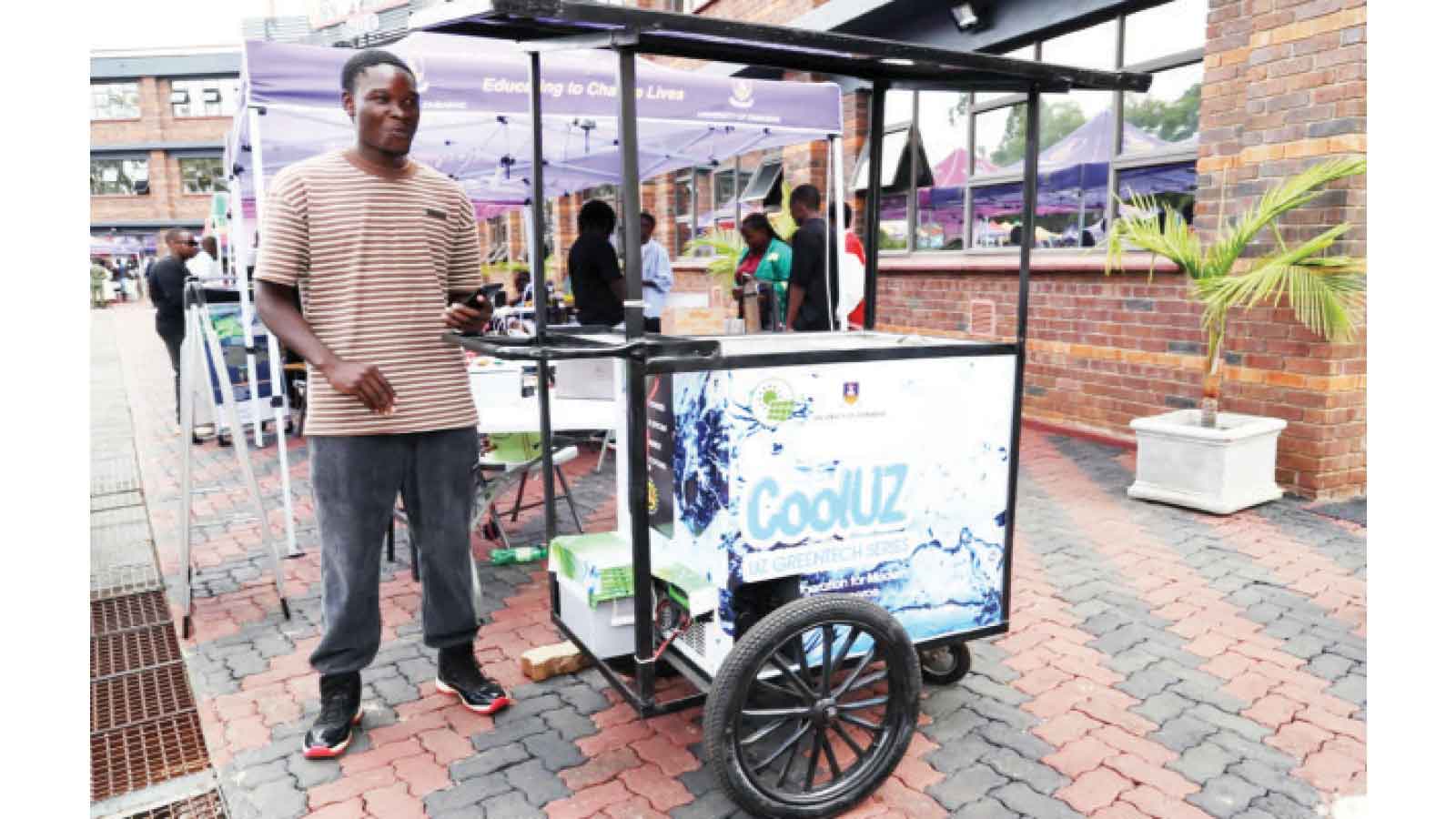
Trust Freddy-Zimpapers Correspondent
IF one walks down any major street in Zimbabwe’s capital at noon they will see the same routine.
An informal vendor hacks away at a heavy block of commercial ice and packs it into a rusted cooler box to keep a few dozen sodas cold.
Every morning, long before the midday sun turns the city’s pavements into furnaces, an invisible tax is levied on the working capital of informal vendors.
To keep a single crate of soft drinks, water or fruit fresh under the harsh African sun, a street trader spends an average of US$4 on commercial ice blocks.
It is a daily survival necessity.
To non-vendors, four dollars seems like a negligible cost of doing business. But after the maths, and the numbers work out: US$4 a day translates to over US$1 400 a year poured down the drain as meltwater.
For a demographic fighting for survival, this “ice tax” represents the difference between breaking even and sinking into debt.
But a University of Zimbabwe, Level 4.2 Mechanical Engineering student Tanaka Harare sought to change this status quo. Instead, he chose to tackle it head-on with physics, engineering and a heavy dose of empathy.
“Vendors spend a lot of money buying ice, so I just decided to come up with this cart, which has a mounted refrigerator,” says Tanaka, gesturing towards his sun-powered prototype parked on the campus pavilion.
“There will be no need to buy ice any more. It’s just a once-off cost, and it is entirely locally available.”
The genius of Tanaka’s design lies in its elegant simplicity and economic accessibility.
Stripping away unnecessary complexity to match the purchasing power of street traders, the cart features a robust chassis built for the urban terrain, topped with an insulated refrigeration compartment.
A sleek, roof-mounted solar panel serves a brilliant dual purpose.
It acts as the cart’s primary power source while simultaneously serving as a built-in canopy to provide much-needed shade for the operator.
To ensure the green revolution does not stop when the sun goes down, Tanaka integrated a smart battery backup system.
This ensures that even on overcast days or during late-evening rush hours, the refrigerator keeps humming, protecting perishable inventory without requiring a single cent of grid electricity.
“I am glad that our Government removed duty on solar panels, so I think it’s quite affordable,” Tanaka explains, opening the hatch to show the unit in action. “If you check inside, it is already working. If funding permits, I am looking to make these at an industrial scale. Given that this is locally manufactured, if I am to sell this cart, it will be around US$450.”
The return on investment is immediate. By eliminating the US$4 daily ice overhead, the cart completely pays for itself in exactly 113 days.
By the fifth month, the money that once enriched commercial ice suppliers becomes pure, unadulterated profit for a vendor’s household.
Tanaka’s solar cart did not sit in isolation.
It headlined a sprawling, multidisciplinary suite of solutions unveiled during UZ’s Research Innovation and Industrialisation Week, organised under the theme: “Advancing Transdisciplinarity for Impact and Competitiveness of Zimbabwe’s Critical Value Chains.”
This practical innovation perfectly dovetails with the Second Republic’s heritage-based Education 5.0 philosophy.
Unlike old-school academic models that relied heavily on imported ideas and purely theoretical learning, Education 5.0 explicitly mandates the generation of home-grown solutions derived from local resources and tailored to local challenges.
The pavilion became a hub where clean-energy engineering converged with advances in agriculture, AI, gastronomy and heavy industry.
Right next to the vending cart sat a solar-powered tricycle fitted with a medical-grade refrigerator, engineered specifically to transport delicate vaccines across off-grid, deep-rural terrain.
In the AI era, student developers showcased smart computer-vision systems designed for automated urban traffic and infrastructure monitoring.
Speaking after touring the exhibition stands, Acting Higher and Tertiary Education, Innovation, Science and Technology Development Minister Kazembe Kazembe recently expressed admiration for the student-led initiatives.
“So, it’s quite diverse, you know, from gastronomy, from the energy perspective to artificial intelligence-driven systems. So, I was quite chuffed. I was quite impressed by what I’ve seen,” Minister Kazembe said.
“And in fact, to say the very least, this is evidence of Education 5.0. It’s one thing that we thought was a talk show when it started, but after having toured the exhibition stands here, I’m convinced this is the way to Vision 2030. I’ve seen Education 5.0 in action. There’s a lot that our students can do in Zimbabwe. You know, we look down upon ourselves, we underestimate our capabilities, and this is quite eye-opening. I would like to kindly invite industry to come in and witness what our students are doing.”
For the informal traders, the innovation represents nothing short of an economic lifeline. “This is an absolute game-changer for us,” said organic fruit and ice cream vendor, Mai Chisale.
“Right now, the ice barons take all our profit before we even sell a single bottle. If I can stop buying ice, that money goes straight to my children’s school fees.”
However, recognising that an upfront capital expense of US$450 can still be an insurmountable hurdle for those living hand-to-mouth, the traders made an impassioned plea for structural support.
“We are appealing to the Government to step in and fund this project so we can buy these carts through a lay-by or hire-purchase scheme,” urged street trader, Panashe Ndlovu. “If they allow us to pay in small monthly installments while we use the cart, it will lift thousands of us out of debt.”
Another vendor who requested anonymity said that while critics might look down on street-level technology, he sees the project as a vital intervention exactly where the national economy needs it most.
“Others may try to laugh at a vending cart or dismiss it as low-tech, but we must look at the hard data,” he said. “The reality of our environment is that the Zimbabwean economy is largely being driven by the informal sector.
“Roughly 70 percent of our GDP comes directly from informal trade. We shouldn’t expect every academic solution to be some massive, heavy-industrial complex. A solution doesn’t have to be ‘too big’ to be revolutionary. We are happy that our university students are looking at the actual, day-to-day challenges being faced by our informal traders. Saving a vendor US$1,400 a year is how you build national wealth from the grassroots up.”