Online Reporter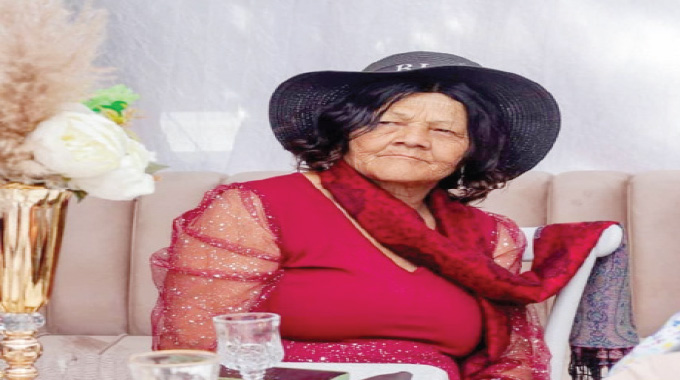
Raymond Jaravaza Sunday News Reporter
A ZAMBIAN princess, Mrs Benedine Regina Davies, whose lineage traces directly to the royal bloodline of the Lewanika Kingdom in western Zambia, was yesterday laid to rest at Athlone Cemetery in Bulawayo — the city she called home all her life.
Mrs Davies (66) passed away in Zambia on 7 October, a few days after travelling to Mongu in western Zambia to finally meet King Lewanika and reconnect with her royal roots, ending decades of efforts to trace her ancestry.
The Lewanika Kingdom, also known as Barotseland, has ruled western Zambia for over 500 years. It is one of Africa’s oldest surviving monarchies, rich in culture and tradition.
Yesterday, hundreds of mourners — including family, church congregants, neighbours from Sauerstown suburb and a delegation from the Lewanika royal family — gathered to bid farewell to a woman who lived in the shadows of royalty, only to rediscover her noble heritage at the twilight of her life.
Prince Aka Wamunyima Yeta, representing the Lewanika royal family, attended the burial and read a message from King Lewanika, who recognised Mrs Davies as a legitimate princess of the kingdom.
“A request was made that she be buried alongside her forefathers, who are buried in this section of Athlone Cemetery. King Lewanika recognises her as a princess and has extended a warm hand to the family to visit Barotseland,” said Prince Yeta.
Family spokesperson Mrs Doreen Roselee said the family’s royal connection dates back to the early 19th century when their ancestor — a young girl from the Lewanika Kingdom — was “abducted” by Ndebele warriors during King Lobengula’s territorial expansion.
“My great-grandmother was abducted by raiding Ndebele warriors from the Lewanika Kingdom when she was about 10 years old and ended up in Matabeleland, where she was given to the Ndlovu family,” she said.
Before her abduction, she was a princess in the Lewanika royal household, a heritage that makes her descendants, including the late Mrs Davies, royalty.
“On 2 October, after years of tracing our lineage, I travelled with Princess Benedine Regina Davies to Mongu to meet King Lewanika. Sadly, before we could meet him, she fell ill and was admitted to Lewanika Hospital, where she passed away on 7 October,” she said.
Mrs Davies is survived by 10 children and several grandchildren. Mrs Roselee said the family’s rediscovery of its royal lineage began in 1981 when she came across two neglected graves at Athlone Cemetery bearing the names of Lewanika princes buried in Bulawayo.
The first grave is marked Prince I. Mwananyanda, inscribed: “Son of the late King Lewanika of Barotseland, born at Lealui in 1892 and died in Bulawayo on the 5th of May 1934.”
The second is marked Mbanga Lewanika of Barotseland, inscribed: “Died at Bulawayo on 18 October 1922, 32 years of age.”
“The people of Barotseland didn’t know about the graves until 1981. I informed the Zambian Embassy in Harare about their existence, but no follow-ups were made.
“The Lewanika royal family later learnt about the graves through newspaper reports in The Chronicle, and they sent a representative to Bulawayo.
“Our history was then made known to King Lewanika, who acknowledged us as part of the royal family,” said Mrs Roselee.
Since then, she said, the family has made several visits to Barotseland to meet the Lewanika family, and a major reunion is now being organised.
“A big reunion has been organised by King Lewanika for us to visit Barotseland, and we are just waiting for the finer details for the extended family here in Bulawayo to travel to Zambia,” added Mrs Roselee.
Historian and researcher Mr Methembe Hadebe said King Lewanika — born around 1842 near Nyengo Swamp in Barotseland and who died in 1916 — ruled the Lozi people of the Luyana lineage.
“King Lewanika was a Southern African king of the Lozi, from the Luyana lineage one of a restored line of Lozi kings that recovered control of Barotseland in the decades following the 1851 death of the Kololo conqueror, Sebetwane,” he said.
“Fearful of attack from the Portuguese (in Angola to the west) and from the Ndebele (Matabele to the east) King Lewanika brought Barotseland under British protection. He expanded Lozi control over the neighbouring Ila and Toka peoples, raiding them for cattle and slaves.
He said the relationship between King Lewanika and King Lobengula was defined by rivalry and mutual distrust.
“As rulers of powerful and competing kingdoms in the late 19th century they vied for regional dominance and control over neighbouring tribes, leading King Lewanika to actively seek European protection against the Ndebele military threat,” said Mr Hadebe.
“The Ndebele kingdom, under both King Lobengula and his father King Mzilikazi, had a reputation for military strength.
“Their impis or military conquests launched incursions into surrounding territories, including those of the Lozi’s neighbours to extract cattle and tribute.
“King Lewanika in turn sought to expand his own kingdom’s influence and raided the neighbouring Ila and Toka peoples for cattle and slaves. These actions put the two powerful kingdoms on a collision course,” he said.
“The Lozi and Ndebele competed for control over the region that is now southern Zambia. The Ndebele threat was a major factor influencing Lewanika’s diplomatic decisions to engage the British for protection.”