Chronicle Editor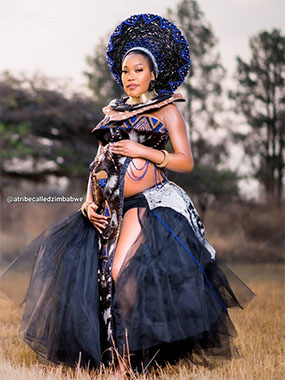
Mbulelo Mpofu, [email protected]
ZANA KAY, (real name Nomakhosazana Khanyile Ncube), a popular traditional attire specialist, has added a new maternity-based piece to her line to cater to those with bumps. The stylish queen of the hand-made stitch took to X to flaunt pictures of her bump before the birth of her child, showcasing her newly-woven apron known as “ingcayo.”
Zana Kay’s new maternity-based piece is a testament to her commitment to providing comfortable and stylish clothing for all women. Her ingcayo is designed to flatter the body and provide comfort during pregnancy. It is a perfect addition to her illustrious line of traditional attire.
Her passion for fashion and design is evident in her work. She has become a household name in the fashion industry, known for her unique designs and attention to detail. Her maternity-based piece is no exception and is sure to be a hit among expectant mothers.
Inevitably, her X post has garnered a lot of attention, with many praising her for her creativity and innovation. Her ingcayo is a perfect example of how fashion can be both stylish and functional.
“I made my maternity apron, ingcayo, predominantly from goat and cow hides. In my culture, the in-laws gift a goat to a pregnant woman, umakoti, to honour the pregnancy and the child. So, naturally, the goat hide was the canvas on which I wanted to tell my story.
“I wanted a maternity outfit that celebrates my culture and tells the authentic story of my roots, as should African Fashion. Pregnancy is a spiritual journey; for me, it was an important time to reflect on my identity, who I am, who I am becoming, where I am coming from,” posted Zana Kay.
Known for her tribal and artistic apparel brand, “A Tribe called Zimbabwe” Zana Kay has become an integral figure in preserving culture and heritage with her special fabric being cow and goat hide, a predominant feature within the Ndebele culture.
“I intricately hand-beaded the goat hide, cowhide, and leather to tell my story as a modern Ndebele woman and honour the beautiful journey of my pregnancy. Yet still, words or symbols cannot fully express this amazing journey and my gratitude to God.
“I have used the blue to also represent the ‘Water Tribe’ the Lozi people of Barotseland, where my husband, Lewanika, comes from. The Lozi, or Barotse, are a Southern African ethnic group who speak Lozi or Silozi, a Sotho-Tswana language, who settled along the Zambezi plains,” she continued.
The in-your-face piece of clothing characterised by triangular ornaments which look chevron-esque has different colours namely, gold representing abundance, wealth, and royalty, black, denoting strength, power, and spirituality as well as blue, a representation of peace, faithfulness, and fidelity.
The apron also has a circle representing sunrise (to shine), a new beginning, a shining bright light piercing through the dark sky and a bright future.
Zana Kay believes that, “Every mother’s vision is for her child to bring light, ukukhanya lezibusiso.”
“Ingcayo brings the element of in-lawship where a daughter-in-law (umakoti) has to be honoured through ukucolwa (bestowing of maternal blessings).”
Zana Kay has a penchant to excite with her show-stopping outfits over the years, particularly at red-carpet events. During the 2021 Roil Bulawayo Arts Awards (BAA), her cowhide costume stood out.
In explaining the idea behind her hand-woven apparel, Zana Kay said, “It is our desire that anyone who adorns ‘a Tribe called Zimbabwe’ apparel feels royal, unique, celebrated, valuable and proud.
“We use prime Zimbabwean Nguni cowhide. The products are handmade and because every piece is unique, each one receives special attention from cutting to packaging. While we specialise in cowhide and leather fashion, our flagship products are tribal crowns, cowhide capes and the cowhide neckties.”
The fashion designer’s designs tell a story and serve as a repository for generations to come.
“The intricate gold, blue, brown, and black beading tells my story. In Nguni culture, the diamond shape symbolises my marital status (married). The upward-pointing triangle represents masculine elements, revealing I am carrying a male child.
“The two other cowhide triangles represent the other two important male figures in my life. These are also connected with a chain of beads to symbolise their strong relationship,” reads the powerful cultural story of nuptial proportions that Zana Kay’s garment tells.
According to Zana Kay, “After the baby was born, the Ingcayo was re-purposed as a baby carrier or a warm blanket. In my case, the same cowhide I used for the maternity outfit was also used to make the baby carrier.”
She went on to share a video of a re-purposed ingcayo covering a baby carrier, a creative move which shows that cultural apparel and significance knows no age. – @MbuleloMpofu


 Online Reporter