Chronicle Editor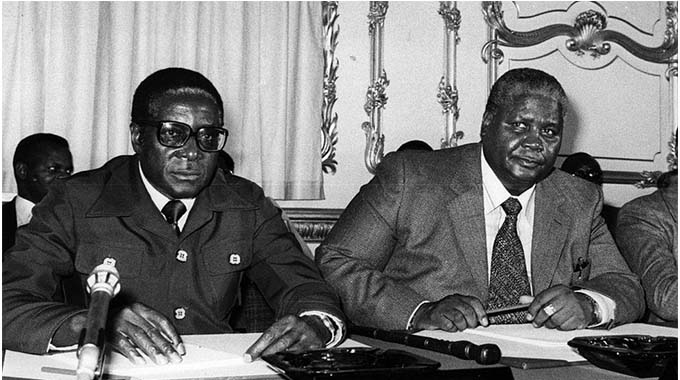
Pathisa Nyathi
“MR Chairman, we have come to a conference, a conference whose aim is to decolonise Southern Rhodesia, and that decolonisation is demanded by the people of Zimbabwe from the British. It is the British that are the decolonising power.
“We here, the Patriotic Front, feel very strongly about the position of the British over the years and our feelings have been expressed, very unfortunately there is a war, a war not of our choice, but a war has come because all else had failed.”
The above are words that were uttered by ZAPU leader Joshua Mqabuko Nkomo on 11 September 1979 the day after the commencement of constitutional talks at Lancaster House in London. The talks were a follow up to the Commonwealth Heads of Government Meeting (CHOGM) which took place in Lusaka, Zambia on Sunday, 3 April 1979. The meeting took place under the new guidance of British Prime Minister Margaret Thatcher whose party, the Conservative Party, had won the plebiscite in Britain.
Nkomo, in the same opening remarks went further to say, “The Patriotic Front, deeply conscious of the need to bring an end to repression and colonisation which continue to plague the people of Zimbabwe, welcomes the British government’s stated aim to assist in this task of decolonisation. We have come to London to attend this conference, in response to the invitation recently extended to us by the British government.”
The meeting was attended by the two components of the Patriotic Front (PF), namely ZAPU led by Nkomo and ZANU led by Robert Gabriel Mugabe. Also present was Bishop Abel Tendekayi Muzorewa’s United African National Council (UANC). The ZAPU delegation included, inter alia, Joshua Nkomo, Josiah Mushore Chinamano, Joseph Wilfred Msika, Ariston Chambati, Dumiso Dabengwa, Akim Ndlovu, George Tarcisius Silundika, William Dzawanda Musarurwa, Leo Baron, Advocate Kennedy Siwanda Sibanda, Reg Austin, Report Mphoko, E T Siziba and Dr Callistus Dingiswayo Ndlovu.
On the ZANU side there were the following: Mugabe, Simon Vengayi Muzenda, Josiah Magama Tongogara, Edgar Tekere, Josiah Tungamirai, Dr Herbert Ushewokunze, Dr Dzingayi Mutumbuka, Dr Simbi Mubako, Dr Eddison Zvobgo, inter alia.
The Muzorewa group included the following, among others, Muzorewa, Dr Silas Mundawarara, Leonard Nyemba, Francis Zindoga, George Bodzo Nyandoro, Z M Bafana, Ian Douglas Smith, David C Smith, David Zamchiya, Chief Khayisa Ndiweni and D C Mukome.
Nkomo was right to say the war had been resorted to not out of their liking. All else had failed. Soon after the Unilateral Declaration of Independence (UDI) on 11 November 1965 there were several attempts that were made to resolve the Rhodesian constitutional lock jam.
British Prime Minister Harold Wilson engaged Ian Smith over warships Fearless and Tiger but the talks collapsed. After the release of detainees from detention in December 1974 Nkomo, under the banner of the African National Council-Zimbabwe (ANC-Z), held talks with Ian Smith. The talks did not yield anything fruitful.
Against the backdrop of the ramping war for independence and threats to western economic and political interests following the independence of Angola and Mozambique, a conference was convened at Geneva in Switzerland in 1976.
Once again, there was nothing positive that emerged out of the talks. Soon thereafter, further talks were called at Malta. The quick succession of the talks demonstrated the urgency to resolve the Rhodesian constitutional impasse. The conference at Lancaster House came against the background of that urgency to resolve the constitutional standoff. What had to be avoided at all costs was getting independence through the barrel of the gun. That route would have favoured the Soviets in the hot political tussle against the background of the hot cold war.
On the day of inauguration of the talks, the conference chairman, Lord Carrington said, in his remarks, “The agreement reached at Lusaka has made it possible for the British government to convene, with the very real hope, that it will lead to an internationally acceptable settlement.
I would like to pay tribute to the Commonwealth Heads of Government and the Commonwealth Secretary General all of whom worked so hard at Lusaka to establish an agreed position.”
It was in the interests of many to resolve the long-awaited constitutional standoff. Indeed, it came as a Christmas gift in the year 1979. A ceasefire was brokered. It was time for the guns to go silent. What is interesting is how the Muzorewa government, behaving like a proxy for the Smith regime, continued its air strikes long after the deal had been struck. The question is why was it so? The one possible answer was ZAPU’s link to the Soviet Union. The West knew well the vast arsenal of weapons of war that ZAPU was receiving while the conference was in progress. Aerial surveillance by the West had monitored movement of the weapons from Dar-es-Salaam to the north western part of Zambia.
Destruction of rail and road bridges in the north west was targeting the arms that had been amassed in that part of Zambia. Road and rail bridges were the targets in contrast to the earlier targets which were bombed with effect from 19 October 1978. In that initial phase of attacks, ZAPU refugee and military camps were the objects. Human personnel, including the young who were deemed to be awaiting conscription to the ranks of ZPRA and the young were the aim. Equally, the physical infrastructure created to support settlements of the cadres were being targeted.
In the second phase, it would seem, from the evident thrust and targets, movement of military hardware, whether by road or rail was being prevented. The transport network was being disabled.
The new weapons arriving then were not to fall into the hands of the regular battalions working in cahoots with other military units such as tanks, armoured car division and the Mig jet fighters. The regular battalions were already in the southern part of Zambia and some had started crossing the Zambezi river.
The battalion that was led by Madliwa Khumalo was engaged by the Rhodesian forces over several days and retreated under cover of the Grad P (plan) which they had to fire so that its smoke would provide some screen while it strategically withdrew in the process.
Indeed, some of the weapons only arrived in several train loads from Ndola after independence. Their destination was the Gwayi River Mine Assembly Point where ZPRA’s elite forces had gathered. Dickson Netsha Sibanda had paid for the transportation of the weapons some of which were cached around the Gwayi River Mine AP and others were later relocated to properties that ZAPU and ZPRA had purchased (see Nyathi, P 2014 Dickson Netsha Sibanda).
As to how the customs clearance for the weapons at the Victoria Falls border post belongs to another day. A carrot was dangled in front of the ZPRA commanders at the Gwayi River Mine AP [Soneni Moyo and Mike Reynolds (Charles Grey)] to provide information relating to the fate of the weapons, a task they performed in collusion with serving white members of the Central Intelligence Organisation (CIO), notably Mac Callaway who was based in Hwange at the time.
Perhaps at this juncture it is pertinent to demonstrate that continued attacks on ZAPU/ZPRA continued during and after the successful conclusion of the Lancaster House Talks. On 12 October 1979 attacks were mounted on the road and rail bridges across the Chambeshi River in the north west of Zambia.
If the weapons were to be delivered to the regular forces stationed in the south, they would have to be transported by either road or rail or both.
Accordingly, on 16 November 1979, the bridges across the Kafue_Chirundu road were destroyed. On the following day, 17 November, 1979, two bridges near Rufunsa along the Great East Road were destroyed. On 18 November 1979, the Kaleya Road bridge in the Southern
Province was demolished. More demolitions were carried out on the Lusamfwa rail and road bridges.
It becomes clear that transport links in north western Zambia were being targeted in order to prevent the movement of ZAPU’s military arsenal to the south. Just in case the weapons were moved out of the north western area, the links, both rail and road were demobilised.
Kafue, Kaleya and other targeted road and rail bridges are to the south. The theatre and drama of the said weapons was played before during Lancaster Talks and also in the post-independence era when arms caches were unearthed at several sites, leading to the expulsion of Nkomo and fellow ZAPU colleagues in government. The other episode in the unfolding weapons drama was the arrest of former ZPRA leaders, but only after the total and complete demobilisation and disarmament of ZPRA combatants at Gwayi River Mine Assembly Point (AP), Silalatshani AP and the urban ZPRA cantonments at Bulawayo’s Entumbane Township.


 Online Reporter