


 admin
admin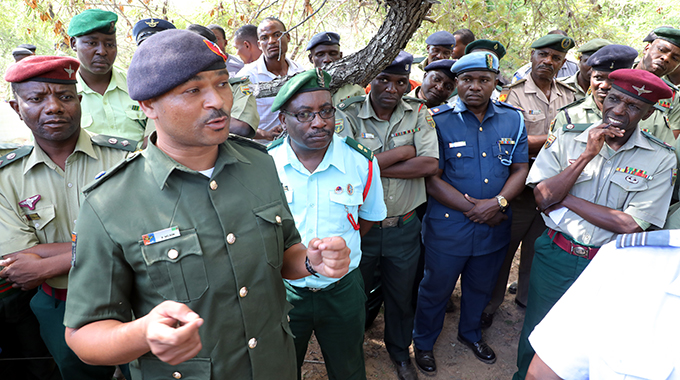
A keen student of Zimbabwean history of the armed liberation struggle watching the cavalcade of military vehicles both heavy and light from the Zimbabwe Defence Forces’ Zimbabwe Staff College on Friday 22 March 2019 on their way to Kezi for some lessons on Zimbabwe’s armed struggle could have been forgiven for thinking about the living and dead heroes.
The keen student could have been thinking about Joshua Nkomo, Jason Ziyaphapha Moyo, Albert Nxele (The Buffalo Mongol), the Camp commander of the 1960s of the Zipra Alma matter, Morogoro Training Camp, Joseph Zwangami Dube (Unzima lumthwalo) the pioneering Zipra ambassador to Cuba in 1966, Roger Mzila Ncube (Matshimini) the Zipra Deputy Chief of Operations, Zidube Farm of the Moffat Hadebe famed Zipra guerilla attack of September 1964.
He or she could have got it all wrong. Brigadier-General Josephat Kudumba and his massive entourage were on their way to Ratanyana (Ratabanyana) to the very point of the Zipra Regional Commander of S.F.3 Cde Mphini (Adam Dube) and his fellow comrades who provided his escort made their last but eternal stand for Zimbabwe on 11 February 1979, in a very dramatic way.
That is why Ratanyana (Ratabanyana) matters. The dramatic events of 11 February 1979 returned in an equally dramatic way on 22 March 2019, 40 years later. Brig-Gen Kudumba had come to conduct a hand over and take over ceremony of the Sword of the office of the leadership of the national heritage of the armed liberation struggle from Cde Mphini’s generation to the young military officers born and growing up in a free and independent Zimbabwe.
He was ably assisted in that awesome responsibility by those who worked with Cde Mphini in the Kezi part of the SF3 as well as by those who trained him at Morogoro and also gave him his operational orders. The people of Ratanyana as well as the larger community of Matobo also gave invaluable assistance for the inter-generational and historical baton exchange to take place flawlessly. The Zimbabwe Staff College in its presentation on the Zimbabwe’s political and military history was very outstanding. There is a need though to do more research on the early developments leading to a full-fledged armed struggle from the periods of 1959 to 1969. Participants of those formative but critical stages are still there although they are a fast disappearing group. The nation owes the future generation a priceless debt, of not burying that dwindling band, with the treasure of the priceless heritage of lessons of its bitter armed liberation struggle.
Retired Brigadier-General Abel Mazinyane spoke about a generation that built Zipra in the early 1970s from the ashes of its predecessor, the Special Affairs Department of the historic battles of Wankie and Sipolilo of the 1960s and their predecessors of General Chedu and General Hokoyo of Zhanda of 1959 to 1961, he spoke about a generation that believed in making the impossible, possible, a mustard seed generation.
Doko Stanley Nleya (Gagisa) spoke about training a disciplined freedom fighter, a people’s army that respected the people, the community, a freedom fighter with human values of ubuntu/botho, a quality freedom fighter. Both Mazinyane and Gagisa are products of Cde Mphini’s Alma matter, Morogoro Training Camp.
The fact that Cde Mphini and his escort of about 11 guerillas faced the might of the Rhodesian air and ground forces from about 9am to 4pm tells a story about the quality of soldiers that they were, let alone the fact that a Rhodesian Army helicopter was also brought down. Standing on the very ground where Cde Mphini and his fellow comrades took their last stand and became martyrs and the call from the residents and the military officers for a monument to be erected and the response from Brig-Gen Kudumba and Deputy Minister of Primary and Secondary Education, Cde Edgar Moyo, I wondered if Abraham Lincoln was overwhelmed with similar emotions at the field of the battle of Gettysburg Memorial back on 19 November 1863 when he said:
“We are met on a great battlefield of that war. We have come to dedicate a portion of that field as a final resting place for those who here gave their lives that that nation might live. It is altogether fitting and proper that we should do this. But in a larger sense we cannot dedicate — we cannot consecrate — we cannot hallow this ground. The brave men living and dead who struggled here have concecrated it far above our poor power to add or detract.”
Ratanyana matters in its own unique way, the SF3 way, the Zimbabwean Liberation Struggle way. It matters in a way different from the way Gettysburg matters to the American people although similarities of sacrifice, self sacrifice for a cause and a calling higher than one’s own do exist. The similarity also of a need to preserve the Ratanyana story for posterity does exist.
The respect for the 12 brave men also exists and so does the sense of tragedy and incalculable loss on the part of Gogo MaDube whose daughter and three grand children were killed by the Rhodesian forces in cold blood. That was evident through the gesture to Gogo MaDube by Brig-Gen Kudumba and the contribution from the Zimbabwe Staff College students and officers and the remarks by the General in his introduction to the public of Mphini’s daughter.
When I read Cde Mphini’s biography from his daughter who also had a picture of her father, I came across names like Magedleni (Mudubani Tlou), Brian Mahlangu (Calvin Mashila), Morogoro, Gwanda, Manama, Beitbridge, Kezi, Plumtree, Binga and many other names and places associated with our armed liberation struggle.
I had been able to get to Ratanyana through the invitation and effort of Mr Headman Mpofu, my supervisor in the Ministry of Primary and Secondary Education. Although we were gathered at Ratanyana Secondary School, Ratanyana Primary School had been my father, Solomon Hleza’s last school in the late 1950s.
The identities of the other ZPRA cadres who fell with their regional commander in the battle of Ratanyana have remained rather classified. There was talk soon after that incident though in hushed tones that Cde Nkomiyahlaba was one of them. He was a darkish and tuby faced young man who used to call himself “inkomiyagwaza”.
There was also mention of Cde Sguqa. Even to this day, 40 years after Zimbabwe’ armed liberation struggle ended, some matters of that period still remain classified in the minds and hearts of those who took an active part and witnessed them, let alone during its live motion.
The first time I met Cde Sguqa was in early or mid August in 1977, a day following the evening when sister Reginah was recruited to the struggle and left the country. I had retired to bed when I was woken up by some noise from the kitchen where Reginah, Judith Makhurane and Gogo Lomalanga Mlilo and little Ndabezinhle, Themba Honest and baby Winston were still enjoying the late hours of the evening. Great grandmother Matshakayile who was in her late 90s or early 100s was oblivious of what was happening in her own hut, alone. That something unusual was happening was clear from the male voices that were coming out of the kitchen.
Twin brother Clever (Khimbini) had already left for the struggle in early April 1977 while Uncle Miziyabo Mlilo after whom my mother Selinah comes and Kephas Mlilo and Moffat Mlilo, his younger brother had left for the struggle in May.
When I got to the kitchen the male voices had disappeared into the darkness. So too was Sister Reginah and the cattle tax that was supposed to be paid the following day. The day had been set aside by the District Commissioner in Gwanda as the day when stock tax would be paid and collected at Kafusi Rest Camp. Every homestead or person with a herd of cattle and a stock card was supposed to travel to Kafusi with the money commensurate with the herd on the stock card.
When the ZPRA guerillas got wind of those developments they visited every homestead and every village where there was a herd of cattle and collected every Rhodesian dollar that had been earmarked for the stock tax. At home they collected the Rhodesian dollars and sister Reginah. At the homestead of Mr Sibuko Dube, our neighbour, the story was the same, with Sibuko’s daughter, Musa, sharing sister Reginah’s fate. She was a year younger than Reginah. There were many in Madipuduhudu village and other villages who were similarly affected.
When the ZPRA guerillas had first arrived at our homestead in June 1976, numbering 10 they told both Uncle Moffat who had recently returned from Wenela in South Africa and grandmother Lomalanga Mlilo that there would come a time in not so distant a future when everyone would be given a gun to fight for freedom from the white settler oppressive rule and return the country to its rightful owners, the black majority.
That time had come much earlier than the not so distant a future that the guerillas had foretold.
The true picture of what had happened overnight came to light in the afternoon of the following day. A massive contingent of recruits briefly camped just close to our homestead. Among this mass of people was sister Reginah who came running to ask for a jersey from uncle’s wife, Judith Makhurane. It was a light cream jersey, she did not put it on but held it by the left hand and rushed back waving me a good bye with her right hand. Meanwhile, Cde Sguqa came and stood by the homestead’s wooden fence and asked for water to drink which aunt Judith gave him. I stood very close to him and studied him very closely from the cap that he had on, the gun that he carried whose barrel muzzle with a projecting lip was stuffed with a white woolen material.
– To be continued next week


 Online Reporter