admin
admin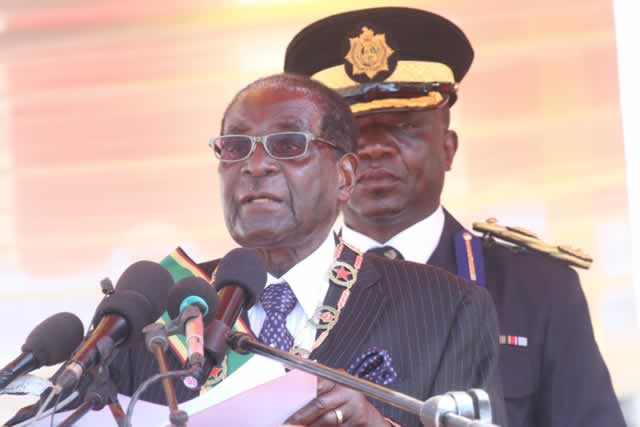
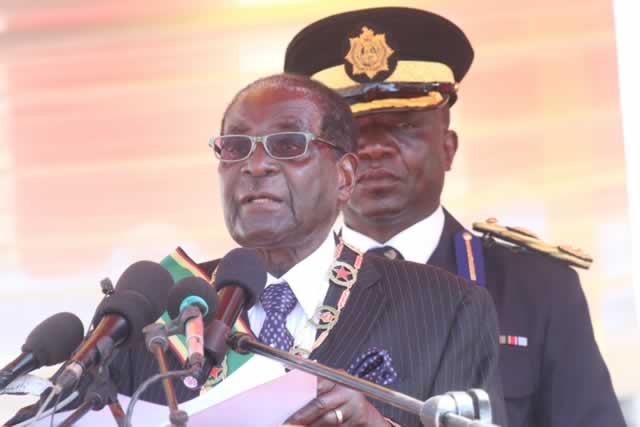
Address by His Excellency the President and Commander-in-Chief of the Zimbabwe Defence Forces, Comrade R.G. Mugabe, at the Zimbabwe Defence Forces 35th Anniversary Celebrations
at the National Sports Stadium yesterday.
Honourable Vice President, Comrade Emmerson Mnangagwa, Honourable Vice President, Comrade Phelekezela Mphoko, Honourable Minister of Defence, Dr Sydney Sekeramayi, Honourable Ministers here present, Secretary for Defence, Comrade Martin Rushwaya,
Commander Defence Forces, General Constantine Chiwenga, Commander of the Zimbabwe National Army, Lieutenant General Philip Sibanda, Commander of the Air Force of Zimbabwe, Air Marshal Perrance Shiri, Commissioner General of Police, Comrade Augustine Chihuri, Commissioner of Prisons, Retired Major General Paradzai Zimondi,
Members of the Diplomatic Corps, War Veterans, Invited Guests, Ladies and Gentlemen,
Pakistan Vice Chief of Air Staff, Air Marshal Saeed Muhammad Khan, Deputy Chief of General Staff of the Angolan Armed Forces, General Antonio Egidio de Sousa Santos “Disciplina”, comrades and friends.
I am delighted to join the Zimbabwe Defence Forces in commemorating the Defence Forces’ 35th anniversary. While the occasion allows us to trace the historic formation of the Zimbabwe Defence Forces, we, at the same time, take this opportunity to reflect and celebrate the essential role played by the armed forces since the attainment of our Independence.
The Zimbabwe Defence Forces were formed by the integration of former warring parties of Zipra and Zanla on one side, and Rhodesian Forces on the other. Overseeing the successful process of integrating the former adversaries into a unified and formidable force, was a difficult task that required tact, patience, and diligence.
Our transformation of the ZDF was strengthened and speeded up by the invaluable assistance we received from our all-weather friends. To bear testimony to this long found friendship amongst the dignitaries here present is the Vice Chief of the Pakistan Air Force, Air Marshal Saeed Muhammad Khan.
His visit is a testimony of the long history of strong bilateral cooperation between Zimbabwe and Pakistan in the area of defence and security that dates back to the integration period soon after independence.
Pakistan gave us much needed technical support. Upon request, during the period of 1983 to 1986, Pakistan seconded Air Chief Marshal Azim Daudpota to head the Air Force of Zimbabwe. Currently we have military officers from Pakistan at the National Defence College and Thornhill Airbase, assisting us with training expertise while a number of our personnel have benefited from training slots offered to us at military training institutions in Pakistan.
From difficult beginnings characterised by deep-seated suspicion, I am pleased that, since 1980, the Zimbabwe Defence Forces have grown into a reputable and reliable armed force, capable of successfully discharging its constitutional mandate of safeguarding the country’s independence, sovereignty and territorial integrity.
The Zimbabwe Defence Forces are instrumental in our country’s quest for socio-economic development, as they do so by guaranteeing us of peace and stability. It is therefore befitting that this year’s Zimbabwe Defence Forces Day commemorations are held under the theme: “ZDF: Consistent in Defence of National Sovereignty, Social and Economic Development”.
Apart from successfully fulfilling their primary mandate, the Defence Forces have a long history of assisting government ministries and departments, local authorities, and needy communities.
During the past rainy season, the Zimbabwe Defence Forces complemented efforts by the Civil Protection Unit by providing an assortment of equipment and specialised personnel to rescue marooned villagers and in monitoring the flooding situation in Mashonaland Central and other flood prone areas in the country.
The Defence Forces also have an equally viable community assistance programme that is aimed at assisting especially the most vulnerable members of society. Under this programme, several communities have benefited from ZDF’s construction and refurbishment of public facilities such as schools, clinics and roads.
Currently, the Defence Forces are constructing a clinic at Chingwizi, which is targeted at benefiting the communities affected by floods at the Tokwe-Mukosi Basin in Masvingo.
The Defence Forces are also constructing a secondary school and a clinic at Murongwe in Mashonaland Central, a project which is a follow-up to the completion of a primary school at the same place.
The Forces are also constructing an Early Childhood Development (ECD) complex at Nyadire Teachers College, and four classrooms at Mapani Primary School in Chakari, Mashonaland West.
On the international scene, the Zimbabwe Defence Forces continue to do the nation proud by contributing to international peace and stability.
They have successfully executed numerous external missions that include the Mozambique Campaign in the 80s, whose objective was to safeguard our economic lifeline in the Beira Corridor; the Operation Sovereign Legitimacy in Democratic Republic of the Congo in the late 90s to early 2000, and the United Nations missions in Angola, Somalia and Rwanda in the ’90s. Recently, the Zimbabwe Defence Forces were successful when deployed in the Kingdom of Lesotho, as an observer mission, following internal disturbances in that country.
Regionally, the Zimbabwe Defence Forces are enjoying excellent relations with their counterparts. This is strongly evidenced by their participation in joint training exercises and student exchange programmes.
While Zimbabwe Defence Forces are part of the SADC Standby Force, they have participated in peace support operations exercises, which include Exercise Golfinho in South Africa (2009), Exercise Highlander in Lesotho and Exercise Ningosile in 2012, Exercise Vale De Keve in Angola in 2013, and most recently, Exercise Nyaminyami that was hosted by Zimbabwe in 2014.
Plans are also at an advanced stage to host a joint SADC Special Forces in Kariba, code- named “Exercise Mahombekombe”, from August to September 2015. The Zimbabwe Defence Forces, together with other armed forces in the region, will participate in Exercise Amani Africa, in South Africa, before the end of 2015.
To enhance mutual cooperation, interaction, and exchange of military expertise, the Zimbabwe Defence Forces are engaged in military student exchange programmes with other defence forces in the region and beyond.
Currently, the Defence Forces have students at training institutions from Botswana, Lesotho, Malawi, Mozambique, Namibia, South Africa, Tanzania and Zambia, while they also have a 14-member training team in Namibia, assisting the sister-country with military training.
Similarly, the Zimbabwe Defence Forces personnel are participating in external courses in China, Pakistan, Malaysia, Greece, Tanzania, South Africa, Egypt, Kenya, Botswana, Mozambique and Zambia. The Defence Forces also have members enrolled at various civilian institutions in Zimbabwe.
Meanwhile, the National Defence College held its third graduation ceremony last week, on 6 August, 2015. Since the initial establishment of the National Defence College was aimed at having an institution of higher learning that specialises on defence and security studies, the college, which has been operating as an associate of the University of Zimbabwe, there are plans, now at advanced stage, to transform it into a fully-fledged independent university before the end of 2015.
As we celebrate the Zimbabwe Defence Forces, I would like to take this opportunity to commend our Defence Forces for remaining resolute in discharging their constitutional mandate, and also for ensuring that the country enjoys peace and stability.
Recently, this has not been an easy task, given that the Forces have become a target of the proponents of the regime change agenda. Many attempts have been made to frustrate and weaken the Zimbabwe Defence Forces, mainly by the imposition of the illegal sanctions and scuttling of military hardware procurement deals.
Add to this, calls for, by misguided elements, the so-called security sector reforms.
It is pleasing though that in spite of these challenges, our defence forces have continued to be loyal, disciplined and resilient. I want to thank you all, whether you are with us in the stadium here, or at any of the various celebration venues in Zimbabwe, for commemorating the Defence Forces Day, an important day on our national calendar.
The Zimbabwe Defence Forces cherish the support they receive from communities, organisations, and individuals across the country.
It is my wish, as the Commander- in-Chief of the Defence Forces, to see the people of Zimbabwe and the Zimbabwe Defence Forces continue working together, peacefully, and amicably, in a peaceful and stable Zimbabwe, that is focused on socio-economic development.
I thank you.



 Online Reporter