Sundaymail Editor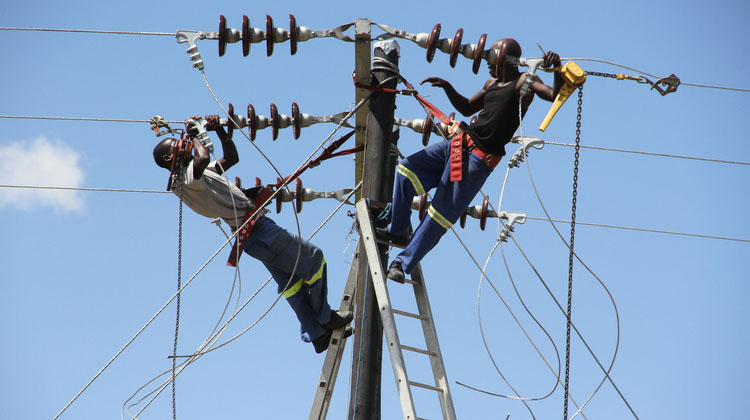
Prince Mushawevato
Features and Arts Editor
Several suburbs in the country have had their electricity switched off by marauding criminals — suspected to be Zesa employees or former workers — preying on power cables.
The disturbing trend, which has recently increased in regularity, betrays renewed interest in electric cables, particularly armoured cables made of copper, as global prices of the metal shoot through the roof.
Zimbabwe last produced copper at Mhangura around 2000 before the mine was closed.
Thus, with a supply side that is completely under-prepared as most copper mine projects are shut, criminals have identified a loophole to make a killing.
Zesa is estimated to be currently losing at least US$100 million per year to theft and vandalism.
Areas that have been affected of late include some sections of Highfield, Glen Lorne, Chisipite, Glen Norah and Glen View in Harare.
Nyameni in Marondera, some parts of Gweru, Macheke, to mention but a few, have been hit hard by thieves, as cables are being stolen and exported to neighbouring countries like South Africa, Mozambique and Zambia.
The syndicates are largely believed to be professionals, as ordinary people would not normally know how to tamper with live cables.
The copper market, local and foreign, is sophisticated and requires well-versed dealers.
Residents suspect zesa officials because of the similar pattern used by the criminals.
The modus operandi is said to involve a reconnaissance visit during the day.
According to reports, this is done by alleged zesa officials in uniforms and/or vehicles that ostensibly come for routine maintenance work.
“Our power cable was stolen some three weeks back. Initially, a team of zesa officials visited our area around mid-morning. That very same day, around midnight, we lost power. I thought it was an ordinary fault or load-shedding only to find out in the morning that our main cable (armoured cable) had been stolen,” revealed Glen Norah-based Tinashe Mukaira.
In Macheke, Marjory Mukwananzi said they experienced a similar ordeal last month.
“We lost power around 2am. No one suspected anything unusual as this normally happens in the area. However, we got worried after we went for two days without electricity. This prompted us to contact our local zesa office, who, in turn, informed us that some cables from the main power source had been stolen,” she said.
Citizens are bearing the brunt of these criminal activities as Zesa officials are taking long to attend to faults.
In worst cases, they are forced to make contributions to meet the replacement costs of the stolen property.
An affected area in Glen Norah, which had gone for two weeks without power, was only reconnected after residents paid US$6 per household to purchase a new cable.
But, should residents be meeting the costs and what are authorities doing to address the predicament?
Efforts to get a comment from Energy and Power Development Minister Soda Zhemu were futile.
“I am busy at the moment. Call zesa for your enquiries. I am sure they should be able to assist you . . . Zesa can dispose of all (questions),” said Minister Zhemu.
However, repeated efforts to get information from Zesa Holdings in the past two weeks hit a brick wall as they failed to respond to our questions by the time of going to print.
At a ceremony to commission 200 transformers and 117 distribution vehicles procured by zesa Holdings in Harare on July 1, President Mnangagwa urged zesa Holdings to adopt modern technology to deal with vandalism of transformers and theft of other energy-related equipment, which he said he suspected was being done by serving and former zesa employees.
“It is disheartening to note the increased vandalism of electricity distribution and supply infrastructure across the country. The loss and cost of transformers, as well as other related infrastructure is counter-productive and retards economic production and productivity.
“To this end, the risk and loss control unit of Zesa Holdings is directed to work closely and honestly with the police and other arms of the State to eliminate the scourge of vandalism.
“The adoption, use and deployment of modern technology to curb this menace must be pursued with urgency,” said President Mnangagwa.
Crime and security expert Brian Kashangura said demand for foreign currency on the market might be one of the reasons for the new spate of criminal activities.
“There are several challenges causing an upsurge in the theft of copper cables; the main being the economic environment where everyone, including criminals, are looking for the United States dollar. Also, copper is a mineral that attracts criminals because it has a ready market. It is being exported through Botswana and South Africa, but it also has overseas markets,” he said.
“To address these challenges, we can ban exports of copper via Botswana and South Africa. Also, Zesa should harvest the copper and replace it with a less attractive aluminium conductor. Dealers should be meticulously licensed.”
The rampant theft of copper cables has seen Zesa replacing copper cables with aluminium.
Stiff penalties
Cabinet has since approved a 30-year mandatory jail sentence for those who steal or vandalise power infrastructure.
Zesa Holdings and law enforcement agents have been lobbying the Government to review upwards the 10-year mandatory sentence that was not deterrent enough.
“Cabinet considered and approved the Copper Control Amendment Bill, which was presented by the Minister of Justice, Legal and Parliamentary Affairs, as chairman of Cabinet Committee on Legislation . . . Convicted copper thieves will now be liable to imprisonment for a period of not less than 30 years without the option of a fine,” said Information, Publicity and Broadcasting Minister Monica Mutsvangwa in a post-Cabinet briefing in March.
Transformer oils have until recently been the major target for criminals.
But, copper is now in demand buoyed by firming global prices and rising demand.
International prices of the commodity were pegged at an average of US$5 000 per tonne on the London Metal Exchange (LME) in the past five years.
However, renewed demand for copper has seen the mineral trading at US$10 000 per tonne — the highest on the LME thus far.
The price is projected to further swell by about 50 percent in the next two years.
Leading global investment companies such as Goldman Sachs Research suggest copper is now strategically the most important resource in the commodities mix.
They opine the mineral will play a critical role in replacing internal combustion engine vehicles with electric cars.
Already, the European Union has proposed phasing out new petrol and diesel cars from 2035 as it looks to switch to zero-emission electric vehicles as part of its commitment to combat global warming.
In the key areas of the green economy, it is argued, the use of copper will be much higher than in the current economies.
Vandalism and theft of public infrastructure has resulted in the Government losing potential revenue as this leads to the interruption of essential services and increased labour costs to repair affected networks.
The public incurs unforeseen expenses by resorting to alternative energy like firewood and gas, which is beyond the reach of many. Refrigerated perishable groceries are also lost in the process.
Pundits opine Zesa should reconsider reactivating its internal security that was effective in safeguarding the properties in the past.
They feel the bane requires all stakeholders to co-operate in safeguarding the property through community groups.


 Online Reporter