Vusumuzi Dube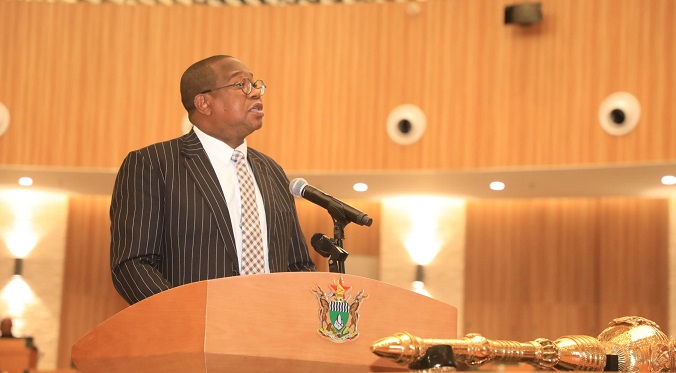
Judith Phiri, Business Reporter
FINANCE, Economic Development and Invest Promotion Minister, Professor Mthuli Ncube has said the Zimbabwe Gold (ZiG) as legal tender will continue to provide impetus to the transformation of the economy and make it more resilient to global and domestic shocks.
Introduced in April this year, ZiG is a structured currency backed by a reserve of foreign currency and precious metals, primarily gold, held by the Reserve Bank of Zimbabwe (RBZ).
Since its introduction in early April, the ZiG has shown incremental growth against the US dollar.
Presenting the Mid-Term Budget review in Parliament on Thursday, the Minister said: “Honourable Members would be aware that Government, on 5 April, 2024, introduced the Zimbabwe Gold as legal tender through the Presidential Powers (Temporary Powers) Regulations. I, therefore, propose to amend legislation to provide for the Zimbabwe Gold as legal tender.”
He said the economy was showing signs of economic transformation, as evidenced by the resilience to the drought reflected by several sectoral robust growth nodes.
Prof Ncube said the stability brought by the new currency (ZiG), provides further impetus to the transformation process which seeks to broaden the range of locally produced goods and facilitate production of high value and complex products which will make the economy more resilient to global and domestic shocks.
He added: “The thrust and theme of the 2024 National Budget remains of “Consolidating Economic Transformation”. With determination and cooperation of all stakeholders, the country can withstand any challenge and progress is inevitable.”
The Minister said the he ZiG month-on-month inflation remained stable at 0 percent in June from -2.4 percent in May 2024, while the US$ month-on-month inflation stood at -0.3 percent, from 0.1 percent in May 2024.
He said inflationary pressures are expected to remain subdued due to the tight monetary and fiscal policies being pursued by the authorities aided by the dissipating negative inflation expectations as the local currency unit remains stable against major currencies.
Prof Ncube said: “Total foreign currency receipts increased by 9.5 percent to US$6.2 billion during the period from January to June 2024, from US$5.6 billion received during the same period in 2023, largely driven by the growth in export receipts, mainly from gold, agriculture commodities and manufactured products, as well as diaspora remittances.”
He said in line with this improvement in foreign currency receipts, preliminary estimates indicate that the current account recorded a surplus of US$19.2 million in the first half of 2024, a turnaround from the deficit of US$13.8 million recorded in the same period last year.
The Minister, however, said to year end, the current account surplus is projected to narrow to US$44.5 million in 2024, relative to a surplus of US$133.9 million recorded in 2023.
He added: “Remittances grew significantly by 16.5 percent, from US$1 billion in the first half of 2023 to US$1.2 billion in 2024, reflecting higher inward remittances from the diaspora, resulting in a favourable impact on the current account balance.”
Prof Ncube said the 2024 National Budget was formulated using the Zimbabwe dollar as the functional currency and a projected economic growth of 3.5 percent.
He said resultantly, total revenue collections were estimated at Z$53.9 trillion, (18.3 percent of GDP) and expenditures of Z$58.2 trillion with a financing gap of Z$4.3 trillion (1.5 percent of GDP).
“In this regard, the approved expenditure for the 2024 Budget of Z$58.2 trillion, converted to ZiG results in a budget envelope of ZiG87.9 billion. In terms of performance during the first six months of the year, revenue collections amounted to ZiG36.5 billion, against expenditures of ZiG38.9 billion. Expenditures are therefore, approximately 44.2 percent of the total approved Budget.”
The Minister said the country’s stock of debt as at end of June 2024 amounted to ZiG287.2 billion, comprising of external debt of ZiG168.5 billion and domestic debt of ZiG118.7 billion, while the debt stock is broken down as 58.7 percent external debt and the remainder being domestic debt 41.3 percent.



 derick.khumalo