Chronicle Editor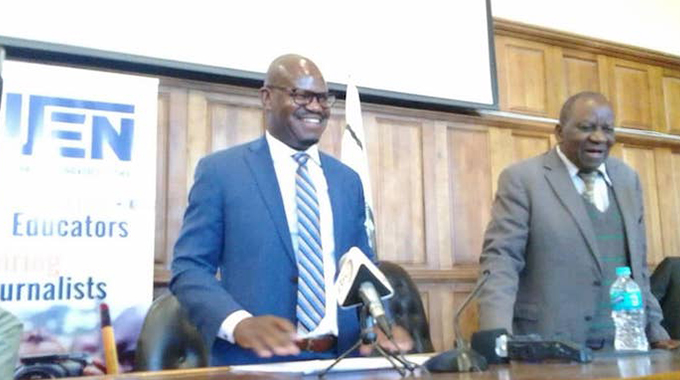
Lingani Nyika in Masvingo
AS the media landscape in Zimbabwe navigates a crucial period of reassessment and transformation, the Zimbabwe Journalism Educators Network (ZIJEN) emerges as a beacon of change, and through collaborative efforts with the Government and media sector, the network strives to restore Zimbabwe’s journalism standards, promoting a transparent and accountable environment for both professionals and the public.
ZIJEN is an organization that seeks to bring together educators and media stakeholders to contribute towards shaping the journalism landscape in the country.
It aims to provide a platform for educators to have a voice in policy-making and decision-making processes, ensuring that the journalism ecosystem remains competitive.
The organization was formed by three prominent institutions, Great Zimbabwe University, National University of Science and Technology, and Harare Polytechnic, who recognized the need for collaboration and a united front in addressing the complex issues facing the journalism industry.
Speaking at the launch, ZIJEN president, Mr Golden Maunganidze said the organisation was a unifying force for journalism educators as they take up a proactive role in shaping the industry’s future.
“For a long time, we were guilt of allowing ourselves to take a backbench when our voices were critically needed in shaping policies, frameworks and laws for our journalism fraternity,” he said.
“This is, therefore, a statement of intend towards an all-rounder educator who discharges his duties in the classroom and remains engaged in the broader environment through engagement with other stakeholders with the aim of ensuring that the journalism ecosystem remains competitive,” said Mr Maunganidze.
“Our organisation will become very critical in the areas such as research, standardized curriculum, policy formulations, community services, innovation and industrialization.”
In a renewed focus on fostering a robust journalism education ecosystem, ZIJEN has reaffirmed its commitment to supporting quality journalism education, serving as a valuable resource for all those striving for an industry’s growth and thriving.
Speaking at the same event, Permanent Secretary in the Ministry of Information, Publicity and Broadcasting Services, Mr Nick Mangwana, emphasized the need for professionals to lead by example and maintain the highest levels of journalistic integrity.
“We believe that when you interact as professionals you benchmark and raise standards and the core of the objective is the standard of journalism, which right now we do not believe that the standard of journalism is where it should be,” said Mr Mangwana.
He highlighted several concerning trends in the industry, including one-sided reporting and the lack of opportunity for subjects to respond or clarify their positions. Additionally, he commented on the prevalence of “desktop journalism,” where outlets pull information from social media without seeking direct input from the original source.
“We have seen a lot of news, which is published without giving the other person the right to reply and a lot of desktop journalism where people just go on X (Twitter) or Facebook and extract a post there and write a story without asking the author of that post to expand on what they were trying to say,” he said.
“That speaks of the standards of journalism going down, not citizen journalism but professional journalists – a person earning a living out of journalism.”
To address these challenges, the Ministry of Information is calling upon professionals within the journalism industry to collaborate with educators and stakeholders to drive innovation and propose policy changes that will elevate the media sector’s standards.
“We will support lecturers when they come together with different innovative ideas to uplift the industry, policy-wise, and take the policy suggestions from them on board and incorporate them in our policy trust,” said Mr Mangwana.
“There is no contradiction between what you want to achieve and where the Government wants to take the media sector.”
He said the Government supports initiatives that empower young journalists and growth for the industry.
“We heard about the need for monetisation of the media products and we support that. We want all these graduates to be absorbed able to be absorbed by industry or they become their own content creators where they make money out of their skills. This is where the Education 5.0 comes in,” said Mr Mangwana.
The organisation is led by Mr Maunganidze as the ZIJEN president, Ms Linda Mujuru, the vice president and other professors and lecturers from the various local tertiary institutions.
Vice Chancellor of Great Zimbabwe University, Professor Rungano Zvobgo, hosted the event at Great Zimbabwe Law School where various media institutes, stakeholders and journalism scholars converged.
Educators and professionals can make significant contributions as consultants and stakeholders in improving the media sector in Zimbabwe.
-@NyikaLingani



 Online Reporter