Online Reporter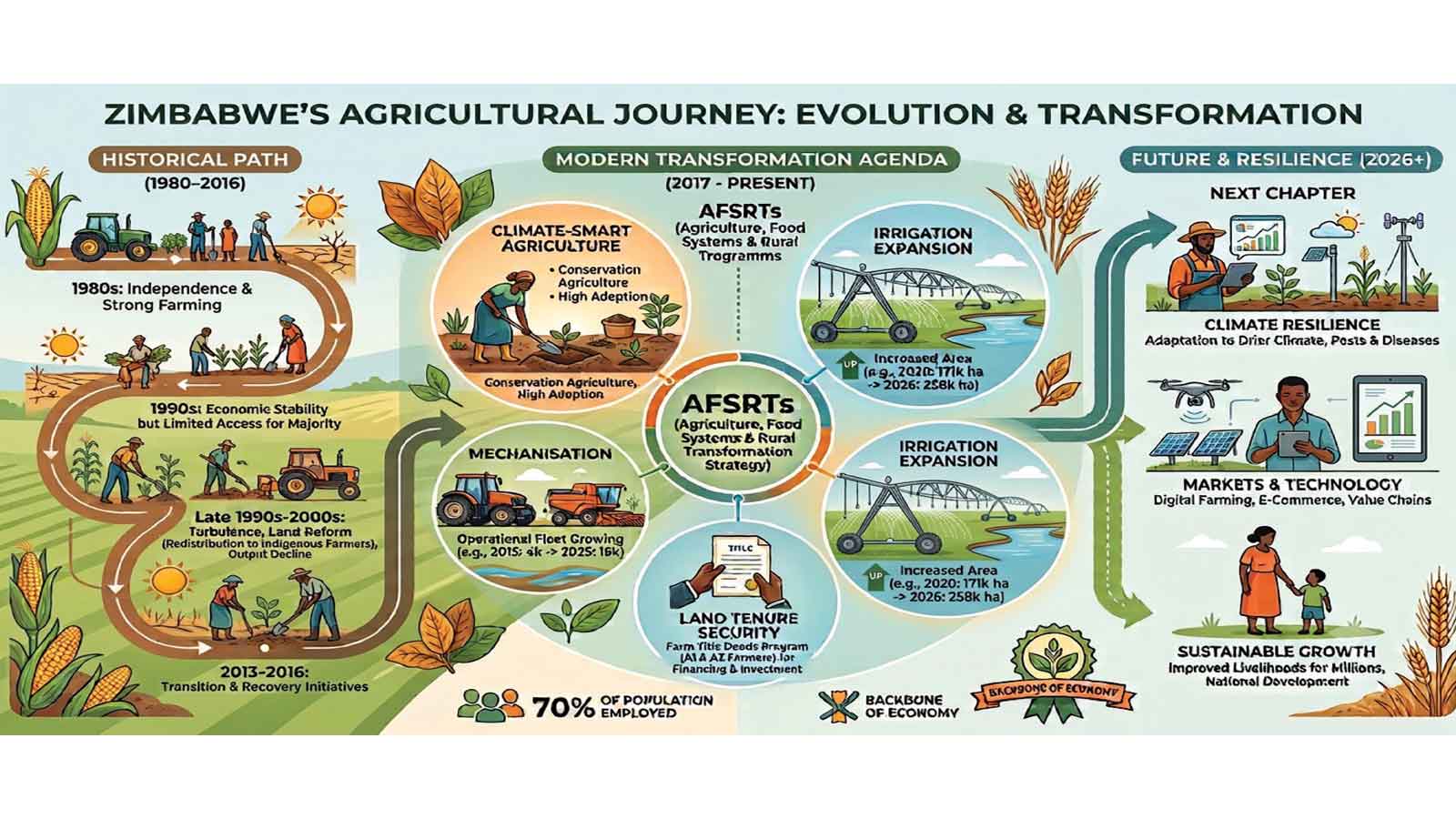
Marilyn Mutize
For a nation, there are few sectors as important as agriculture. It feeds the people, employs millions, sustains industries and determines whether an economy stands firm in times of crisis.
In Zimbabwe, agriculture has always been more than just another economic sector it has been the backbone upon which livelihoods are built and national development is anchored.
Forty-six years after Independence, Zimbabwe’s agricultural story is not one of a straight line from success to prosperity. It is instead a story of remarkable highs, painful setbacks, adaptation and reinvention.
From the commercial farming powerhouse of the 1980s to the turbulence of the late 1990s and early 2000s, and from recovery efforts to the agricultural transformation agenda being pursued today, Zimbabwe’s agricultural sector has demonstrated an extraordinary ability to evolve.
At Independence in 1980, agriculture was already one of Zimbabwe’s strongest economic pillars. The country inherited sophisticated commercial farming systems that produced substantial volumes of maize, tobacco, wheat and livestock products.
However, agricultural participation was highly unequal, with the majority of indigenous Zimbabweans confined to communal lands with limited access to productive resources. The challenge after Independence was therefore two-fold to preserve productivity while broadening participation.
For nearly two decades, agriculture remained one of the country’s strongest economic sectors. It contributed significantly to export earnings and food security while supporting industries such as manufacturing, transport and financial services. Yet, like every economic sector, agriculture would eventually face both domestic and external challenges that would fundamentally alter its trajectory.
The period between 1995 and 2013 was arguably the most difficult chapter in Zimbabwe’s agricultural history. Economic instability, recurring droughts, sanctions, limited access to international finance and the disruptions associated with the Fast-Track Land Reform Programme significantly affected productivity across several sub-sectors. Agricultural output declined, food imports increased and financing mechanisms that had traditionally supported commercial farming became increasingly constrained.
However, history has shown that agricultural sectors are rarely static. Zimbabwe’s agricultural landscape was changing. While large-scale commercial agriculture declined, millions of hectares of land were redistributed to indigenous Zimbabweans, laying the foundation for the emergence of a new generation of farmers. The challenge became one of capacitating these farmers to become productive and commercially viable.
The years between 2013 and 2016 represented an important transition period characterised by recovery and resilience-building initiatives. Government interventions increasingly focused on improving productivity, strengthening value chains and addressing financing constraints facing farmers.
The most significant transformation has arguably occurred from 2017 to date under the Second Republic’s agricultural modernisation agenda. Rather than pursuing isolated interventions, Government has adopted a comprehensive approach under the Agriculture, Food Systems and Rural Transformation Strategy (AFSRTS 1: 2020-2025), which recognises agriculture as an integrated system encompassing production, financing, mechanisation, irrigation, markets and climate resilience.
Perhaps no programme better symbolises this transformation than Pfumvudza/Intwasa. What began as a conservation agriculture initiative has evolved into one of Zimbabwe’s most ambitious climate-smart agricultural programmes.
Its emphasis on minimum soil disturbance, moisture conservation and efficient land utilisation has demonstrated that productivity is not necessarily determined by the size of one’s land but rather by farming practices employed. Government’s target of achieving 100 percent adoption by 2026 speaks to its confidence in the model’s effectiveness.
Equally important has been the expansion of irrigation infrastructure. Agriculture can no longer afford to rely exclusively on rainfall patterns that are becoming increasingly unpredictable due to climate change.
Irrigation area has grown from 171 000 ha in 2020 to an anticipated 258 773 ha by 2026 a remarkable achievement considering that irrigation only increased from 150 000 ha to 171 000 ha between 1980 and 2020. The figures illustrate how climate adaptation is increasingly shaping agricultural policy.
Mechanisation has also recorded notable progress. The country’s operational tractor fleet has increased from 4 466 in 2015 to 16 350 in 2025. While mechanisation alone does not guarantee productivity, it significantly improves efficiency, reduces labour constraints and enables timely agricultural operations.
Perhaps one of the most significant policy developments has been the introduction of the Farm Title Deeds Programme in 2024. For decades, questions surrounding land tenure security have dominated conversations about agricultural financing and investment. Bankable title deeds for A1 and A2 farmers represent an important step towards unlocking agricultural financing and encouraging long-term investments in farming infrastructure.
The story of the tobacco sector demonstrates what can happen when policy, financing and farmer participation align. Tobacco production has increased dramatically from 48,8 million kg in 2008 to 354,9 million kg in 2025.
Significantly, much of this growth has been driven by smallholder farmers and contract farming arrangements, challenging long-held assumptions that large-scale commercial farmers alone could sustain export-oriented agriculture.
Livestock production tells a similarly encouraging story. Following substantial declines during previous decades, the national cattle herd has recovered to 5,7 million animals in 2025.
Government interventions prevented potentially devastating livestock losses during recurring drought periods. Milk production has more than doubled to 152 million litres annually, while poultry production continues to expand rapidly, reflecting increasing investments across livestock value chains.
Agricultural transformation has equally required difficult policy choices. The deliberate repositioning of soyabean primarily as a feed crop while promoting sunflower and cotton as alternative oil seed crops reflects Government’s broader food security strategy. By releasing more land for maize production, policymakers are attempting to balance nutritional requirements, livestock feed demands and national food security objectives.
The wheat sector deserves particular mention. Zimbabwe’s 2025 wheat season has produced the highest wheat output and Grain Marketing Board procurement volumes in the country’s history. For a country that once relied heavily on wheat imports, this achievement represents significant progress towards import substitution and food sovereignty.
Yet significant challenges remain. Climate change presents perhaps the greatest threat to future agricultural productivity. Zimbabwe is projected to become increasingly drier in coming decades, characterised by shortened rainfall seasons, uneven rainfall distribution, rising temperatures and increased pest and disease pressures.
These realities mean that agricultural transformation cannot simply focus on increasing production it must equally prioritise sustainability and resilience.
Agriculture today employs approximately 70 percent of Zimbabwe’s population, making its success inseparable from broader national development. The sector’s performance determines household incomes, industrial productivity, export earnings and ultimately national food security.
Zimbabwe’s agricultural journey since 1980 has been neither perfect nor without setbacks. It has been a story of adaptation in the face of profound political, economic and climatic changes.