admin
admin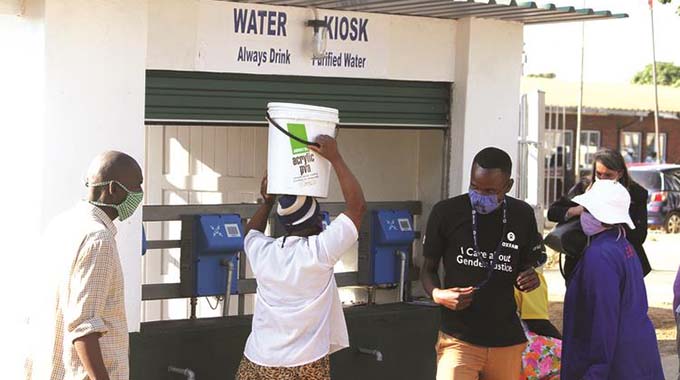
Blessings Chidakwa Municipal Correspondent
Zimbabwe yesterday unveiled a first of its kind water kiosk that uses a tap card system to draw water from an automatic dispenser.
The kiosk, comprising a solar-powered borehole, is a pilot project in Budiriro suburb, Harare and it will be managed by the local community.
It has a borehole that has a filtration, chlorine system and the water is tested for microbial and biological composition.
Use of traditional water taps was also excluded and users will only be required to tap a sensor so that water automatically comes out.
It was constructed by UNICEF, Oxfam and UNDP and handed over to council on behalf of the user community.
Water users will have to fork out $4 for a 20 litre dispenser of purified water.
The funds generated are earmarked for the maintenance of the borehole at the kiosk, buy chlorine, pay allowances for those manning the kiosk and also help maintaining other boreholes in the area.
Speaking during the unveiling of the kiosk yesterday, Oxfam country director Miriam Van Dorssen expressed commitment to set up other kiosks across the country.
“We have helped building this kiosk in partnership with UNDP and UNICEF so it’s a pioneering project here in Zimbabwe. Oxfam has worked with this concept in other countries, but it is the first time that we have it in Zimbabwe.
“We are looking forward to be able to evaluate it and be able to learn how things are going on here so that we can take the concept to other communities,” she said.
Harare City Council director of water, Engineer Mabhena Moyo said there is a water committee comprising of local residents that will manage operations at the kiosk.
“The kiosk has an automatic dispenser, a borehole with submissive pumps which pumps into 20 000 litre tanks. Within the borehole there are inline chlorination for purifying water.
“Inside the kiosk there are also filters and UV disinfection. People will buy electronic tokens using the concept more like that of tap cards and one can buy the amount of water he or she requires.
“A 20 litre dispenser is being sold for $4, but this is very pure water and I think mostly people are using it for drinking. There was a lot of disinfection because the area once experienced diarrhoea diseases so our partners were very cautious,” he said.



 Online Reporter