

 admin
admin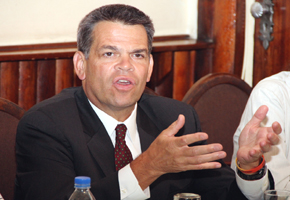
“Zimbabwe’s elections have been run in a professional manner. I for instance had a personal experience with the 2002 elections which were well run. This country is able to run a credible election,” said Ambassador Wharton.
“It is not the US business to become involved in the domestic political processes of the country. That is not my business but the business of Zimbabweans.”
He said Zimbabwe has recorded a lot of successes adding that his government was prepared to accept the outcome of the poll even when President Mugabe wins.
“The important principle is for leaders to accept the will of the people. Leaders should have a common goal just as Zipra and Zanla did when they fought to bring majority rule to the country.
“If the elections are run fairly my government will support anyone who is chosen by the people, including President Mugabe,” he said.
Commenting on the constitution-making process and the debate on the governance system Mr Wharton said Zimbabweans have the sovereign right to determine their destiny and to choose the governance style they wanted.
He was, however, defensive on the issue of sanctions, saying the embargo imposed on the country was targeted on a few individuals.
This is despite the fact that Zimbabwe was failing to access lines of credit from international financiers due to sanctions.
On Monday Bulawayo Governor Cain Mathema attacked Ambassador Wharton over sanctions, saying the US was pretending to be nice when it was responsible for the economic challenges facing the country.
The Governor took a swipe at the ambassador accusing envoys from the US of sowing divisions among Zimbabweans and seeking to manipulate the people of Matabeleland in order to deliberately incite conflict.
In his response, the US diplomat said he was willing to meet Governor Mathema but regretted his stance against him.
“I regret that the Governor did not want to meet me. If we had met we could have found common ground and I could have understood more issues,” said Ambassador Wharton.
He also said he does not foresee the quick repeal of the Zimbabwe Democracy and Economic Recovery Act, a US Act of Parliament, that has been blamed for weighing down the country’s economic recovery.
The envoy said he was committed to improve relations between US and Zimbabwe.
He commended the warm welcome that he said he received at the just ended Zanu-PF conference in Gweru where he said he had fruitful discussions with the party’s senior leadership.
“Our relationship with Zimbabwe is good. I even attended the Zanu-PF conference and it was good. My ambition is to build bridges and strengthen our relations.
“I have met different political leaders and I am willing to meet more people and learn more about this country,” he said.
“We do not want to appear to be aligned to a certain political party.”
Ambassador Wharton admitted that the Wikileaks revelations, which caused a lot of confusion in the country’s politics were genuine.
He said the issue came out during his interactions with political leaders, who viewed him with mistrust.
Zimbabwe and US relations turned sour a decade ago after the country embarked on the successful land reform programme, which angered Britain, the US main ally.
Under the instigation of Britain, the whole European block and the US responded by slapping Zimbabwe with sanctions.



 derick.khumalo
 Online Reporter