Online Reporter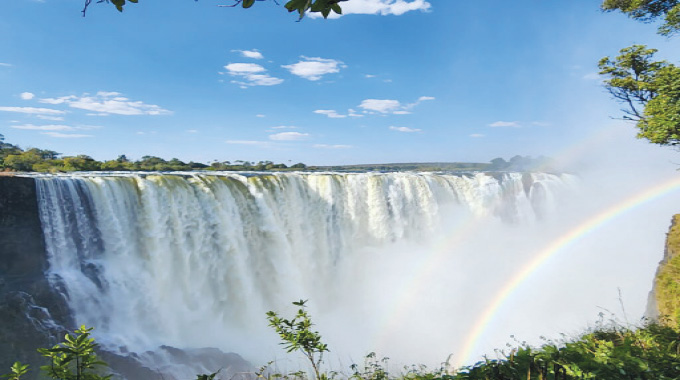
Zimpapers Writers
VICTORIA Falls and Matopos National Park, two of some of Zimbabwe’s most iconic tourist destinations, shed their usual rhythms on Christmas Day, transforming into vibrant festive playgrounds as thousands of local and international holidaymakers gathered to celebrate the season amid nature’s splendour.
At Victoria Falls, one of the Seven Natural Wonders of the World, the festive mood was evident by mid-morning as the parking bays near the rainforest were completely overwhelmed.
Vehicles spilled onto roads leading towards the Central Business District (CBD), a clear sign of the surge in visitors eager to witness the mighty cascade on Christmas Day.
Families formed the heart of the celebrations, with domestic, regional and overseas tourists converging beneath the spray of the Falls, cameras flashing as the thunderous water plunged into the gorge under a bright holiday sun.
Laughter, excited chatter and the hum of different accents filled the air, blending seamlessly with the roar of the Falls.
Beyond the rainforest walk, many visitors extended their celebrations with afternoon game drives and popular sunset cruises along the Zambezi River, taking full advantage of the pleasant weather.
UK-based Zimbabwean Grace Asare, who travelled with her family for the festive season, said Victoria Falls was the perfect setting for a family reunion.
“I decided to bring my family here, and what better way to celebrate Christmas Day than at one of the wonders of the world,” she said.
For first-time international visitor Cathrine Narendra, spending Christmas in Victoria Falls was unforgettable.
“There’s no place better than Victoria Falls. This is pure magic,” she said, gazing towards the spray rising above the gorge.
About 40 kilometres south of Bulawayo, Matopos National Park — part of the Unesco-listed Matobo Hills — offered a very different but equally enchanting festive experience. Light drizzles fell intermittently throughout Christmas Day, cloaking the iconic granite kopjes in a soft veil of cloud and mist
Instead of dampening spirits, the cool weather enhanced the day’s charm, offering visitors a rare December escape from the city’s bustle.
When a Zimpapers news crew arrived at the park, a winding queue of vehicles packed with families snaked patiently towards the entrance gates. Picnic baskets, cooler boxes, camping chairs and excited children filled cars inching forward under overcast skies.
Gone was the familiar blazing December sun. In its place, a refreshing breeze swept through the park as fine rain speckled picnic blankets and clung to leaves made lush by the season. Families huddled closer beneath trees and makeshift shelters, sharing meals, laughter and song as the mist drifted gently across the landscape.
Along the park’s narrow roads, a stream of vehicles ferried picnickers to favourite spots, while others made their way to World’s View — the famed lookout that is home to the grave of Cecil John Rhodes. Access to the monument costs US$4 per adult and US$2 for children, and despite the drizzle, visitors continued to trickle in, cameras in hand.
Matopos National Park sits within the granite-decorated terrain of the Matobo Hills, a place of immense natural and historical significance. When Rhodes, then chairman of the British South Africa Company (BSAC), first laid eyes on the dramatic landscape, he famously dubbed it “The View of the World.”
Beyond its colonial history, the Matobo Hills boast exceptional biodiversity. More than 200 species of trees have been recorded in the park, including mountain acacia, wild pear and paperbark acacia.
The area is also home to numerous aloes, wild herbs and over 100 grass species, with several rare endemic plants.
Wildlife thrives among the rocks and valleys. The park is home to white rhinos, sable antelope, impala, bushbuck and leopards. In fact, Matopos contains the world’s densest leopard population, sustained largely by hyrax, which make up about half of the predator’s diet.
It also holds the highest concentration of black eagles and breeding pairs anywhere in the world. For many visitors, the scenery alone was worth the journey.
“I was taken away by the beauty of the water bodies and the mountains. This is a very beautiful area that I would recommend to anyone who wants to visit Zimbabwe,” said Botswana-based economist Dr Oscar Chiwira.
“People often rush to travel outside the country, yet there is so much beauty here at home. We should support domestic tourism and get to know our environment.”
Dr Chiwira, however, urged tourism authorities to review pricing structures to encourage greater local participation in domestic tourism.
“I came all the way from Botswana to enjoy Matopos with my family, but I paid US$10 as an entrance fee for my foreign-registered vehicle even though I am a Zimbabwean. I feel that is not fair,” he said.
Bulawayo-based tour guide Engelbert Karombo echoed similar sentiments.
“Prices are becoming ridiculous and my clients are complaining. There is a need to review these fees to promote both domestic and international tourism, especially considering Zimbabwe was named the best country to visit in 2025 by Forbes Magazine,” he said.
Under a cluster of trees near Maleme Dam, Nokuthula Dube and her family spread blankets and shared a Christmas meal as light rain fell around them.
“The drizzle actually made the day perfect. It’s cool, it’s peaceful and the children are comfortable. You can sit and talk without rushing to escape the heat,” she said with a smile.
Nearby, the scent of wet earth mixed with that of sizzling meat as braais were carefully tended beneath plastic sheets. Laughter echoed softly across the hills while children darted between rocks, their shoes splashing through puddles.
“We wanted something different this year, away from the noise of town. Matopos gives us peace. The children can run freely and we reconnect as a family. It feels like a blessing to celebrate Christmas here surrounded by nature,” said Mrs Thokozani Ndlovu, who travelled from Bulawayo with her extended family.
At Maleme Dam, anglers welcomed the weather, confident it would stir fish activity.
Mr Thulani Moyo, who travelled from Harare, said Christmas in Matopos had become a family tradition.
“We come here every year to relax and give thanks. With this drizzle, everything feels alive. It reminds us how important rain is to our lives,” he said.
Young visitors found delight in the misty conditions. Clutching a bright raincoat, Sammy Jackson from Bulawayo described the day as magical.
“I came here to celebrate Christmas with my parents and to enjoy the beautiful scenery at Matopos. We played in the mist and saw so many birds. I like this Christmas because it feels like a storybook,” she said.
Mr Sibusiso Moyo, a teacher from Gwanda, said visiting Matopos during Christmas had become a tradition.
“This place reminds us of our history and our resilience. As we celebrate Christ’s birth, we also remember who we are as a people,” he said, gesturing towards the towering kopjes.
The festive crowds reflect a broader resurgence in tourism.
According to the Zimbabwe National Statistics Agency (ZimStat) Quarterly International Migration Statistics, as of 24 December, figures show that the country received about 520 000 visitors this year compared to the 454 000 received last year during the same period.
Of these, 58 percent came from Africa, 17 percent from Europe, while visitors from North and South America accounted for 10 percent.
By November, Zimbabwe had received an estimated 1,6 million international tourists, marking one of the strongest post-Covid-19 tourism recoveries in the region.
Improved air connectivity, infrastructure upgrades and intensified marketing, coupled with Zimbabwe being named the world’s number one destination to visit in 2025, have all contributed to the surge.