Online Reporter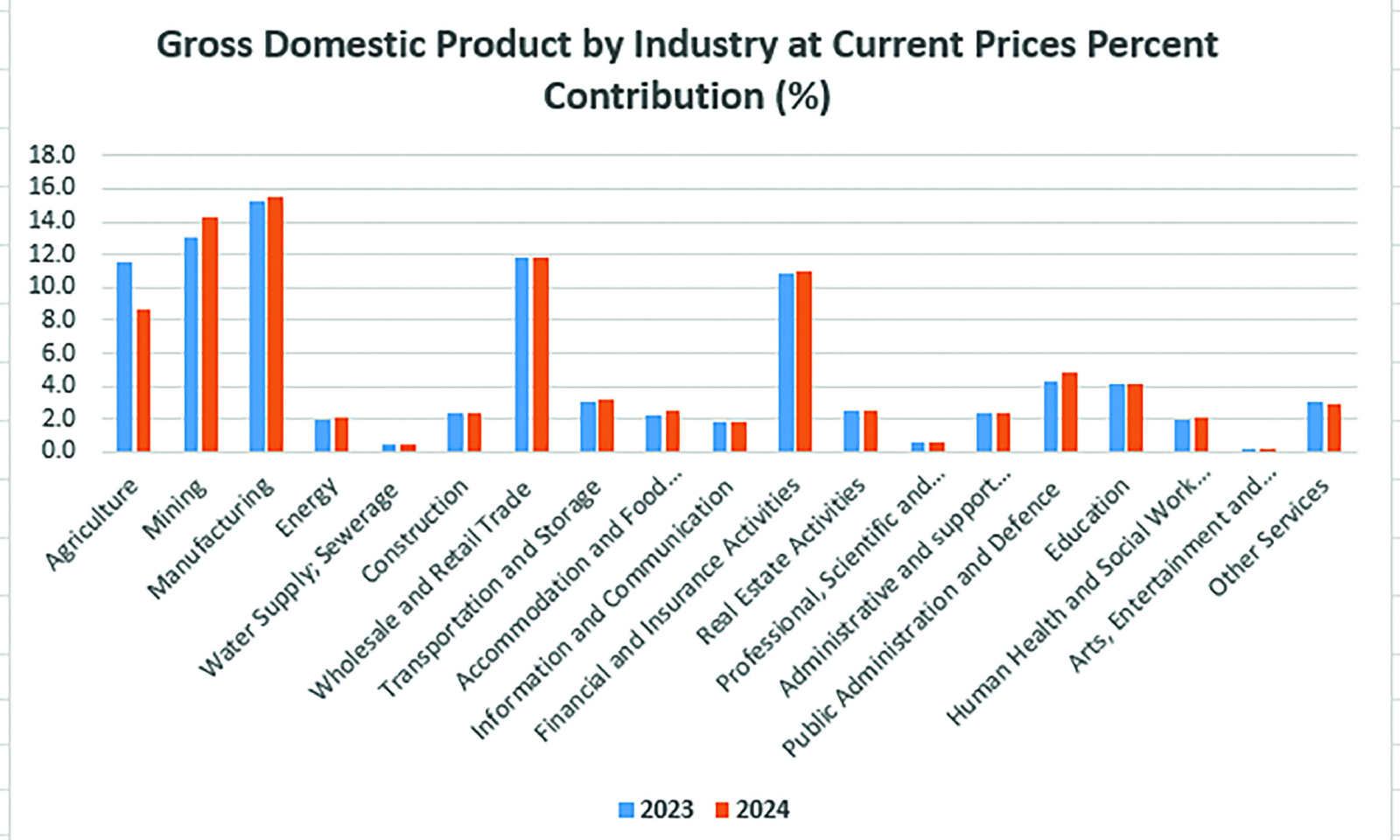
Business Reporter
Zimbabwe’s Gross Domestic Product (GDP) rose by 2,9 percent to US$45,7 billion in 2024, from US$44,4 billion in 2023, according to the latest figures released by the National Statistics Agency (ZimStat).
While ZimStat did not provide direct US dollar figures, it stipulated an exchange rate of ZiG18 per US$1 for converting the GDP at current prices of ZiG822,94 billion.
For 2023, Zimbabwe’s local currency-denominated GDP stood at ZiG67,5 billion, which translates to US$44,4 billion using the then-provided exchange rate of ZiG1,52 per US$1.
Using the income approach to calculate GDP, compensation of employees emerged as the largest contributor at ZiG344,46 billion, followed by gross operating surplus at ZiG288,23 billion.
The balance was made up of mixed income (ZiG143 billion), net taxes on products (ZiG47 billion) and taxes on products (ZiG48,1 billion).
The manufacturing sector led sectoral contributions to GDP at current prices, accounting for 15,6 percent (up from 15,3 percent) after recording a 1,61 percent growth rate.
The mining and quarrying sector, which experienced the highest growth rate of 12,9 percent during the period, contributed 14,3 percent to the overall GDP.
The wholesale and retail trade sector, previously a dominant contributor to GDP, came third with an 11,8 percent share, following a 2,6 percent growth rate.
However, two key sectors recorded negative growth rates.
The agriculture, forestry and fishing sector saw an 18,12 percent drop in 2024, primarily due to the impact of the El Niño-induced drought.
Consequently, its contribution to GDP dropped to 8,7 percent from 11,5 percent in the prior year.
Similarly, the accommodation and food service activities sector suffered a negative 6,4 percent growth rate, although its contribution to GDP increased to 2,6 percent from 2,2 percent in the prior year.
Commenting on the 6,4 percent decline in the accommodation and food service activities, Tourism Business Council of Zimbabwe president Clive Chinwada said destinations that relied largely on domestic tourism experienced regression as a result of a cocktail of factors including reduced spending by Government on MICE and travel.
He, however, said the industry recorded growth in both accommodation services uptake in the key tourism destination such as Victoria Falls.
“This is a result of that destination relying on international tourist arrivals and for Victoria Falls MICE and leisure were key drivers to the demand,” said Mr Chinwada.
He added that Harare was flat while Bulawayo experienced marginal decline in overall activity.
Wafa Kuchera, an analyst at Trigrams Investments, urged Government to “focus on defending recent gains while also actively supporting lagging sectors to stabilise and contribute more meaningfully in the years ahead”.
Mr Kuchera stated that “manufacturing and mining will require increased access to grid power from ZESA and foreign currency allocations from the RBZ to modernise operations and upgrade machinery. The current push for local beneficiation could place both sectors on stronger footing as related projects begin to come online.”
Mr Kuchera observed signs of recovery in agriculture, attributed to a favourable rainy season, but stressed the urgent need to prioritise climate resilience. He called for accelerated investment in water capture and irrigation technologies across all farming scales, including small-scale operations.
“Government can support adoption through tax incentives for irrigation equipment, while private capital can be mobilised for large scale water infrastructure,” said Mr Kuchera.
Commenting on the same subject, economic analyst Gladys Mutsopotsi-Shumbambiri said the sharp drop in the agriculture sector “underscores the urgency of investing in climate-smart agriculture, irrigation infrastructure and rural financing mechanisms to shield the sector from climate shocks and ensure its resilience”.
Regarding the consumptive sectors, Mr Kuchera indicated that current efforts to streamline regulations should facilitate a natural recovery during the current year.
“However, the continued overreliance on compensation of employees is an issue that requires attention. As the economy matures, there is an urgent need to shift labour from primary production into higher value roles. In other words, to enable people to add more value per unit of labour across goods and services.”
Mrs Shumbambiri said the fact that the biggest contributor to GDP is compensation of employees points to a few important dynamics.
“Firstly, the large share of employee compensation suggests that formal employment — especially in sectors like Government services, education and formal retail — remains a cornerstone of national output. It reflects the weight of the public sector and established industries in sustaining economic activity.
“Secondly, the strong gross operating surplus indicates robust profit generation by firms, especially in capital-intensive sectors such as mining, retail, and manufacturing. However, this could also reflect inflationary pressures or exchange rate effects, rather than pure productivity growth,” observed Mrs Shumbambiri.
She however, said a critical takeaway was the underrepresentation of the informal sector in this calculation.
“Although mixed income (ZiG143 billion) attempts to capture informal activity, it is unlikely to fully reflect the size and importance of Zimbabwe’s informal economy, particularly in urban and peri-urban areas.
“Gains in mining and manufacturing are encouraging, but they must be complemented by inclusive policies that empower informal enterprises, protect vulnerable sectors like agriculture and strengthen economic diversification,” said Mrs Shumbambiri.