

 admin
admin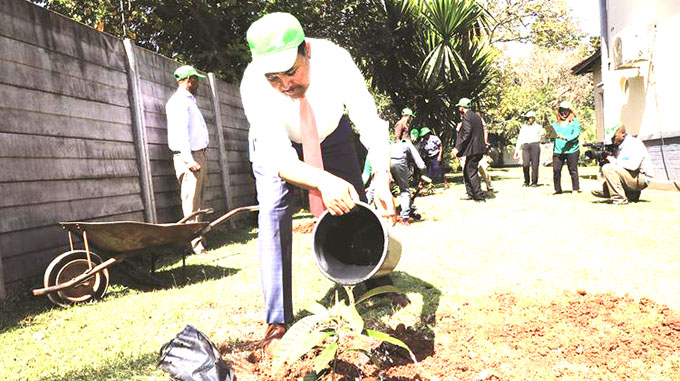
THE INTERVIEW KUDAKWASHE MUGARI
Zimbabwe and Ethiopia are celebrating 34 years of diplomatic relations this year.The Ethiopian embassy this week on Monday held a four-billion tree planting campaign initiative. The Herald Deputy News Editor Kudakwashe Mugari (KM) spoke to the Ambassador of Federal Democratic Republic of Ethiopia to Zimbabwe, Dr Addisu Gebreigzabhier (AG) to gauge the current state of relations between Harare and Addis Ababa.
KM: You recently started your term of office in Zimbabwe. How has been your stay and your overall assessment of Zimbabwe?
AG: I have been here for almost one month and half. I was welcomed by Zimbabwean officials here in Harare. I presented my credentials to President Mnangagwa at State House on June 21, 2019 and it has been wonderful. I can say it has been an honour for me to be appointed Ambassador of Ethiopia to our sister country Zimbabwe.
During my stay here in Harare, I have had a meeting with President Mnangagwa and other officials of the country. We talked about Ethiopia and Zimbabwe relations that goes back to time of struggle for the liberation. Ethiopia and Zimbabwe started their close bilateral relations before the Independence of Zimbabwe, while the country’s patriots were struggling for their country’s independence.
During Zimbabwe’s war of liberation, Ethiopia hosted and trained freedom fighters who were fighting until Independence in 1980. Immediately after its independence, Zimbabwe opened its embassy in Addis Ababa, and Ethiopia in turn opened its embassy in Harare in 1985.
We have a long-standing relationship in various areas. The President of Zimbabwe is very keen to engage other countries, so Ethiopia is ready to work with Zimbabwe.
(We have) relations binding (us) historically, culturally and now look forward to deepening of our economic relations.
As we can see, Zimbabwe is entering a New Dispensation and Ethiopia wants to be a strong partner of Zimbabwe in this chain of strengthening economic relations.
Under the New Dispensation, my country would seek economic cooperation in several areas.
From these, I can say that Zimbabwe has unlimited potential, a welcoming and conducive environment for business and we have to put all our efforts in making a difference in the economic relations.
KM: What is the relationship like between Addis Ababa and Harare and how can the two countries further enhance the relationship?
AG: Activities to explore the potential of creating a link between the two cities — Addis Ababa and Harare — have already taken place. Draft twinning agreement that has been exchanged between Addis Ababa and Harare City is expected to be signed. Both are committed to exploring various ways of furthering their economic cooperation and engagement as they seek to develop their economies and improve people’s lives.
We are working that the draft twinning agreement between Addis Ababa and Harare is signed.
KM: There have been reports of disturbances in some parts of Ethiopia, what is the situation now?
AG: Recent disturbances took place in Southern Nations, Nationalities, and Peoples’ Region (SNNPR) 275km from the capital Addis Ababa. The Sidama Zone demanded a referendum a year ago on the question of a new regional state — a right enshrined by the Federal constitution — and said they would declare their own region if the ballot was not held within the stipulated time.
Ethiopia has nine regional states, which have autonomy over revenues and regional security forces. Sidama activists wanted to unilaterally declare a new regional state and disturbances and violence in Hawassa was largely averted after an agreement was made to delay the declaration and accept a government offer to hold a referendum in five months.
Not all Sidama people accepted the delay. When they saw people gathered near the roads, they thought they were there to create a problem and that is how the disturbances happened. Now all the disturbances are under control and people are back to their daily normal and peaceful life.
KM: Tell us about the safety of Zimbabweans and other nationals living in Ethiopia regarding the disturbances that have been experienced?
AG: Ethiopia is remarkably safe for Zimbabweans and other nationals living in Ethiopia. Travellers or foreign nationals living in Ethiopia are extremely welcome. It’s very unlikely you’ll encounter any serious difficulties and even less likely if you’re prepared for them. Ethiopia is Africa’s safest country in which one can travel and live fairly trouble-free.
KM: On Monday, you had a function of planting four billion trees in Ethiopia and around the world. Tell us more about this initiative and how you plan to roll it out in Zimbabwe.
AG: In Ethiopia, more than 2,6 billion seedlings have been planted across Ethiopia during the past three months to regain our lost forest resources. The seedlings have been planted across the country as part of a nationwide project that aspires to see the plantation of four billion seedlings during the second half of the current Ethiopian physical year.
More than 60 percent of the target has been already met. The national four billion trees planting project, which was officially kicked off by the Ethiopian Prime Minister Abiy Ahmed on May 29 2019, is set to mobilise national reforestation programme of planting 40 tree seedlings per head.
The four billion trees planting project was launched amid the Ethiopian government’s call to promote reforestation efforts, and eventually bring an end to the rising deforestation, which the Ethiopian government frequently labelled as a daunting challenge to the country’s green economy strategy. It has launched the planting of 200 million trees in a single day, which is slated for July 29 2019, an initiative which is expected to break a world record. As the country is set to hold the 200 million saplings planting initiative on Monday, July 29 2019, the distribution of the planned 200 million seedlings — most of which are said to be indigenous tree species — will be completed throughout the country.
Nationwide monitoring of planted seedlings will be conducted to ensure that the planted trees would be grown. The government-led reforestation initiative is a “critical impute” for Ethiopia’s aspiration towards green economy. The country had lost billions of trees and forest resources over the past decades.
As part of this incentive here in Zimbabwe, all diplomats and members of the Ethiopian community are to plant the trees in the compound of the embassy.
KM: Zimbabwe is preaching economic diplomacy. Tell us how you are marketing potential investments in Zimbabwe to Ethiopian businesspeople.
AG: Well, we understand that Zimbabwe attaches great importance to economic diplomacy for reasonable reasons. Zimbabwe needs to boost foreign direct investment and tourism and help revive the economy. The 21st century diplomacy is focusing on economic diplomacy. No matter how struggling Zimbabwe’s economy might seem, there would still be countless opportunities waiting to be grabbed by those who have keen eyes for them. Without wasting our time, there are business opportunities in Zimbabwe that Ethiopia’s businesspeople can explore. For business entrepreneurs and for those who have a background in business management, I understand that a good business opportunity is in Zimbabwe.
As we all know, Zimbabwe is rich in a large number of highly-educated and experienced citizens, who can contribute to the development of their country. Zimbabwe has also natural resources.
While many investors and businesses are already into the i.e. gold mining business, the door of opportunities remains open to Ethiopia’s businesspeople. This can be done by collaborating with a gold mining business people here in Zimbabwe which is very, very profitable.
The demand for construction services is also another large market in Zimbabwe to cater to. Better yet, one can start a business that sells materials used in construction, such as cement, nails, wires, etc.
The other aspect has to do with tourism. In many countries, tourism is already a major part of their economy and a significant source of income and employment. As it is well known, Ethiopian Airlines, which has a flight from Addis Ababa to Harare and Victoria Falls, is doing excellent job in terms of bringing a lot of tourists from tourist origins i.e. USA, Canada, Germany, China and from other parts of the globe. Ethiopian
Airlines has increased its flight frequency from four to five days per week on its route between Addis Ababa-Victoria Falls. This means it has been a remarkable achievement for the tourism industry.
The Ethiopian Airlines’ catalyst role has never been more impactful, especially in promoting tourism. Africa’s largest carrier today spreads its wings to 120 destinations throughout the world, with half the destinations in Africa. Thanks to Addis Ababa’s strategic location at the centre of the East-West lane and the ever-expanding service of Ethiopian Airlines, the city has emerged as the major gateway into Africa, surpassing Dubai.
Besides its wide connectivity and multi-award winning signature services, the flag carrier’s cutting-edge technologies are adding a definite wow factor that is enabling the influx of tourists. Thus our embassy in Harare is working in exploring the best investment opportunities in Zimbabwe for Ethiopians businesspeople.
KM: Give us an idea of trade volumes between Zimbabwe and Ethiopia in the last year and how you intend to increase trade volumes during your tenure?
AG: Over the course of my tenure, our embassy will focus producing an updated data that can help our business people to start business. The data we have now is (for the period) between 2007 and 2011. We, therefore, need to continue with market research to identify who indeed our customer is and what products and services they need and what we can do best to satisfy them for trade growth.
Zimbabwe’s trade with Ethiopia cumulatively averaged only US$1,02 million between 2007 and 2011 and this was about 0,01 percent of the country’s trade with the world. Zimbabwe largely exported intermediate and consumer goods to Ethiopia. Intermediate goods constituted 66 percent of total exports, while consumer goods constituted 23 percent of exports. Capital goods and raw materials had the least composition, covering 9 percent and 2 percent respectively.
Like exports, intermediate goods constituted a greater proportion of imports, covering 43 percent and consumer goods constituted 37 percent. Main export products included machinery, cereals, furniture and articles of leather. Imports for capital goods represented a larger proportion than exports, covering about 18 percent and raw materials only constituted 2 percent.
Import composition included, raw hides, skins and leather, trees, flowers, electronic equipment, footwear, plastics, machinery and vehicles. There is a potential to increase trade between Ethiopia and Zimbabwe, hence the need for continuous sharpening of relations between the two countries, taking advantage of the market access opportunity that has been provided to the two countries.
Looking at the trade statistics between the two countries, there has been a decrease since 2011. We believe the data from 2007 to 2011 has to be changed and focus on new opportunity to increase the volumes.
KM: What is the general attitude of Ethiopians regarding Zimbabwe’s investment climate?
AG: Generally, the attitude of Ethiopians regarding Zimbabwe’s investment climate is good. Zimbabwe has attracted low investment inflows. It has also warmly received appreciation to the announcement and commitment made by the Government to improve transparency, streamlining business regulations, and removing corruption. The Government has been praised for working to improve the business environment by reducing the regulatory costs measured in the World Bank’s Ease of Doing Business index.



 leeroy
 Online Reporter