
Debra Matabvu
Senior Reporter
THE Second Republic is strengthening investor confidence and accelerating the exploitation of the country’s vast mineral wealth by providing the legal certainty and investment security needed to turn the country’s resources into jobs, economic growth and tangible benefits for communities, President Mnangagwa has said.
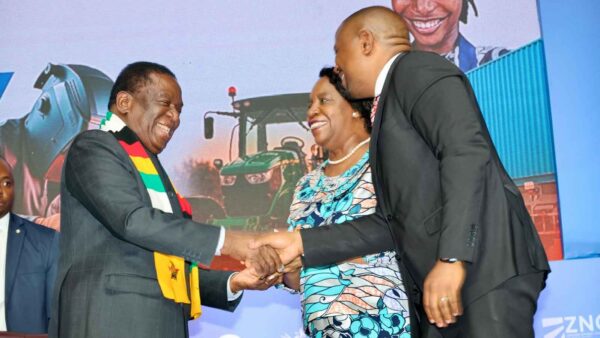
The President said this after witnessing the signing of a 25-year Special Mining Lease Agreement between the Government and Karo Platinum (Private) Limited, part of Tharisa Plc, at State House in Harare yesterday.
Writing on his microblogging platform, X, President Mnangagwa said the agreement demonstrated Government’s commitment to unlocking the country’s mineral wealth while creating a predictable investment environment.
“Today (yesterday), I had the privilege of witnessing the signing of a landmark 25-year Special Mining Lease Agreement between the Government of Zimbabwe and Karo Platinum (part of Tharisa Plc),” he said.
“This major milestone secures long-term tenure over a 23 903-hectare mining area on our mineral-rich Great Dyke.
“This project is a direct outcome of the vision we launched in 2018. With over US$240 million already invested in plant establishment, mining fleets, water and power infrastructure, and community development, Phase 1 alone is set to create up to 1 000 jobs for our people.”
President Mnangagwa added that the fully compliant agreement—signed on behalf of the Government by Mines and Mining Development Minister Engineer Polite Kambamura and Finance, Economic Development and Investment Promotion Minister Professor Mthuli Ncube—underscores the Second Republic’s commitment to transparency, legal certainty and investor security.
Karo Resources managing director Mr Bernie Pryor signed on behalf of the company.
“We are unlocking our nation’s vast mineral wealth to drive sustainable industrial growth, create decent employment, and uplift communities,” President Mnangagwa said.
The 25-year Special Mining Lease provides Karo Platinum with the long-term tenure and fiscal certainty required to commence its first production, expected in the second half of next year.
The agreement, granted under the Mines and Minerals Act (Chapter 21:05), establishes the fiscal and operational framework applicable to high-value, large-scale mining projects of national importance.
It also secures long-term tenure over the project’s 23 903-hectare mining area on the Great Dyke, providing certainty for both Zimbabwe and Karo Platinum.
At full production, Karo is expected to produce up to 226 000 ounces of platinum group metals (PGMs) annually, further strengthening Zimbabwe’s position as one of the world’s leading platinum producers.
Speaking after the signing ceremony, Minister Kambamura said the agreement demonstrated that the country remained open for business and provided investors with security of tenure.
“Firstly, I would like to outline that this is what is granted in terms of our legislation.
“It confers a long-term lease to Karo Platinum with regards to the 23,903-hectare concession that they have.
“Also, it establishes the fiscal and operational framework which allows the company to get more funding for the establishment of the project.
“Finally, it provides that certainty that is needed by investors. So, this is actually a testament enough that Zimbabwe is open for business and security of tenure is provided.”
Minister Kambamura said Karo Platinum had also established a strong foundation through investments made in the country since the project was launched in 2018.
“The fact that Karo Platinum has been patient since 2018 when His Excellency made a ground-breaking settlement of the project means that there is patient money that has been waiting and the fact that they have waited for all these years building the project, is a strong foundation that they have built for long project implementation,” he said.
“As you have heard, the life of the mine is 50 plus years. So, to be able to live those 50 plus years, you need to build a strong foundation.
“Karo Platinum has done exactly that.”
Prof Ncube said the investment would help transform the mining area into a development hub.
“I am very pleased that they have invested so far US$240 million into this resource, developing the mine,” he said.
“They will be investing almost close to US$1 billion, at least in Phase One alone, which is just to be able to mine open cast.
“Then they will move on to Phase Two. So, more investment is going to come. But also, my interest is really the fiscal incentives that go with the special mining lease.”
Prof Ncube added that the Government had extended fiscal incentives, for Karo Platinum to be able to raise additional capital to keep investing in the mine and to make it more viable.
“They will be creating jobs. At their peak they will be employing around 3 000 people.
“They are going to be developing the whole area. Many cities should emerge out of their involvement and investment in the area,” said Prof Ncube.
He emphasised the fiscal incentives provided under the Special Mining Lease, including tax write-offs and employee exemptions, which are intended to enhance project viability and attract additional capital in the first five years to allow them to invest and recoup their money.
“We also support their employees with special tax exemptions so they can employ the best and be able to attract the best skills to work in these mines.
“But of course, in the same agreement, we do specify the royalties that they have to pay.
“As you know, for platinum, the royalty currently is 7 percent; that is very clear in the lease agreement that (it) ought to be met.
“So, we feel that it is the right combination of fiscal incentives to support this investment,” said Prof Ncube.
Karo Platinum country manager Mr Joe Zimba said the signing marked the conclusion of a de-risking period and ushered in a new phase for the project.
“What we have signed here is a special mining lease agreement that has been signed between the Government of Zimbabwe and Karo Platinum,” he said.
“What that does is provide security of tenure and also some fiscal support for the project, which is normal for projects of this magnitude.”
Mr Zimba said efficient mining would provide the foundation for value addition, while the company would continue prioritising communities around the project.
The first phase of the project, expected to come on stream during the second half of next year, is expected to employ more than 1 000 people and produce 226 000 ounces of PGMs annually, positioning Karo Platinum as a major player in Zimbabwe’s mining sector.v