Nduduzo Tshuma in NAIROBI, Kenya
ZIMBABWE and Kenya have deepened their strategic partnership with the signing of seven bilateral agreements in Nairobi yesterday, where President Mnangagwa called for swift implementation of commitments spanning trade, customs, housing, immigration, culture, media and diplomatic training.
The accords give fresh impetus to the elevation of bilateral ties from a Joint Permanent Commission on Cooperation (JPCC) to a Bi-National Commission (BNC), establishing a higher-level platform to drive cooperation and deliver tangible economic benefits.
President Mnangagwa and his Kenyan counterpart, President William Ruto, jointly presided over the signing ceremony at State House in Nairobi, emphasising effective execution through stronger institutional linkages, clear timelines and close oversight.
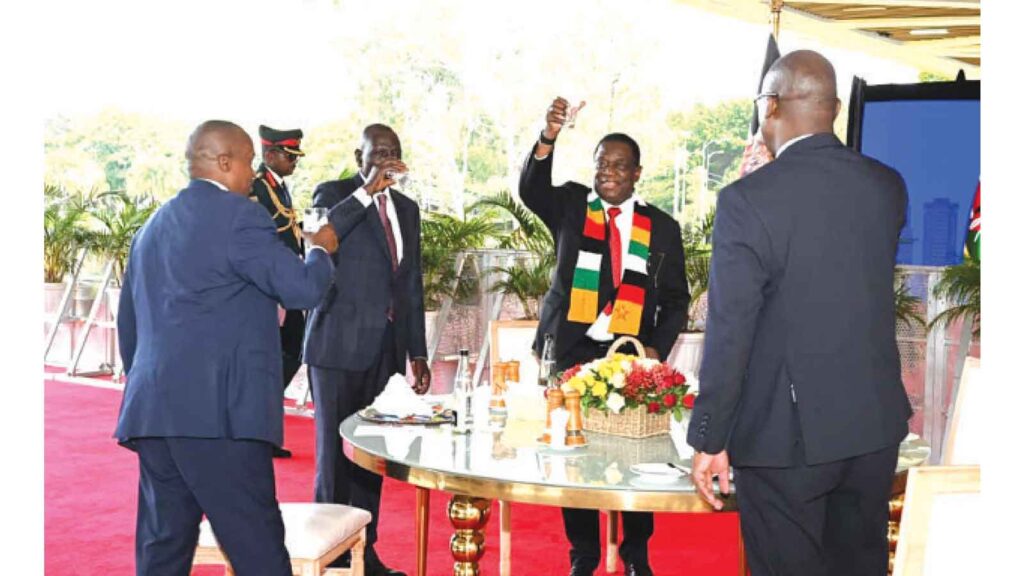
President Mnangagwa and his Kenyan counterpart President William Ruto toast to strong bilateral relations at State House in Nairobi, Kenya, yesterday. — Pictures: Presidential Photographer Joseph Nyadzayo.
Both nations also resolved to dismantle tariff and non-tariff barriers to ease the movement of people, goods and services under the Common Market for Eastern and Southern Africa (COMESA) and the African Continental Free Trade Area (AfCFTA).
Signed by ministers and senior officials from both Governments, the seven Memoranda of Understanding (MoUs) cover:
• Diplomatic training: Signed by Foreign Affairs and International Trade Minister Professor Amon Murwira and Kenya’s Prime Cabinet Secretary and Cabinet Secretary for Foreign and Diaspora Affairs Dr Musalia Mudavadi, linking Kenya’s Foreign Service Academy and the Zimbabwe Foreign Service Institute to strengthen capacity through expertise and knowledge exchange.
• Affordable housing: Signed by Prof Murwira and Kenya’s Cabinet Secretary for Lands, Public Works, Housing and Urban Development Ms Alice Wahome to foster institutional cooperation in housing delivery and appropriate building technologies.
• Immigration: Signed by Home Affairs and Cultural Heritage Minister Kazembe Kazembe and Kenya’s Cabinet Secretary for Interior and National Administration Mr Onesimus Kipchumba Murkomen to enhance information-sharing and combat irregular migration, human trafficking and migrant smuggling.
• Arts, culture and heritage: Signed by Minister Kazembe and Kenya’s Cabinet Secretary for Gender, Culture, Arts and Heritage Ms Hanna Wendot Cheptumo to promote cultural exchanges and heritage preservation.
• Media exchange: Signed by Information, Publicity and Broadcasting Services Permanent Secretary Mr Nick Mangwana and Kenya’s Principal Secretary for Broadcasting and Telecommunications Mr Stephen Motari Isaboke, enabling the Zimbabwe Inter-African News Agency (New Ziana) and the Kenya News Agency to exchange news reports without substantial alteration.
• Customs cooperation: Signed by Zimbabwe Revenue Authority Commissioner-General Ms Regina Chinamasa and Kenya Revenue Authority Commissioner-General Mr Adan Abdulla Mohamed to facilitate lawful trade and combat customs offences.
• Export promotion: Signed by ZimTrade chief executive officer Mr Allan Majuru and Kenya Export Promotion and Branding Agency (KEPROBA) counterpart Mr Austin Macheso to boost bilateral market access and trade diversification.
Delegates also adopted the agreed minutes of the inaugural BNC and a joint communiqué to formalise deliberations and guide implementation.
Addressing the inaugural BNC, President Mnangagwa urged officials to build on JPCC gains by expediting outstanding accords and closely supervising high-impact projects.
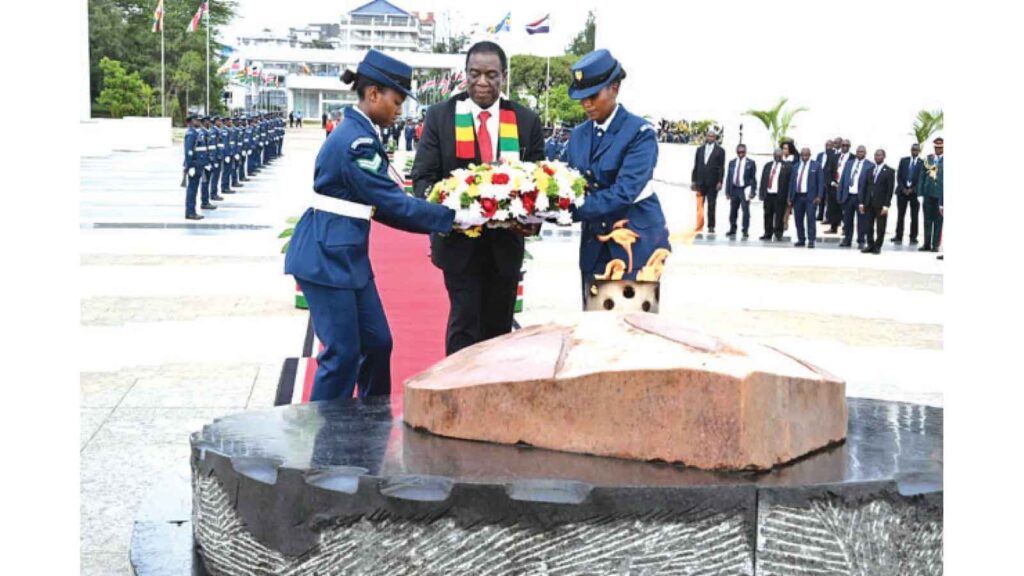
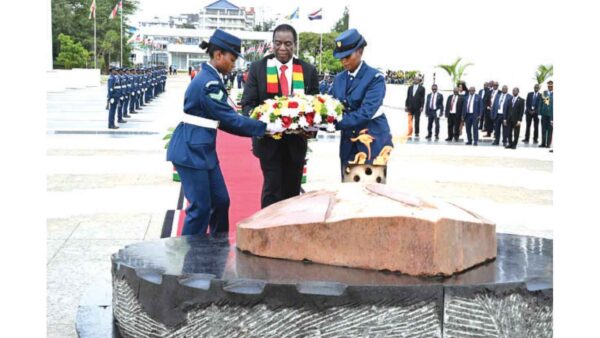
President Mnangagwa lays a wreath on the Tomb of the Unknown Warrior at Uhuru Gardens National Monument and Museum in Nairobi, Kenya.
“Ministers and senior officials must thus, urgently finalise outstanding agreements, implement decisions within agreed timelines and prioritise high-impact projects that catalyse economic transformation, sustained growth and shared prosperity,” he said.
He called on both countries to move beyond political goodwill towards practical collaboration through value addition, beneficiation and mutual investment, challenging the private sector to form joint ventures in agro-processing, mining, manufacturing and cross-border distribution.
“Value addition and beneficiation, trade expansion, and enhanced mutual investments must be promoted,” said President Mnangagwa.
Highlighting logistics connectivity —with Kenya serving as an East African and Indian Ocean gateway and Zimbabwe anchored in Southern Africa — he commended Kenya Airways for increasing flights into Zimbabwe and welcomed ZimTrade’s exploration of the Port of Lamu as an additional trade corridor.
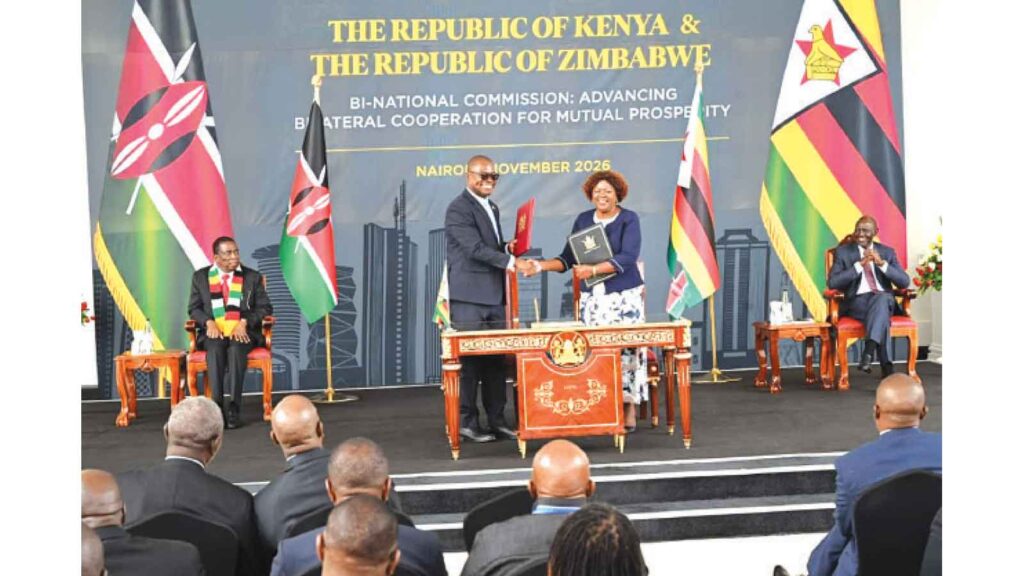
President Mnangagwa (left) and President Ruto (right) witness as Foreign Affairs and International Trade Minister Professor Amon Murwira and Kenya’s Cabinet Secretary for Lands, Public Works, Housing and Urban Development Ms Alice Wahome exchange documents after signing an MoU on affordable housing and appropriate building technologies in Nairobi.
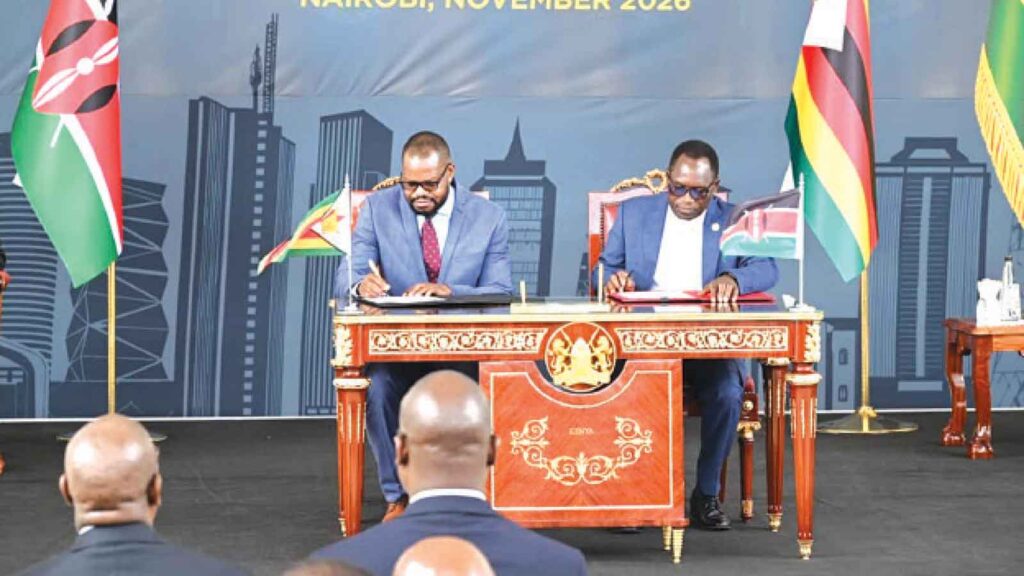
Information, Publicity and Broadcasting Services Permanent Secretary Mr Nick Mangwana and Kenya’s Principal Secretary in the State Department for Broadcasting and Telecommunications Mr Stephen Motari Isaboke sign a Memorandum of Understanding between the Zimbabwe Inter-African News Agency (New Ziana) and the Kenya News Agency.
President Mnangagwa invited Kenyan investors to tap into opportunities under Zimbabwe’s National Development Strategy 2 (NDS2, 2026–2030), which prioritises industrialisation, agricultural modernisation, mineral beneficiation, infrastructure and human capital.
While Kenya seeks to expand exports of tea, coffee, pharmaceuticals, leather goods, ICT services and processed foods, Zimbabwe aims to grow agricultural and manufactured exports into Kenya.
He also thanked Nairobi for backing Zimbabwe’s election as a non-permanent member of the United Nations Security Council for the 2027–2028 term and supporting its 2026–2027 COMESA chairmanship, noting their shared liberation history underpins regional integration.
In his remarks, President Ruto commended the constructive deliberations, noting that both nations were focused on building economic resilience and expanding opportunities amid global turbulence.