

 admin
admin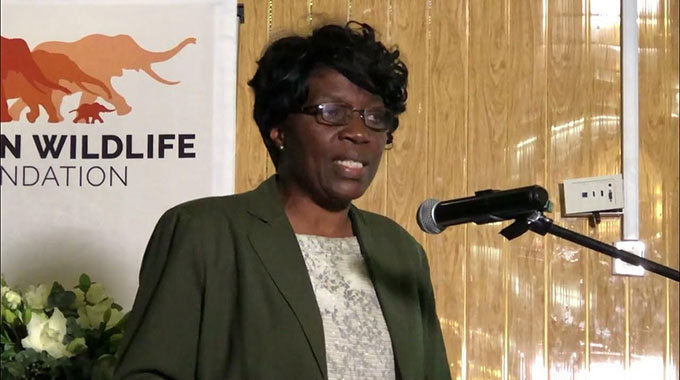
Michael Magoronga
THE Ministry of Environment, Climate and Wildlife has joined hands with the African Wildlife Foundation (AWF) to launch the inaugural Zimbabwe Biodiversity Economy (ZBE) report aimed at maximising economic benefits from the country’s rich biodiversity.
The document was launched after the realisation that Zimbabwe is rich in biodiversity, which comes with huge economic benefits, but there was no systematic framework to fully measure biodiversity contributions to economic development.
Officially launching the document in Harare recently, acting Permanent Secretary in the Ministry of Environment, Climate and Wildlife, Mrs Tariro Musonza, said the ZBE study recognised the key role of nature in harnessing opportunities and the long-term growth of a biodiversity economy towards attaining Vision 2030.
“The main objective of the report is to ensure that the value of biodiversity is recognised and mainstreamed in development planning and national accounts for sustainable social and economic development,” she said.
Mrs Musonza said the ZBE report provides a framework that would help Zimbabwe to mainstream the value and contribution of nature into development and decision-making on public and private sector investments.
“These legal and policy frameworks seek to create an enabling environment for natural resources conservation and sustainable use,” he said. “These processes will no doubt enhance the Zimbabwe biodiversity economy.”
AWF Zimbabwe director, Mrs Olivia Mafute, said the report did not only set a baseline on the value and contribution of nature, but also identified viable business and investment opportunities through which Zimbabwe can unlock the enormous potential value in its rich biodiversity.
“We are optimistic that the ZBE report is a huge milestone for Zimbabwe towards economic development that is consistent with sustainability objectives of social well-being, environmental health and an equitable economy,” she said.
“The roadmap for Natural Capital Accounting, illustrated in the report, provides a framework that would help Zimbabwe to mainstream the value and contribution of nature into development planning, policy development and decision-making on public and private investment.”
Mrs Mafute said ZBE will play an important role in addressing challenges underpinning biodiversity loss in Zimbabwe and positioning the biodiversity economy as a key economic sector to invest in.
“The successful implementation of various recommendations put forward in the ZBE report will promote poverty reduction and economic growth as various groups including the women and youth, private sector, and the Government can tap into various opportunities presented in bioprospecting and bio trade, fisheries, wildlife and forestry sectors,” she said.
There is a need to ensure that development and biodiversity conservation are complementary because that way, development would be sustainable, said Mrs Mafute.
The development comes days after the Nairobi Declaration, which culminated in the adoption of the Nairobi Declaration sought to deliberate on solutions to climate change shocks and its cost to Africa, as well as influence commitments towards addressing climate change on the African Continent.
“I am happy that at the local level in Zimbabwe, the launch of the ZBE Report is a manifestation of Zimbabwe’s willingness to act on climate change adaptation and mitigation measures as it contextualizes this global issue within the confines of Zimbabwe,” said Mrs Mafute.
“As you may be aware, biodiversity conservation and its benefits play a very critical role in mitigating the effects of climate change fuelled by various factors such as deforestation, emission of greenhouse gases, pollution, and other human activities.”



 Online Reporter