Chronicle Editor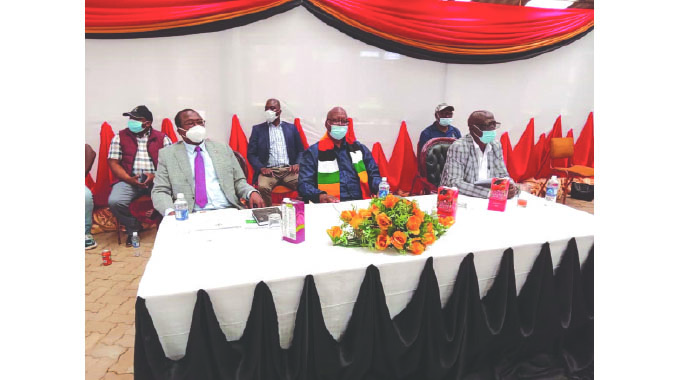
Patrick Chitumba, Midlands Bureau Chief
ZIMBABWE has lost over US$42 billion in potential revenue as a result of the illegal sanctions imposed by the Western countries following the successful agrarian reform.
Western countries imposed illegal sanctions on Zimbabwe after rolling out the land reform programme in 2000, crippling many sectors of the economy.
The illegal sanctions imposed on the country have seen Zimbabwe failing to access lines of credit and support from international financial institutions where the country is a member.
The agriculture sector was also battered, but is now on an upward trajectory which if sustained will see Zimbabwe regaining its “Africa’s bread basket” status.
Despite the effects of the illegal sanctions, Government has not been resting on its laurels as it has been doing its best to ensure food security by investing in agriculture through programmes such as the climate proof Pfumvudza/Intwasa programme and CBZ Agro scheme.
The Second Republic has however, come up with robust measures contained in Vision 2030, envisaged to transform the country into an upper middle-income economy.
Addressing youths drawn from tertiary colleges in Gweru during a youth symposium organised by the Zanu-PF Midlands province leadership at Mkoba Teachers’ College in Gweru on Friday, Finance and Economic Development Minister, Professor Mthuli Ncube said in 2000 Government undertook the fasttrack land reform programme which resulted in the Western countries imposing unilateral coercive measures.
The symposium which ran under the theme, “Impact of Sanctions on the economy” saw Prof Ncube explaining to the youths that the economy could have been on a better standing if it wasn’t for the illegally imposed sanctions by Britain and her allies.
He said the sanctions imposed by Europe, the United States of America and other countries have had devastating effects on the economy.
Prof Ncube said there are also over 180 individuals and entities on targeted sanctions as well whose movement and businesses are restricted adding that anyone wanting to deal with them is also restricted.
“Most of our banks in which the Government has a foot print were also put under the sanctions. Our calculations so far indicate that Zimbabwe lost over US$42 billion of revenue.
The size of the economy is about US$25 billion and because of the sanctions we have lost double of our economy.
“We have also lost US$4,5 billion of bilateral donor support and also US$18 billion in international commercial loans that are critical for the nation and various companies that create jobs especially for the youths,” he said.
Prof Ncube said sanctions have disturbed the entire economy adding that the provisions of Zimbabwe Democracy and Economic Recovery Act (Zdera) state that Zimbabwe must not be supported by the governors of International Monetary Fund (IMF) who are in the United States for example when it comes to debt clearance.
He said the country can’t access loans from the World Bank, IMF and other regional banks because of the sanctions.
“I recall that banks lost nearly 100 corresponding banking relationships with other banks with other countries.
We have lost those amounting to US$18 billion.
We experienced massive loss of jobs and we were unable to create jobs easily.
We have lost a lot as a country including foreign direct investment,” he said.
Prof Ncube said Government has come up with various sanctions busting mechanisms for the benefit of the people.
“Like any nation under attack, we had to come up with something so that we stand on our own. We had to come up with a firm foundation for us to begin to realise the fruits of our efforts.
The Government developed the Transitional Stabilisation Programme (TSP) to guide the reform process during the period 2018 to 2020.
Significant progress was made in the implementation of the TSP across its various pillars.
The next steps towards attaining the objectives of Vision 2030 is being guided by the National Development Strategy 1 (NDS 1) as the country march towards achieving an upper middle-income society by 2030,” said Prof Ncube.
He said the devolution fund was also introduced to ensure that every region has to get support from their own resources.
“Our goal is to ensure that employment is improved to 80 percent while poverty has to be reduced by 25percent,” said Prof Ncube.



 Online Reporter