daniel chigunwe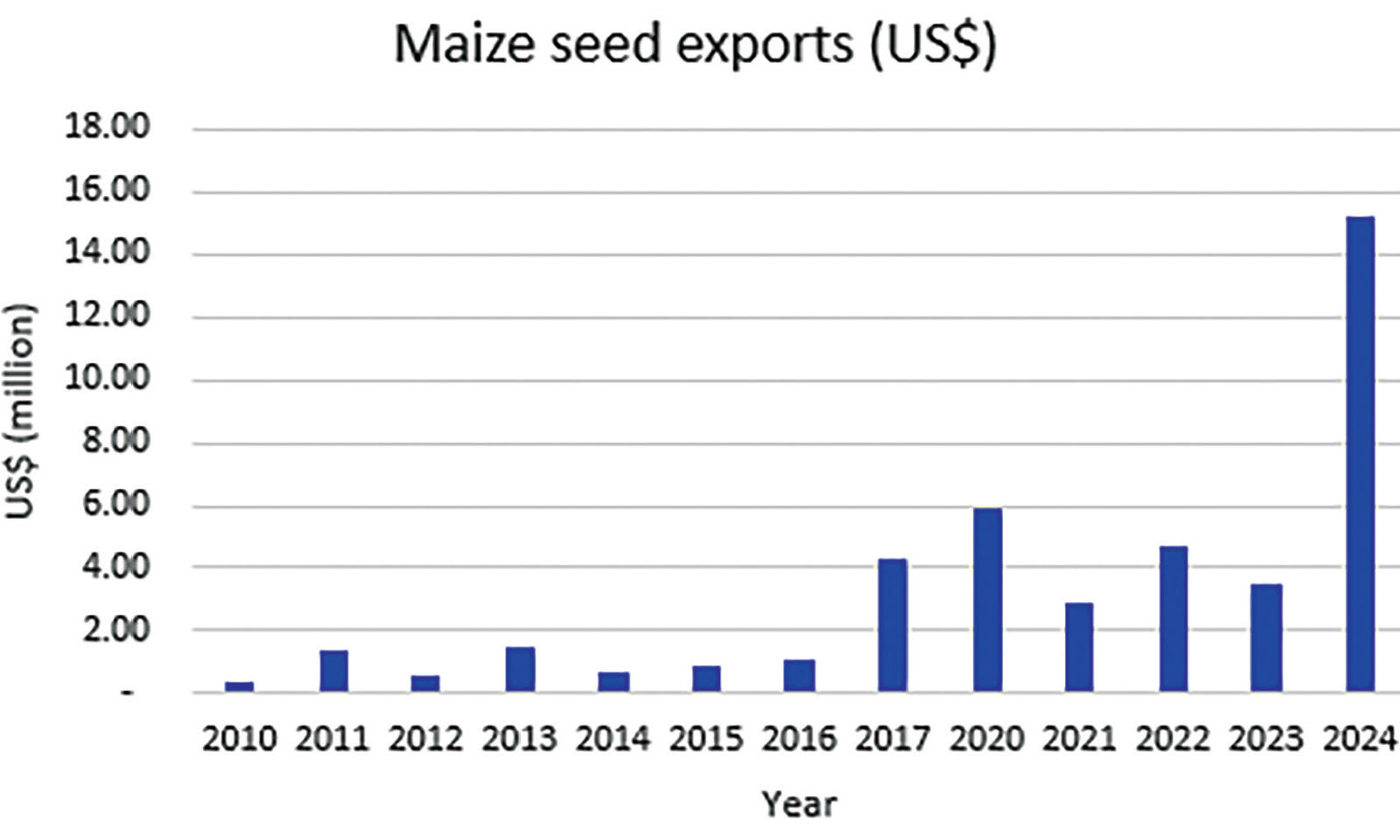
Edgar Vhera
Agriculture Specialist Writer
THE positive impact of the Southern African Development Community (SADC) Seed Charter is already showing with Zimbabwe’s maize seed exports surging by 331 percent from US$4 million in 2023 to US$15 million last year.
Statistics released by the Zimbabwe National Statistics Agency (ZimStats) show that maize seed exports rose from US$3 539 951 in 2023 to US$15 274 760 last year.
In volume terms it rose from 2 566 686 to 11 556 321 kilogrammes.
After the signing of the Seed Charter in July last year, exports of maize seed in the last quarter of the year reached US$11 287 826.
The Department of Research and Specialist Services (DRSS) chief director, Dr Dumisani Kutywayo yesterday said the increase in exports was not affected by the El Nino induced drought as production of was not rain-fed.
“Production of maize seed for the 2023/24 season was mainly under irrigation and expected volumes were achieved.
“The industry also had substantial quantities of carry-over seed from the previous season,” he said.
Dr Kutywayo said overall maize seed availability exceeded national requirements, necessitating exports.
“There was also increased demand for maize seed in the region, which the seed industry took advantage of,” added Dr Kutywayo.
The country signed the SADC Seed Charter for plant variety protection last year, which paved the way for harmonisation of trade. Lands, Agriculture, Fisheries, Water and Rural Development Minister, Dr Anxious Masuka signed the charter on behalf of the Government of Zimbabwe.
Speaking during a press conference after the signing, Dr Masuka said: “Most economies in the SADC region are agro-based, making it crucial for their agricultural sectors to collaborate and speak to each other at various levels. This charter facilitates the free movement of seeds between countries, enhancing regional trade and food security.”
Harmonisation of regulations allows for standardisation, exchange and trade, so this is a facilitatory mechanism to ensure that we are able to exchange, to accelerate agricultural development in the face of climate change, added the Minister.
The International Union for the Protection of New Varieties of Plants (UPOV) ensures standardisation and harmonisation of trade at the international level, but more importantly, it ensures that plant breeders’ rights are protected for a defined period.
The Agricultural and Rural Development Authority (ARDA) board chair, Mr Ivan Craig concurred, saying the signing was long-overdue.
“This is a very good and welcome development for the growth of the seed industry. I would like to thank the Government for joining the other countries that have already signed. It has a positive impact on seed houses/producers and most importantly, seed breeders because the signing and ratification of the charter will protect germplasm,” the ARDA board chair said.
Mr Craig said it protected business interests and intellectual investments for breeders, as no one would be able to replicate one’s work. Interested parties would need to ask for permission to use the germplasm, making business sense to the breeder.
Seed harmonisation will allow smooth movement of seed from one country to another — a process that used to be costly and lengthy in the past, as it involved acquiring permits from different departments.
“With harmonisation, if one seed company comes with a new variety, the trials of that variety are done in all SADC countries. The company will then be able to tell where the particular variety performed best and targets the export of this variety to that country for enhanced foreign currency generation,” he added.
SADC is a regional economic community comprising 16 member states of Angola, Botswana, Comoros, Democratic Republic of Congo, Eswatini, Lesotho, Madagascar, Malawi, Mauritius, Mozambique, Namibia, Seychelles, South Africa, United Republic of Tanzania, Zambia and Zimbabwe.


 Online Reporter