admin
admin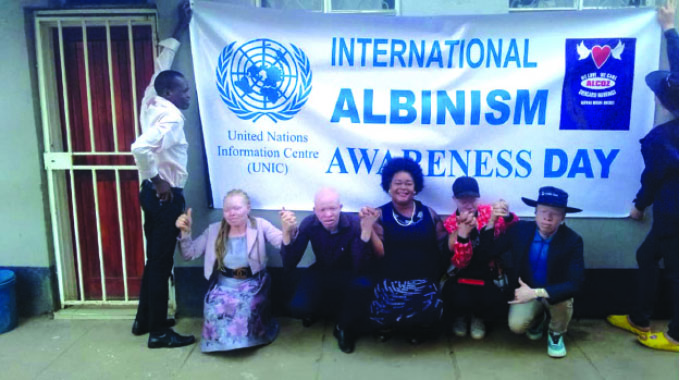
Herald Reporter
The world yesterday commemorated the International Albinism Awareness Day.
Zimbabwe will officially commemorate the day in Matobo, Matabeleland South on Friday in respect of the albinism society and their contribution to the well-being of the nation.
The theme for the International Albinism Awareness Day 2023 builds on the call for albinism-affected individuals to have their voices heard in all spheres of society last year.
Albino Charity Organisation of Zimbabwe (Alcoz) founder Mrs Loveness Mainato said the day was important in recognising people with albinism, sharing love with them and looking at some of the challenges they face in communities.
“People with albinism have several challenges,” she said. “Some are shunned by their parents and communities at birth, while some, especially those from underprivileged families cannot afford resources such as sunscreens.
“Some parents do not send children with albinism to school. Some employers also do not want to employ people with albinism and therefore they are left out from some economic activities.”
Mrs Mainato said skin cancer was a major challenge to people with albinism.
She urged individuals and the corporate world to assist those living with the condition, especially with resources such as sunscreens.
“We need to unite as a nation and not discriminate each other,” said Mrs Mainato. “The President’s mantra sums it all “leaving no one behind” and we should not leave our fellows with albinism behind.
“Our commemorations are starting this Friday in Matobo and thereafter we are going province by province until the end of August. It is our duty as a nation to share our love with those with albinism.”
In an effort by the United Nations to end the abuse of people with albinism, June 13 was set as the International Albinism Awareness Day around the world.
Albinism is a rare genetic condition in which the skin, hair, and eyes lack pigmentation (melanin), making those affected vulnerable to the sun and bright light.
Even though albinism is not contagious, most people who have it have trouble seeing and are more likely to get skin cancer.
In some few societies, including in Africa, individuals with albinism live in constant feelings of fear towards murder. Others are subjected to severe bullying and discrimination.
Health challenges of people living with albinism
The lack of melanin means persons with albinism are highly vulnerable to developing skin cancer.
In some countries, a majority of people with albinism die from skin cancer between 30 and 40 years of age.
Skin cancer is highly preventable when persons with albinism enjoy their right to health.
This includes access to regular health checks, sunscreen, sunglasses and sun-protective clothing.
In a significant number of countries, these life-saving means are unavailable or inaccessible to them.
Consequently, in the realm of development measures, persons with albinism have been and are among those “left furthest behind.”
Therefore, they ought to be targeted for human rights interventions in the manner envisioned by the Sustainable Development Goals.
Due to a lack of melanin in the skin and eyes, persons with albinism often have permanent visual impairment.
They also face discrimination due to their skin colour; as such, they are often subject to multiple and intersecting discrimination on the grounds of both disability and colour.
International Albinism Awareness Day 2023: Theme
The theme of the current year’s celebration of International Albinism Awareness Day — “Inclusion is strength” — emphasises the significance of including people with albinism of all races and ethnicities, as well as young people, women, children, and the elderly.
It also emphasises the necessity of collaborating with other organisations, such as human rights organisations that are not directly associated with the albinism movement.
According to the UN, this year’s theme focuses on the importance and benefits of:
• Involving a wide range of people with albinism including youth, women, children, older adults and of all races and ethnicities, in albinism-related discussions.
• Collaborating with and accepting albinism in the disability movement as well as in other areas where decisions affect people with albinism, and looking for ways to work together with human rights groups and other groups that are not part of the albinism movement.
International Albinism Awareness Day 2023: History
Tanzania was plagued by albinism during the middle of the 2000s, as the country was reported to have the highest level of people with albinism.
In recent decades, hundreds of them have been brutally murdered and mutilated in the African nation.
According to local superstitions, certain parts of the body can bring luck and prosperity. There is also a superstition that albinism is evil spirits.
Yet all these are unjustified attacks on people living with albanism, which must be condemned in all respects and never tolerated in any society.
In 2013, the UNHRC took on an objective called “Attacks and discrimination against persons with albinism.”
Since albinism is still widely misunderstood, both socially and medically, this UN resolution called for the prevention of attacks and discrimination against albinos.
People with albinism are frequently the target of erroneous beliefs and myths that are influenced by superstition.
These misconceptions contribute to their marginalisation, social exclusion, and a variety of forms of stigma and discrimination.
In the end, on December 18, 2014, the United Nations General Assembly (UNGA) approved a resolution claiming June 13 as International Albinism Awareness Day, which would take effect in 2015.
On March 26, 2015, the UNGA established the mandate of Independent Experts on the enjoyment of human rights by persons with albinism in response to a request made by civil society organisations.
International Albinism Awareness Day 2023: Importance
Every year, International Albinism Awareness Day celebrations are necessary to continue the fight for people with albinism’s rights and condemn such attacks.
The day provides an opportunity to educate the general public and fight against misconceptions about albinism.
It helps bring issues to light about the hereditary condition, its causes, and the difficulties looked by people with albinism.
By eliminating fantasies and advancing precise data, International Albinism Awareness Day adds to lessening stigma, discrimination, and prejudice against individuals with albinism. — The Herald/Business Standard.com


 Online Reporter