admin
admin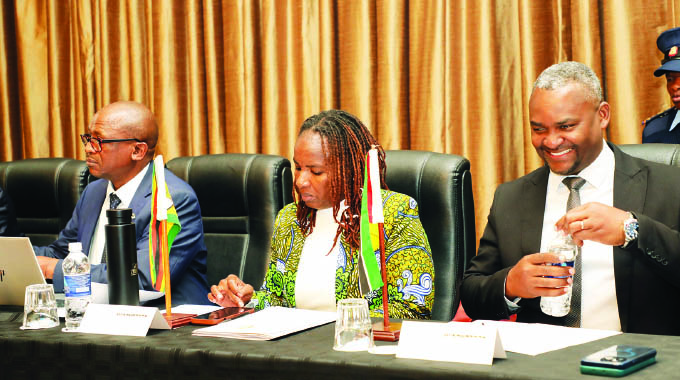
Freeman Razemba
Senior Reporter
PERMANENT Secretaries from Zimbabwe, Botswana and Mozambique are working on a draft proposal on the implementation of the trilateral US$6,5 billion Ponta Techobanine Project.
This comes after President Mnangagwa, his Mozambican and Botswana counterparts — President Filipe Nyusi and President Mokgweetsi Masisi, respectively, presided over the signing of the multi-billion-dollar project that will see the construction of a deep-water port in Matutuine District and a 1 700km railway line linking the three countries.
Once the senior government officials from the three countries come up with a draft proposal, they will present it to their ministers, who will then make presentations to the three principals.
Permanent Secretary for Transport and Infrastructural Development Engineer Joy Makumbe, Mr Ambrósio Sitoe, permanent secretary of the Mozambican Ministry of Transport and Communications and permanent secretary for the Ministry of Transport and Public Works in Botswana, Mr Kgakgamalo Ken Ketshajwang are attending the two-day meeting along with their technical teams.
The meeting seeks to continue discussions from where railway agencies from the three countries left and find sustainable solutions in upgrading and ameliorating the two existing lines, particularly along the Botswana-Zimbabwe-Mozambique railway corridors.
They also want to jointly develop resources and information arising from various feasibility and/or pre-feasibility studies by the tripartite countries into one joint volume to be used as a tool of engagement with the African Development Bank.
Speaking at the meeting yesterday, Eng Makumbe said the Ponta Techobanine Project includes the development of a port at Ponta Techobanine and the development of a Heavy-Haul Railway Line from Botswana, through Zimbabwe to Mozambique as a railway project.
The project has two components, it looks at the greenfield port and rail infrastructure and the existing brownfield railway projects.
“We should unlock the value of Joint Transport Development Corridors as they are for integration in the SADC region and beyond. Africa is on the trajectory of economic growth by opening new frontiers of co-operation, as Zimbabwe, Botswana and Mozambique are demonstrating today.
“It thus calls for greater collaboration and support for African led initiatives, to ensure the achievement of the aspirations of African people. The targets contained in the Agenda 2063 and the strategies therein dovetail with the collaboration that exists between us,” Eng Makumbe said.
Mr Ambrósio Sitoe said they appreciated Zimbabwe’s proactive approach which, shortly after the summit of Heads of State of the three countries, took the initiative to invite the other two counterparts to follow up on guidelines set by the Heads of State Summit in Maputo.
Mr Kgakgamalo Ken Ketshajwang described the infrastructure project as one of the key drivers that will not only stimulate trade, but also improve the livelihood of communities.
“Operationalisation of this corridor will also provide our landlocked countries with an alternative route to our traditional routes and provide opportunities to expand our connectivity in the region,” he said.
The initiative has potential to unlock far-reaching opportunities that will transform trade infrastructure within Southern Africa and improve transport and logistics efficiencies.
Businesses and individual citizens from the three countries are expected to benefit immensely from the project, whose scope covers the rehabilitation and upgrading of the railway line linking Botswana, Mozambique and Zimbabwe to facilitate bulk cargo movement within the bloc and connecting it to global markets.
The development has significant implications for Zimbabwe, in particular, as it entails critical investment in upgrading its railway system to ensure smooth operability with regional peers for expanded bulk cargo carriage capacity.
Once complete, the Techobanine Port, which is set to be among the biggest capacity facilities in the region, is expected to significantly decongest and ease pressure on all ports in the region.


 Online Reporter