malvernmugadzikwa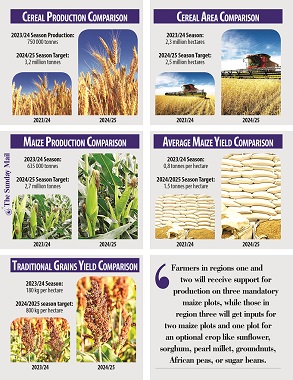
Sunday Mail Reporter
THE Government last week unveiled a comprehensive plan for the upcoming 2024/2025 summer cropping season to revitalise the agriculture sector.
The plan is geared towards catapulting the agriculture sector after the worst El Niño-induced drought in 43 years.
Last season, the production of maize — a staple crop in Zimbabwe — plummeted by a staggering 77 percent, creating a significant food and feed deficit.
This new plan, which was approved by Cabinet on Tuesday, represents a bold commitment to building resilience and achieving food security in the face of climate change.
Building back better
The Crops, Horticulture, Fisheries and Livestock Summer Plan: 2024/2025 is premised on the “build back better” principle, which seeks to strengthen the agriculture sector’s resilience against future shocks.
It outlines a systematic approach to sustain increased production and productivity, encompassing various agricultural enablers and fostering a multiplier effect.
At the centre of the initiative are two key strategies — agro-ecological tailoring and climate-proofing.
These are meant to facilitate a quick turnaround for the sector.
This year, the authorities will ensure that crops grown under Government-funded initiatives are suitable and aligned to specific ecological zones within the country.
At the household level, the Pfumvudza/Intwasa programme, which promotes conservation agriculture techniques to mitigate drought, will be expanded.
On the national scale, expansion of land under irrigation will be a major focus.
Targets and funding
The Government has set an ambitious target of increasing overall crop production by 347 percent, from 914 848 tonnes (t) achieved in the last drought-affected season to 4 093 700t in the 2024/2025 season.
This will ensure that production surpasses national food and feed requirements by 10 percent.
In terms of cereal production, the authorities have set a production target of 3 274 200t, compared to the meagre 744 271t harvested last season.
To achieve these lofty targets, the plan requires an investment of US$1,6 billion (approximately ZiG22 billion).
The Government intends to contribute about 37 percent, with the private sector pouring in roughly 60 percent through contract farming schemes.
Self-financing farmers will account for the rest.
Diversifying food systems
According to the plan, food consumption patterns in Zimbabwe have shifted significantly in recent years, with maize no longer the only staple. It says approximately 15 percent of the population now relies on rice and potatoes as their primary source of carbohydrates. The strategy, therefore, includes measures to boost production of these alternative staples.
Zimbabwe currently produces only 2 000t of rice against a national demand of 120 000t.
The plan outlines efforts to support local rice production through initiatives like the NERICA and K-Rice projects to achieve self-sufficiency in production of the crop by 2030.
Currently, Zimbabwe imports a staggering 98 percent of its rice.
While Zimbabwe has achieved a remarkable feat of attaining self-sufficiency in potato farming, the plan proposes further enhancement of production.
Presently, the national average yield for potato farming sits at 20t per hectare, with the potential to double output to 40t per hectare. To reach that milestone, the Government will actively work towards securing new potato varieties.
Additionally, state-of-the-art micro-propagation facilities have been established to strengthen disease management, a crucial factor in boosting yields.
Presidential support
The climate-proofed Presidential Input Support Scheme will remain a cornerstone of the Government’s agricultural revival plan.
For the 2024/2025 season, the programme will support 3,5 million households across communal, A1, small-scale commercial, old resettlement and peri-rural farms.
The programme will provide support for three Pfumvudza/Intwasa plots per household, with crop input packages based on the specific agro-ecological region.
Traditional leaders will also benefit, with the Zunde raMambo scheme offering input support for chiefs, headmen and village heads.
Through agro-ecological tailoring, farmers will receive the most suitable crop varieties for their regions.
Farmers in regions one and two will receive support for production on three mandatory maize plots, while those in region three will get inputs for two maize plots and one plot for an optional crop like sunflower, sorghum, pearl millet, groundnuts, African peas or sugar beans.
Those in regions four and five will receive inputs for sorghum and/or millet.
Comprehensive input packages
Each household that benefits will receive a package containing essential inputs such as lime, basal and top-dressing fertiliser, as well as pesticides.
The specific seed type and quantity will vary based on the region.
For instance, farmers in regions one and two will get a 10kg bag of maize seed, while those in regions with less suitable conditions for the staple crop will receive sorghum or pearl millet seeds.
A crucial pillar of the programme will be the establishment of 35 000 farmer field schools across the country.
These schools, to be run by Government extension workers, will serve as continuous learning centres for farmers in each village.
Each school will be GPS-marked for tracking and yield assessment purposes.
Transparency
There will also be enhanced transparency in the distribution of inputs this year.
A designated committee, comprising local leaders, Government representatives and security personnel, will oversee the distribution process. Strict protocols ensure proper record-keeping and prevent misuse of inputs.
Reads the report: “The distribution committee for the Presidential Climate-Proofed Inputs Scheme will comprise the councillor (chairperson); representative of the chief/headman (vice chairperson); village heads; Agritex officer (secretary), a local headmaster (vice secretary); party representative; SMEs (small and medium enterprises) ward coordinator; youth coordinator and the security sector.
“The chairperson, vice chairperson, secretary and vice secretary will sign for the receipt of the inputs, and a report of the distribution will be made to the GMB (Grain Marketing Board) supply chain manager who will superintend the input distribution process in their catchment and be accountable for receiving at GMB and reconciling distribution to farmers.”
Crucially, in areas with a history of malpractices, new distribution committees will be established.
Arda takes centre stage
The Agricultural and Rural Development Authority (Arda) is poised to play a pivotal role in achieving the ambitious production targets set out in the revival plan.
Designated as the country’s food security agent, Arda has been tasked with significantly increasing its output.
The authority has been assigned to produce not less than 500 000t of cereals annually from 100 000 hectares (ha) of irrigable land.
Arda will leverage on a combination of approaches to achieve these targets.
Production will be ramped up at the parastatal’s 23 estates, which cover 20 179ha of arable land.
More importantly, 2 500ha within these estates are currently under irrigation.
Arda will also collaborate with other entities through joint ventures to further expand production capacity.
However, the Government is also exploring additional irrigation potential.
The Ministry of Higher and Tertiary Education, Innovation, Science and Technology Development has requested support to produce cereals on an additional 3 600ha under irrigation, provided land is made available for development by
July.
The plan also identifies existing underutilised land within the public sector that could be harnessed for agricultural production.
The Zimbabwe National Army has approximately 8 500ha available, while the Zimbabwe Prisons and Correctional Service has identified 3 635ha within its farms suitable for use this summer.
Agricultural colleges have also designated a combined 2 973ha of land for production.
The road to recovery will undoubtedly be challenging, but the Government’s new plan demonstrates a resolute commitment to overcoming adversity.
With the rollout of innovative interventions and focus on climate resilience, as well as concerted effort to empower smallholder farmers, Zimbabwe could be on the brink of a robust comeback.



 Online Reporter