Online Reporter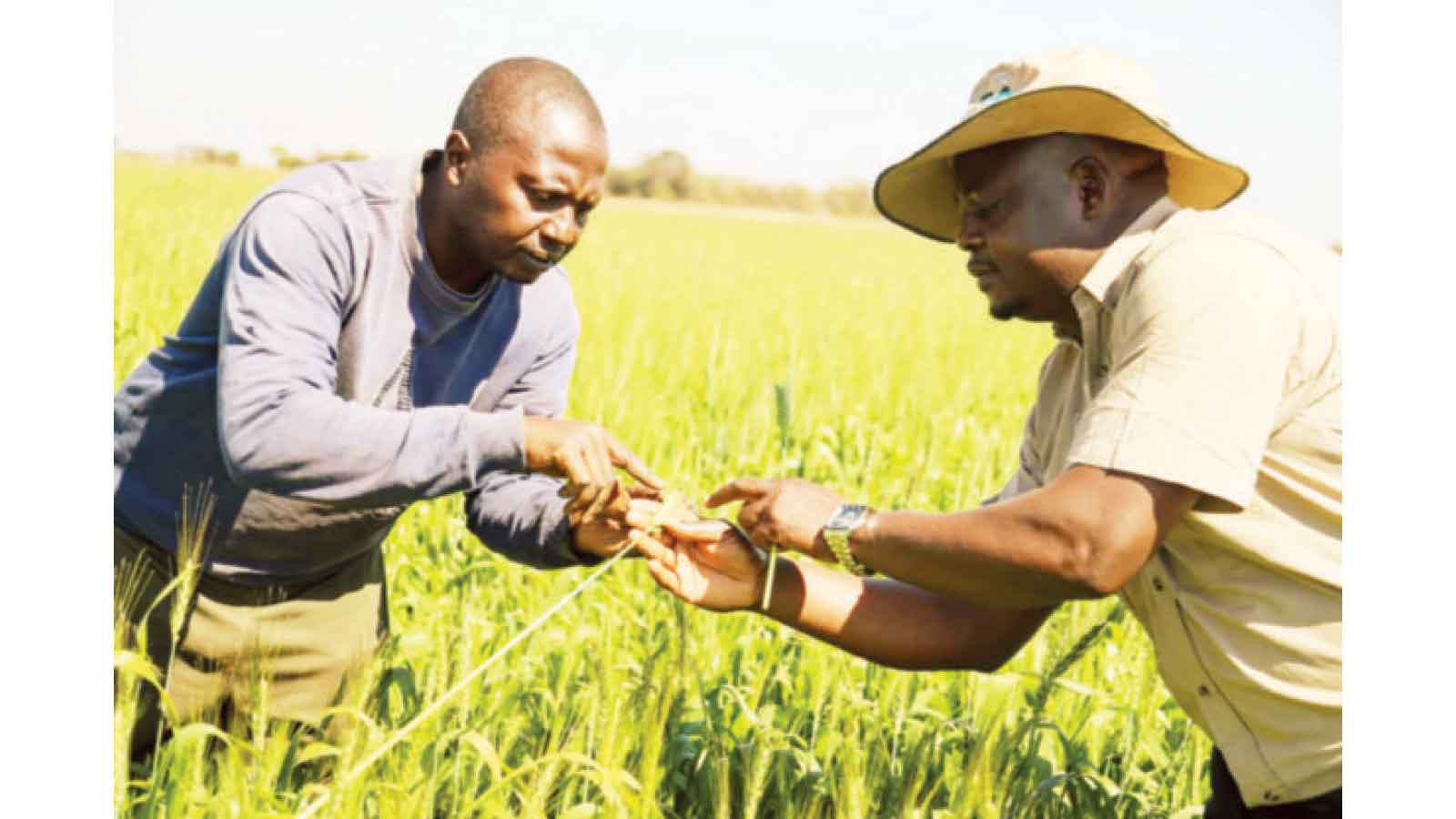
Theseus Mauruki Shambare
THE journey of a loaf of bread does not begin at the bakery.
In Rusape, it begins in the soil.
Rows of wheat stand across Takudzwa Nyabadza’s Granite Flat Farm in Makoni District, their heads heavy with grain as the crop moves towards harvest.
But this is not ordinary wheat.
It is seed wheat — the beginning of another crop, another harvest and, ultimately, another loaf of bread. For Zimbabwe, that distinction is becoming increasingly important.
After years of relying on imported wheat seed, the country has achieved seed self-sufficiency and is now confronting the next challenge — producing wheat grain with the quality demanded by millers and bakers, particularly the hard wheat qualities that have traditionally been imported.
Despite record-breaking domestic grain production, including 639 942 tonnes harvested in 2025, local millers still face a structural deficit in protein and gluten content.
Zimbabwe spent US$124,5 million importing premium hard wheat in 2023 and nearly US$135 million in 2024.
The imported grain is blended with local soft wheat, under a Government-backed ratio of 70 percent local wheat to 30 percent imported wheat, to achieve the baking standards required by the local industry. Now, the ambition is to make that imported component increasingly unnecessary.
At the centre of the effort is ARDA Seeds (Private) Limited, which is targeting production of 16 000 tonnes of certified wheat seed per cycle, surpassing Zimbabwe’s annual requirement of about 14 000 tonnes. But the significance of ARDA Seeds goes beyond its role as a seed producer.
The company is part of Government’s wider effort to transform strategic State assets into commercially driven institutions capable of contributing meaningfully to national development.
In 2023, President Mnangagwa’s administration established the Mutapa Investment Fund to improve the management, performance and value of strategic State institutions.
ARDA Seeds was among the entities transferred into the Fund’s portfolio and now falls under its agricultural cluster alongside other strategic companies, with its work centred on strengthening agricultural value chains, seed development and food security.
Its wheat programme therefore sits at the intersection of two national objectives — building commercially viable State enterprises and reducing Zimbabwe’s dependence on imported agricultural inputs.
The target is ambitious.
ARDA Seeds wants to produce 16 000 tonnes of certified wheat seed per cycle, against a national requirement of about 14 000 tonnes. That would not only secure domestic seed requirements but potentially create a surplus.
For ARDA Seeds board vice chairperson Dr Patience Siwali, the significance of the crop standing in front of her in Rusape goes beyond the farm.
“We are happy to say this is a good crop. It is such a contribution to the start of the bread that is on someone’s table. It is not just bread; it is seed first,” she said.
ARDA Seeds, she said, was supporting contracted farmers with inputs and technical expertise to ensure the production of authentic, high-quality seed.
“ARDA Seeds is committed to supporting the farmers in terms of the chemicals, the fertilisers, agronomic support, to ensure that we get good, authentic seed. And this is what we call good, authentic seed,” she said.
But the company is also preparing for the next challenge — ensuring the crop does not lose quality because of climate shocks.
“We understand the challenges of climate. So we’re going further to support in irrigation, ensuring that the crop never lacks water,” Dr Siwali said.
She said the country’s achievement in seed self-sufficiency was an important milestone in rebuilding its agricultural base.
“For a long time, wheat was imported in Zimbabwe. But I must say, for the last three years we haven’t imported seed,” she said.
“We’re on the route to reclaiming the breadbasket position. And with such a crop as seed, it then goes into the actual production of the wheat in the next stage.”
That next stage is becoming the more difficult one. Zimbabwe is no longer simply asking: Can we grow enough wheat?
It is increasingly asking: Can we grow the right wheat?
Growing the right wheat
One of the varieties at the centre of this effort is Ncema, a hard wheat variety developed by ARDA Seeds.
The medium-maturing spring wheat reaches physical maturity i0n about 125 to 130 days and can yield up to 10 tonnes per hectare under optimum management. Its crude protein content ranges from 13 to 17 percent, while wet gluten content is about 37,6 percent and the falling number is approximately 420 seconds — characteristics suited to industrial baking.
ARDA Seeds general manager for operations, Mr Innocent Musiiwa, said Ncema was specifically developed to address the hard wheat gap.
“We pride this variety for good hard wheat qualities,” he said.
“It has high protein content, which ranges from 13 to 17 percent. It has wet gluten content of about 37,6 percent as well as specific grain density of about 78 hectolitres and high falling numbers of about 420 seconds.”
These characteristics, he said, could help Zimbabwe reduce its reliance on imported hard wheat.
“The milling and processing wheat industry in Zimbabwe has been facing a lot of challenges in terms of accessing hard wheat qualities in Zimbabwe,” Mr Musiiwa said.
“So, there has been a lot of importation and huge cost in terms of processing, which has had a resultant effect on the price of bread in Zimbabwe.”
He said Ncema had been tested by laboratories and the processing industry and had demonstrated the qualities required by processors.
“ARDA Seeds has come up with the variety that is called Ncema, which has been tested by several labs and the processing industry and has proved to provide an answer to the shortage of hard wheat qualities in Zimbabwe,” he said.
“We are actually encouraging farmers to grow with us in terms of getting this hard wheat quality to the processors.”
Breeding for quality
ARDA Seeds is not alone in pursuing that goal. Seed Co has developed and released more than 25 wheat varieties since its breeding programme began, with current commercial varieties including SC Nduna, SC Select, SC Serena, SC W9101 and SC W9104.
Seed Co chief executive Mr Morgan Nzwere said the company’s breeding programme had increasingly responded to the quality specifications demanded by the milling and baking industries.
“Like any other industry, the milling industry specifies quality and baking parameters required by the industry, prompting innovation and demand-driven wheat seed breeding approaches over the past decades,” he said.
Seed Co varieties are being developed around high and stable yields, disease resistance, climate adaptation and milling and baking quality. Mr Nzwere said the company’s current varieties could achieve yields of at least 10 tonnes per hectare under optimum management, while meeting important quality specifications.
“They have excellent milling and baking qualities in terms of grain protein content, wet gluten content, falling numbers and test density,” he said.
The company’s newly released SC W9104, he said, had also demonstrated a particular advantage after milling.
“SC W9104 consistently results in white flour after milling,” Mr Nzwere said.
The development of such varieties reflects a deliberate attempt to close the quality gap that has historically separated local wheat from imported hard wheat.
Mr Nzwere said Seed Co had invested in laboratory equipment, including Near Infra-Red analysers, Perten Falling Number machines and Alveograph machines, while its molecular laboratory supports marker-assisted selection for important quality traits.
“We collaborate with millers and bakers in testing the nutritional quality and baking characteristics during variety development,” he said.
The company also conducts farmer trials and works with Government research stations and independent laboratories before varieties are released.
Breeding for Zimbabwe’s climate
The push for quality wheat is also extending beyond irrigated production, with breeders developing varieties capable of delivering premium grain under Zimbabwe’s increasingly unpredictable weather conditions.
Mr Jairos Masawi, a wheat breeder at the Crop Breeding Institute under the Ministry of Agriculture, Mechanisation and Water Resources Development, described Save as a spring-type, erect-growth variety combining resilience with quality.
“It is white-seeded, early maturing and rust-tolerant, with an average yield potential of 6,4 tonnes per hectare,” Mr Masawi said.
“It flowers in 84 days and reaches maturity in about 134 days. Beyond yield, it is premium quality, with high flour extraction, rich grain protein and gluten content.”
Its ability to perform under different production systems could prove particularly important as Zimbabwe seeks to expand wheat production beyond areas with reliable irrigation.
“Critically, it can be grown under rain-fed conditions, giving farmers flexibility amid erratic rainfall,” Mr Masawi said.
The focus on varieties such as Save, Ncema and SC W9104 reflects a fundamental shift in Zimbabwe’s wheat strategy. The challenge is no longer simply producing enough grain.
It is producing grain that performs like the imported wheat that millers have traditionally depended on. Hard wheat, prized by millers for its high protein and strong gluten, produces dough with better elasticity and higher loaf volumes, making it the preferred choice for bread flour.
For years, the absence of sufficient quantities of such grain has remained one of the final obstacles to complete wheat self-sufficiency.
Developing locally adapted varieties with comparable premium milling qualities could therefore close one of the last major gaps in Zimbabwe’s wheat value chain. At farm level, the benefits of improved varieties are already becoming visible.
Nyabadza, who is growing 40 hectares of Ncema seed wheat under contract with ARDA Seeds, said the variety had performed well on his farm.
“It’s turned out to be a very good variety for us. It grows well. It’s very fast. It’s resistant to a lot of the diseases that you sometimes get with other varieties,” he said.
He said the support received from ARDA went beyond seed.
“We get support with the inputs, we get support with agronomy services — what to do, when and why. And we also get support with the market through the contract,” he said.
Nyabadza believes quality seed has implications all the way down to the village farmer.
“The importance of seed, you know, we cannot stress how important good seed is,” he said.
“If they get it from the Presidential Input Scheme or from the shop, they know they’re getting good seed that is going to give them a good yield.”
Another contracted farmer, Kamusasa Felix Farai, has planted 60 hectares of Ncema and expects to harvest about 480 tonnes at an estimated eight tonnes per hectare.
“We are very happy to work with the people of ARDA Seeds because they are helping us greatly with inputs,” he said.
“They give us fertilisers to apply in the field, chemicals including for weeds, pests and other diseases that affect the wheat crop.”
For Zimbabwe, however, the significance extends beyond individual farmers.
The Government has introduced a levy of US$89,25 per tonne on soft wheat and excess hard wheat imports, both to protect local growers and contribute towards irrigation infrastructure. The strategy is increasingly shifting from protecting local production from imports to building local production capable of replacing the qualities those imports provide.
And that is where Zimbabwe’s wheat story is entering a new chapter.
The first victory was seed self-sufficiency. The next is grain quality.
If varieties such as Ncema, Save and SC W9104 can consistently deliver the protein, gluten, density and baking characteristics required by industry, Zimbabwe could progressively reduce the 30 percent imported component currently used in blending.
That would mean the journey of bread — from seed to field, from field to mill and from mill to bakery — could increasingly take place within Zimbabwe. And for a State-owned enterprise now operating under a commercially focused investment framework, the measure of success will ultimately be more than tonnes of seed produced.
It will be whether that seed strengthens farmers, reduces import dependence, supports processors and contributes to a more resilient domestic food system.
For Dr Siwali, the destination is clear.
“We are so set on being the breadbasket once again,” she said.
“And this is not a dream, it is a reality.”