


 Andrew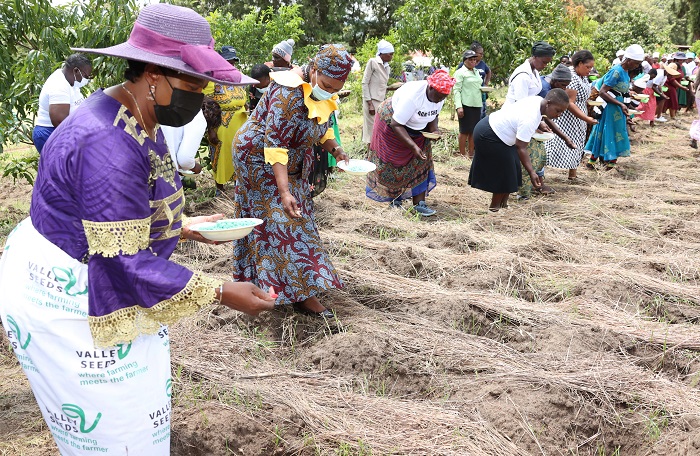
Sunday Mail Reporters
Zimbabwe is on the brink of achieving high nutritional levels and food self-sufficiency, thanks to the Agric4She Programme being spearheaded by its patron, First Lady Dr Auxillia Mnangagwa, countrywide.
Under the programme — which bodes well for the country’s agro-based economy — women are being given free inputs that include maize seeds, vegetable seeds, sunflower seeds, fertilisers and extension services in an unprecedented empowerment initiative that will see them walking tall come harvest time.
They are also receiving chemicals to fight worms; herbicides; and knapsack sprayers.
The women are also being introduced to poultry projects and fish farming, with fish ponds being established, thanks to the hard working Mother of the Nation.
Other schemes under the Agric4She Programme, which was launched in November this year, are Pfumvudza4She, Horticulture4She, Livestock4She, Fisheries4She, Mechanisation4She, Irrigation4She and Veterinary4She. All of them are tailored to make women fully fledged farmers.
Those in agro-ecological regions suitable for cotton are being provided with cotton seed under the initiative.
So popular is the programme that women in all the country’s 10 provinces came out in their thousands as Dr Mnangagwa joined them in ploughing fields before giving them the inputs to kickstart the farming projects.
Amai Mnangagwa has done a lot in a very short space of time for millions of beneficiaries of the programme, showing her dedication and commitment to ensure food self-sufficiency is achieved.
Dr Mnangagwa has taken the Agric4She Programme to all the provinces, where rural and urban communities are being covered.
In provinces she has not personally visited due to other commitments, she has been represented by Deputy Minister of Environment, Climate, Tourism and Hospitality Industry Barbara Rwodzi, Women’s Bank chief executive Mandas Marikanda and Deputy Minister of Women Affairs, Small and Medium Enterprises Development Jennifer Mhlanga.
Herself an avid farmer and hands-on person, the First Lady was appointed Agric4she patron by the Ministry of Lands, Agriculture, Fisheries, Water and Rural Development.
Apart from the farming inputs, the women, through the Angel of Hope Foundation, are also receiving broiler chickens, complete with feed and chemicals.
According to recent census results, women constitute 52 percent of the country’s population, and harnessing this important demographic assures there will be enough food for both urban and rural households since the programme is leaving no one and no place behind, following the launch of the Urban Transformation Programme. The First Lady, who is also the patron for the environment, is encouraging climate-smart agriculture (CSA) – an integrated approach to managing landscapes, cropland, livestock, forests and fisheries that address the interlinked challenges of food security and climate change.
Wherever she goes, Dr Mnangagwa leads communities in planting trees to unlock benefits like fruits, energy, shade and medicinal properties of the plants, which also act as windbreaks and provide vegetation cover. This comes at a time when some people are cutting down trees indiscriminately.
She also makes it a point to advise the beneficiaries in urban areas not to plant on wetlands and to practise good farming methods to curb soil erosion and other environmental challenges.
Right from the start, and in her acceptance speech, Dr Mnangagwa acknowledged that women are hard workers and that doors were opening for them to make meaningful contributions towards the economy.
“Indeed, the doors are opening for women to make meaningful contributions towards society and initiatives such as this should not be taken lightly. I accept the role you have given me.
It is not for being clapped hands for, but madzimai, I have accepted this role because I believe in you and that you are there and you will not embarrass me.
“If it fails, it’s you, but here I have accepted. I know we can do it. We shall work together and show the difference.
Life is a journey, when we stop, things don’t go right. I want us, ladies, to understand that if we stop, we won’t reach our destination. Where I am, where you are, you are a traveller. A journey is a person and a distance has to be covered, it has to be covered by you and it has different paths. It is up to you to select the path you want to follow. Use it as your destiny. The path you shall choose today is your destiny,” she said to applause.
And she lived up to her words by launching an Urban Transformation Programme in Dzivaresekwa, which she also took around the country to uplift the marginalised and less-fortunate through income-generating projects.
During the launch in Dzivaresekwa, she opened a community garden equipped with an irrigation system to allow all-year-round production of crops, and a poultry project.
Fowl runs to house the chickens are in the fenced garden.
Dr Mnangagwa said she felt encouraged by the women who turned up and urged them to work hard.
“Vanamai, here is an opportunity to end gossip and sitting idly. I have come to give you dignity and mould you into respectable hardworking women who shun gossiping. Working together brings about unity, friendliness and the ability to assist each other in times of challenges. Agric4She has brought a lot, let’s embrace the programme. No one should be left behind. My programmes are all-encompassing. I invite the elderly and the newly married. To ladies of the night, I urge you to quit the oldest profession so that you earn clean money. My sons, let us shun drugs like mutoriro and spend time in our plots with our mothers using our hands and staying away from mischief,” she said in Harare.
Addressing gatherings countrywide, Amai Mnangagwa encouraged women to work hard to achieve higher yields.
“Nhasi ndauya kuti tivake hozi or dura raamai (Today, I have come so that we build a mother’s granary). Granaries have always been there and in the past, no one would enter the granary and take produce without a mother’s permission. This is what I have come to build because it bears meaning and brings dignity to women in the home.
“This granary helps in times of challenges; you will get something that helps you and your family. You can also take some of your produce and assist those in need. In homes with adequate food, there is less violence. If a woman gets time to produce for the family, there will be less gossip as you won’t get the time due to commitment.
“I have come so that we take away gossip in women. Women face many challenges as they spend time in the home with the children. She is the one who sees to it that children have eaten, have left for school and are well-dressed.
“We are living in an era of climate change and we ask God to give us great yields. I agreed to be appointed Agric4she patron by the Ministry of Lands, Agriculture, Fisheries, Water and Rural Development because I knew women are hard workers. After harvesting, we will keep some of the produce in the granary, while we take some to the Grain Marketing Board (GMB) and sell part of this so that we get income. Nyika inogarika inoita maguta (If we get good yields, the country will be a better place to live in).
“I have come so that, as women, you are seen working. This will give you a good image as women. How you walk, dress and your manners distinguish you as women.
“I have come to make you complete women. I saw there were grey areas in terms of the elderly, widows, former ladies of the night in urban areas and I saw they were present in urban and peri-urban areas and in need of help.
“I saw it fit to start the Urban Transformation Programme. However, as the environmental patron, I say no to those who plant in wetlands. In towns, there are small fields where you can plant and I implore you to grow crops in permitted areas. I implore you to take your children along to the farm so that they stay away from drugs and substance abuse. Our children are being ruined by drugs. They should learn to work using their hands so that they appreciate that nothing is for free. This lessens the number of children doing drugs. Agric4She is not for maize alone, it encompasses Horticulture4She, Livestock4She, Fisheries4She, Mechanisation4She, Irrigation4She, and Veterinary4She,” she said.
In interactive sessions, Amai Mnangagwa explained what horticulture, livestock, fisheries, mechanisation, irrigation and veterinary mean and what they involve.
“When doing projects of this nature at your homestead, it now requires smartness padzimba dzenyu; smartness on your body because you will be selling things people eat. Business requires friendly people with good customer care. Smiling invites customers. In this Urban Transformation Programme, we encourage a member of one family to work with other community members so that, during the marketing season, the family benefits. When we harvest plenty, we dry some of the produce so that they do not go bad. We say no to those who sell the inputs that I have brought.
“We shall have competitions in all the towns and cities to see the best farmers, so be prepared,” she said.
Principal agricultural extension specialist in the Ministry of Agriculture Ms Chipo Zishiri said the programme would do wonders for the nation because of the First Lady’s hard work and hands-on approach.
“We are grateful for this programme that is being spearheaded by the First Lady as the patron. Truly, women of all demographic groups, from the elderly to widows, youths and others are happy with the First Lady’s programme. Some get to the extent of shedding tears for being remembered by our mother. This had never happened; it is a first of its kind. When the First Lady does something, she does it emphatically. Women constitute 52 percent of the population and what they are doing is in sync with the vision of the National Development Strategy 1 (NDS1), which dwells on food self-sufficiency, food security and nutrition at household level. The First Lady is ensuring that people get the resources they need like inputs for both the rural and urban setup. No one is being left behind,” she said.
Beneficiaries of the programme from all the provinces, urban and rural, expressed gratitude for what the Mother of the Nation had done for them.
Mrs Jane Mutatu (56) could not hide her joy.
“On behalf of many women here, we want to thank our mother, Dr Auxillia Mnangagwa, for the Agric4She Programme she has brought here. We now have something to do and no longer just rely on our spouses for income because, if we produce crops, we would have been weaned off from phrases like ‘marry me and feed me’.
“There are so many things we have benefitted from Amai and we are saying thank you Mhamha for bringing this project and many others you are always bringing. We also want to thank the First Lady because the programme will benefit women who constitute 52 percent of the population. Women were in the periphery of agriculture. The First Lady is encouraging every woman to have a field, have crops and their own vegetable garden. This removes that confusion which hits us in the evening as we ponder on what we will eat with our families. I am happy that, if we manage to farm for ourselves and manage to have our own resources, we will live happily. Thank you so much. Mhamha makatikoshera (Mother, you are very special to us),” she said.
Similar words were echoed by Ms Pretty Moyo.
“On behalf of youths here in the Midlands province, we are thankful for this programme that has been launched by the First Lady today. As youths, we are known for bad things in bars and drug consumption, but Amai has done wonders for us and taught us how to farm, and gave us inputs so that we start farming.
“This is a great day for us, as you will never hear again that there are some of your daughters who are frequenting bars because we will never have time for that. We will now spend time in our fields. We will now be occupied.
“We will show the nation our strength in the field. Amai is empowering us financially through agriculture so that we can improve our livelihoods. Because of the training we received, we are guaranteed of surplus,” she said.
Ms Lesley Muringaniza from Manicaland in Zimunya said: “I recently acquired a piece of land and I did not know where to get the inputs. I would like to thank the First Lady for making it possible. I am looking forward to becoming a master farmer and hosting a field day come harvest season next year,” she said.
In Matabeleland South, a beneficiary from Gwanda, Mrs Mavis Moyo, applauded Amai Mnangagwa for the Agric4She Programme, saying it would go a long way in alleviating poverty among women that were previously sidelined from owning the means of production.
“Intwasa, which Umama taught us, is a noble gesture which we greatly applaud. I am now guaranteed of eliminating hunger in my family and society at large.
“Umama is also empowering us financially so that we can improve our livelihoods. Instead of solely relying on my husband for basic needs, I can now complement him,” she said.
In Masvingo, Mrs Maryline Chinaka, from Mpandawana, said Zimbabwe is an agro-based economy and any intervention that seeks to boost the sector would bring immense benefits to the generality of the people.
“We can’t thank the First Lady enough for her gesture to help women to be self-reliant through agriculture. Women are the pillars of many homes and by empowering them through agriculture, our mother, the First Lady, is empowering the whole nation,” said Mrs Chinaka.
Ms Sinikiwe Ncube from Bulawayo said she was happy that women in urban areas were receiving inputs.
“In the past, we were not considered because it was assumed we lived in urban areas, but we are grateful to our mother, who has taken this stance to ensure that we, too, take part in farming. There is no greater empowerment than this and I encourage women to participate in their numbers,” she said.
The women were taught farming skills by agricultural extension officers in support of Amai Mnangagwa’s vision.
Failure is certainly not an option given that every province, including hard-to-reach areas, have been covered.



 Bongani Ndlovu
 Online Reporter