Online Reporter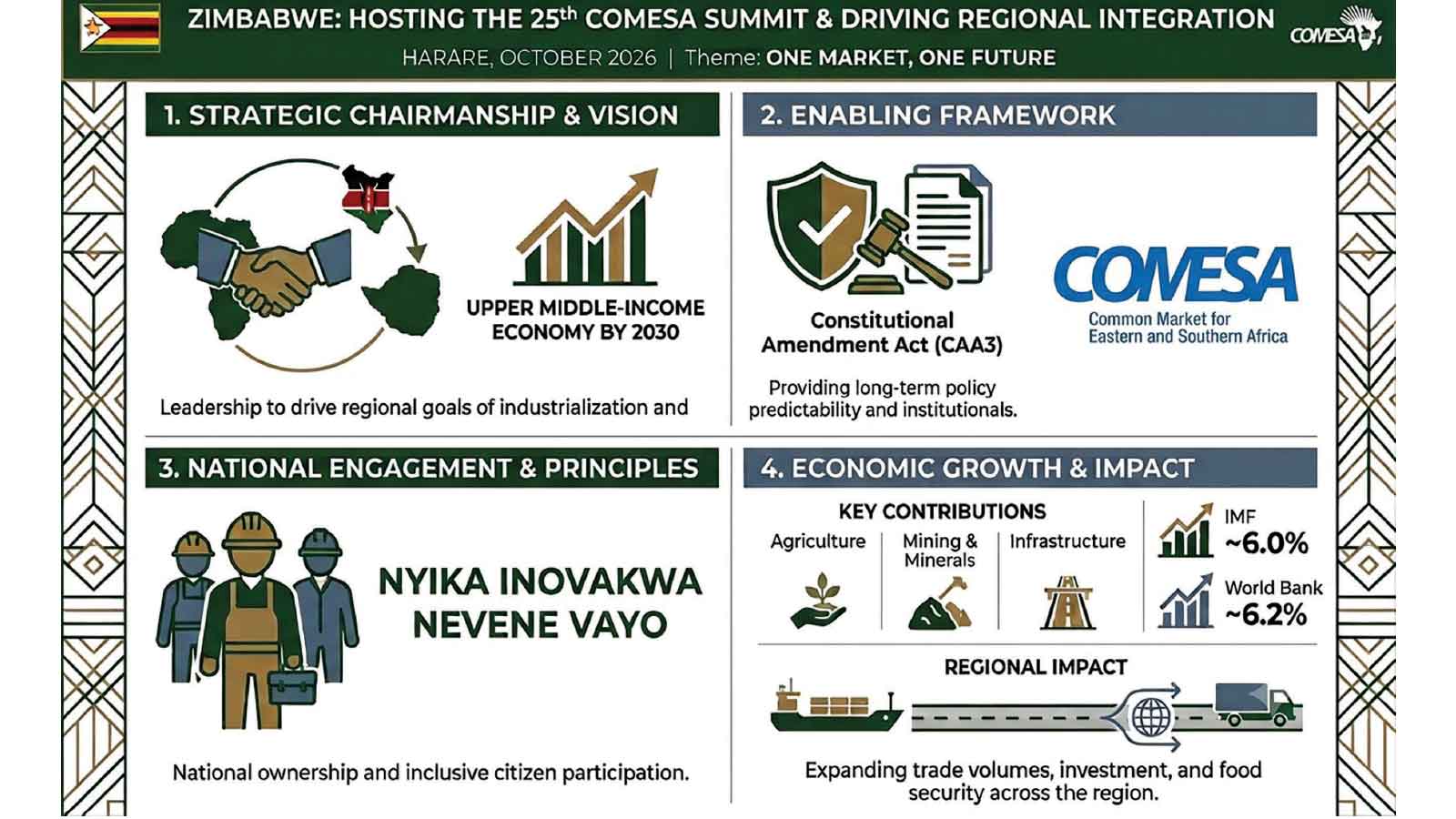
Richard Muponde
Zimpapers Politics Hub
ZIMBABWE’s hosting of the 25th Common Market for Eastern and Southern Africa Heads of State and Government Summit in October 2026 represents far more than a diplomatic calendar event.
It places the country at the centre of one of Africa’s most important regional economic organisations at a time when Zimbabwe is pursuing accelerated infrastructure development, industrialisation, economic reforms and regional cooperation.
As the nation assumes the Comesa chairmanship from Kenya, it has an opportunity to influence the direction of regional integration by presenting practical experiences drawn from its own development agenda.
The Summit’s theme, “One Market, One Future: Advancing Inclusive Industrialisation, Investment and Regional Integration in Comesa,” resonates with Zimbabwe’s national aspiration of attaining an upper middle-income economy by 2030 through industrialisation, value addition and infrastructure development.
The convergence between Zimbabwe’s domestic development philosophy and Comesa’s regional ambitions creates an opportunity for Harare to shape a more integrated regional economic future.
Regional Integration Requires Development-Oriented Leadership
History demonstrates that regional integration succeeds when member states provide practical examples of economic transformation capable of inspiring their neighbours.
Throughout the world, successful regional blocs have often drawn momentum from countries that emerged as engines of growth.
The European Union benefited enormously from the industrial strength of Germany and France, whose economic expansion created supply chains and investment opportunities across Europe.
The Association of Southeast Asian Nations gained remarkable momentum from the industrial rise of Singapore, Malaysia and later Vietnam, whose manufacturing success encouraged deeper regional production networks.
Likewise, the Gulf Cooperation Council has relied heavily on the economic transformation of the United Arab Emirates and Saudi Arabia to drive regional infrastructure development and investment.
These examples demonstrate that regional integration is built not merely on treaties but also on visible economic success capable of encouraging neighbouring countries to cooperate more closely.
Zimbabwe now has the opportunity to play such a catalytic role within Comesa by demonstrating how national development can strengthen regional prosperity rather than compete against it.
CAA3 as a Framework for Regional Stability
The recent enactment of Constitutional Amendment Act No. 3 (CAA3) seeks to provide greater policy continuity and long-term planning within Zimbabwe’s governance framework.
From this perspective, the legislation seeks to create conditions under which long-term national development strategies can be pursued with greater consistency, thereby strengthening policy predictability for investors and development partners.
Advocates argue that the sustained implementation of infrastructure projects, industrialisation programmes and economic reforms benefits from institutional continuity.
Viewed through a regional lens, supporters contend that greater policy stability in one member state can contribute positively to regional integration by enhancing investor confidence, facilitating cross-border infrastructure planning and supporting long-term economic cooperation.
Whether other Comesa member states adopt similar constitutional arrangements remains a sovereign decision for each country.
However, the broader principle of ensuring stable governance capable of sustaining long-term regional development remains consistent with Comesa’s objectives of promoting economic integration, industrialisation and investment.
Nyika Inovakwa neVene Vayo/Ilizwe Lakhiwa Ngabanikazi Balo — as a Regional Development Philosophy
President Mnangagwa’s governing philosophy, Nyika Inovakwa neVene Vayo — Ilizwe Lakhiwa Ngabanikazi Balo — emphasises national ownership of development while encouraging every citizen to contribute towards economic transformation.
Coupled with the principle of leaving no one and no place behind, this approach places inclusive development at the centre of national planning.
Although coined within Zimbabwe’s national context, its underlying principles could stimulate broader discussions within Comesa about citizen participation in regional development.
Economic integration ultimately depends not only on governments, but also on businesses, farmers, manufacturers, researchers, entrepreneurs and communities engaging across borders.
If adapted thoughtfully to the regional level, the philosophy could encourage Comesa citizens to view regional markets not as foreign territories, but as shared opportunities for production, trade and investment.
Infrastructure as the Foundation of Integration
Zimbabwe’s extensive investment in transport infrastructure, border modernisation, airports, power generation, irrigation systems and digital connectivity aligns closely with Comesa’s strategic priorities.
Modern highways linking Zimbabwe with Zambia, Mozambique, Botswana and South Africa improve trade corridors serving multiple Comesa countries. Upgraded border posts reduce transport costs while facilitating the smoother movement of goods.
Infrastructure development does not benefit Zimbabwe alone. Every efficient transport corridor passing through Zimbabwe strengthens regional supply chains extending from Indian Ocean ports into Central and Southern Africa.
Such investments illustrate how national infrastructure can generate regional public goods that enhance continental integration.
Industrialisation Beyond Raw Material Exports
Comesa has consistently encouraged member states to move beyond exporting raw commodities towards manufacturing and value addition.
Zimbabwe’s emphasis on mineral beneficiation, agro-processing, steel production and industrial parks reflects this continental objective. Rather than exporting unprocessed minerals and agricultural products, value addition retains greater economic benefits within Africa while creating employment and expanding manufacturing capacity.
As Comesa promotes regional value chains, Zimbabwe can contribute practical experiences in developing industries capable of supplying intermediate products across neighbouring economies.
This approach complements the African Continental Free Trade Area by encouraging African countries to trade more manufactured goods with one another instead of relying predominantly on overseas markets.
Agriculture, Food Security and Regional Resilience
Zimbabwe possesses extensive agricultural potential capable of contributing significantly to regional food security.
Investments in irrigation, dam construction, mechanisation and climate-smart agriculture have sought to strengthen production resilience against recurring droughts.
Given increasing climate variability across Eastern and Southern Africa, Zimbabwe can champion regional cooperation in seed development, irrigation technologies, grain reserves, livestock disease control and agricultural research.
Food security remains fundamental to sustainable regional integration because economic cooperation cannot flourish where humanitarian crises dominate national priorities.
Financial Integration and Digital Transformation
Comesa has already introduced several mechanisms designed to simplify regional commerce, including the Regional Payment and Settlement System, digital trade platforms and customs harmonisation initiatives.
Zimbabwe’s expanding digital financial ecosystem, together with efforts to modernise payment systems and public services, offers opportunities to support wider regional digital integration.
Digital commerce increasingly determines competitiveness.
Harmonised electronic customs systems, digital certificates of origin, electronic sanitary certifications and interoperable payment platforms reduce transaction costs while making regional markets more accessible, particularly for small and medium-sized enterprises.
Strong Economic Fundamentals and Growth Prospects
International financial institutions have projected continued economic growth for Zimbabwe in 2026, despite acknowledging ongoing macroeconomic and structural challenges.
The International Monetary Fund has projected growth of around 6 percent, while the World Bank has forecast growth of approximately 6.2 percent, placing Zimbabwe among the faster-growing economies in Southern Africa in 2026.
Such growth is expected to be supported by agriculture, mining, infrastructure investment and continued economic reforms.
While growth projections remain subject to factors such as weather conditions, commodity prices and global economic developments, they nonetheless reinforce Zimbabwe’s ambition to position itself as an increasingly significant regional economic player.
Sustained growth enhances Zimbabwe’s credibility when advocating for deeper regional integration because expanding economies generate greater trade volumes, investment opportunities and industrial linkages.
Zimbabwe’s Strategic Contribution to Comesa
Zimbabwe occupies one of Africa’s most strategic geographical positions, connecting Southern, Eastern and Central Africa through major transport corridors.
Beyond geography, the country contributes experienced diplomatic leadership, established educational institutions, skilled human capital, abundant mineral resources, agricultural potential and growing industrial capacity.
Its previous leadership within Sadc provides valuable institutional experience that can strengthen coordination between Comesa, Sadc and the African Continental Free Trade Area.
Greater policy alignment among these regional frameworks would reduce duplication while expanding opportunities for businesses operating across multiple African markets.
The country’s experience in infrastructure financing, public-private partnerships, mining value addition, energy development and regional transport connectivity can also inform broader Comesa strategies.
Towards One Market, One Future
Zimbabwe’s assumption of the Comesa Chairmanship comes at an important moment in Africa’s regional integration agenda.
The continent increasingly recognises that fragmented national markets cannot fully realise Africa’s economic potential.
Larger integrated markets create economies of scale, attract investment, stimulate industrialisation and enhance resilience against global economic shocks.
By hosting the 25th Comesa Summit, Zimbabwe has an opportunity to translate its domestic development experience into regional leadership.
Its emphasis on infrastructure, industrialisation, agriculture, value addition, investment promotion and inclusive development aligns closely with Comesa’s founding objectives.
Whether through strengthening transport corridors, promoting regional value chains, advancing digital commerce, encouraging industrial cooperation or fostering citizen-centred development, Zimbabwe is well placed to contribute meaningfully to the next phase of Comesa’s evolution.
Ultimately, the success of Zimbabwe’s chairmanship will not be measured solely by summit declarations, but by its ability to inspire practical regional cooperation that transforms Comesa from a common market into an integrated community of shared prosperity, where national development strengthens regional unity and regional unity, in turn, accelerates the development aspirations of every member state.