daniel chigunwe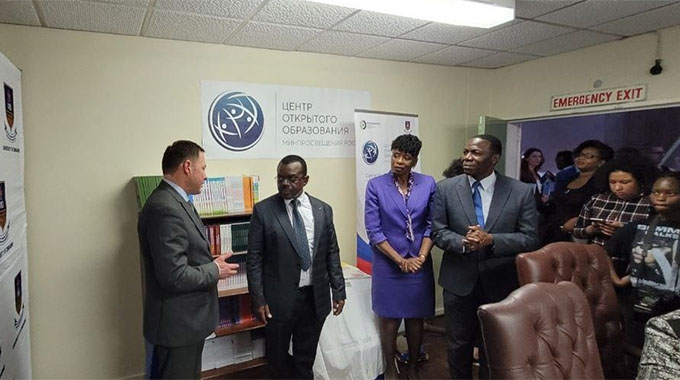
Herald Reporter
Zimbabwe and Russia signed a Memorandum of Understanding (MoU) in higher education, which would see the number of scholarships for Zimbabwean students aspiring to pursue studies in medicine, pharmacy, aircraft, electrical and power engineering, among other trades in the sciences being raised from 65 to 80.
This comes as Zimbabwe and Russia continue to enjoy close bilateral relations across numerous fields.
The deal was signed recently by Higher and Tertiary Education, Innovation, Science and Technology Development Deputy Minister Raymore Machingura and Russia’s Science and Higher Education Deputy Minister Natalia Bocharova in Moscow, Russia.
In a statement yesterday, the Russian Embassy in Harare indicated that the document’s focus was to prepare “highly qualified Zimbabweans at Russian universities.”
There are 487 Zimbabwean students studying at universities in Russia, with 160 of them being funded by the Government of the Russian Federation.
“Due to the close bilateral partnership in various spheres as well as the growing interest among the Zimbabwean youth to study in Russia, it was decided in Moscow to raise the quota for this country from 65 up to 80 scholarships for the next academic year,” reads the statement.
Deputy Minister Bocharova invited the Zimbabwean partners to join the Russian-African Network University (RANU).
RANU was established last August by 12 Russian major universities involved in cooperation with African countries.
The project is intended to promote intercultural dialogue through educational and research activities, and afford academics and students mobility.
The two countries signed another MoU in the area of exploration and use of outer space for peaceful intents, in Moscow on Monday last week.
The deal was inked following deliberations between Deputy Minister Machingura, coordinator of the National Geospatial and Space Agency of Zimbabwe (ZINGSA), Painos Gweme, and Russian deputy director-general of the State Corporation, Roscosmos Oleg Frolov.
The discussion focused on envisaged cooperation between Harare and Moscow on remote sensing of the earth for meteorology and agriculture, satellite navigation, broadcasting and information technologies, as well as personnel education and training.


 Online Reporter