admin
admin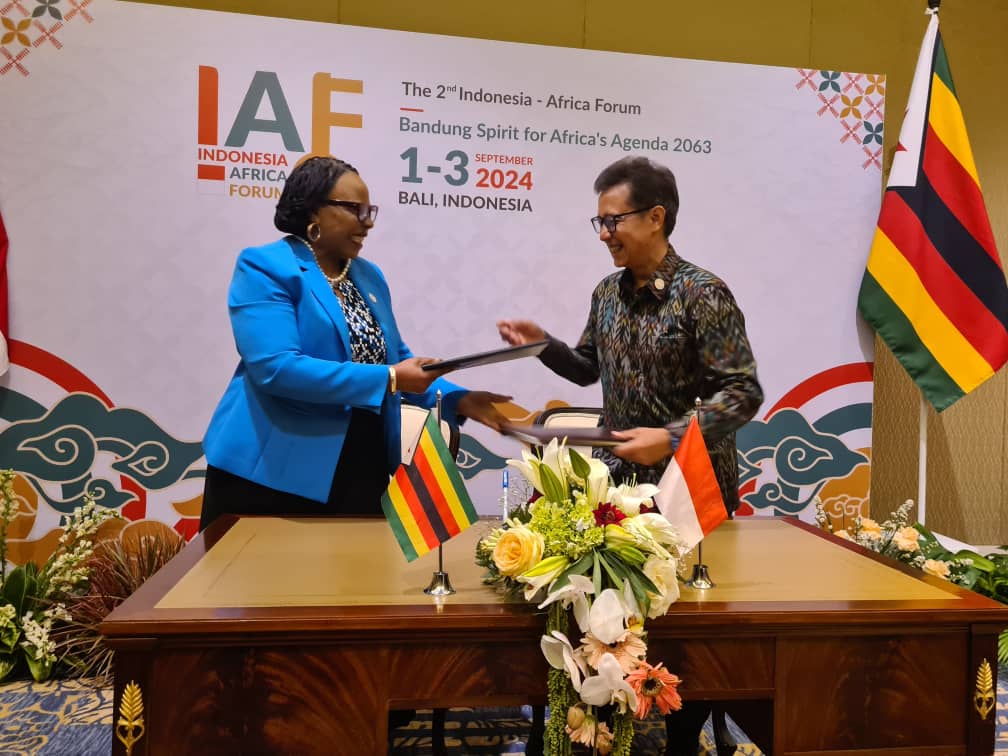
Africa Moyo in BALI, Indonesia
ZIMBABWE continues to attract cash-rich investors, with the country sealing three important memoranda of understanding in the areas of health and fertiliser at the Second Indonesia-Africa Forum and the High-Level Forum on Multi-Stakeholder Partnerships which ended here yesterday.
Vice President Kembo Mohadi, who was representing President Mnangagwa at the conferences, said Government would ensure the speedy implementation of the agreements.
Negotiations for the MoUs had been on for some time, but agreements were reached during the conferences.
VP Mohadi witnessed the signing ceremony yesterday.
The MoU in the field of health was signed between Zimbabwe’s Ministry of Health and Child Care and Indonesia’s Health ministry. Women Affairs, Community, Small and Medium Enterprises Development Minister, Monica Mutsvangwa represented Zimbabwe while Indonesia’s Health Minister, Budi Gunadi Sadikin, signed for his country.
The MoU proposes collaboration in health workforce training and exchange programmes, management of communicable and non-communicable diseases, solidifying co-operation on traditional medicine, collaboration in disease surveillance and co-operation in preparedness and response to health emergencies, which are increasingly becoming a global threat.
The other health-related MoU was signed between the National Pharmaceutical Company of Zimbabwe (NatPharm) and Indonesia’s Bio Farma Group. NatPharm board chairperson Ms Ruth Kaseke represented her organisation while Bio Farma was represented by business development director, Ms Yuliana Indriati.
Co-operation in this field will ensure Zimbabweans have enhanced access to quality and affordable medical products. Some vaccines being used in Zimbabwe are procured by Unicef from Bio Farma, a World Health Organisation pre-qualified company in Indonesia.
Further, the MoU entails the establishment of a pharmaceutical plant in Zimbabwe. Once production outstrips local demand, some of the medicines will be exported into the region.
The other MoU is on technology transfer signed between a Zimbabwean company, Futurefert (Private) Limited and an Indonesian firm, Saputra Global Harvest, which will provide a high-tech plant worth a combined US$3 million that makes five tonnes of coal fertiliser per hour.
At the moment, Futurefert has a plant that makes one tonne of coal fertiliser per hour.
The coal fertiliser, which is said to be good for the soil, is expected on the market ahead of the oncoming summer cropping season after undergoing tests by experts in the Ministry of Lands, Agriculture, Fisheries, Water and Rural Development in the last few years.
Futurefert was represented at the signing ceremony by CEO Mr Hendon Chatambalala while Ms Augustina Panjaitan signed for Saputra Global, with Indonesia’s Ambassador to Zimbabwe Dewa Sastrawan witnessing the ceremony.
In an interview, VP Mohadi said the signing of MoUs “symbolises a lot of things”.
“It is the beginning of many things to come. Like I said, we need to have a Joint Permanent Commission on Co-operation to discuss quite a number of things that involve either side, that is Indonesia and ourselves.
“It is from that JPCC that we are going to discover quite a number of areas that will get us to sign more MoUs and further our co-operation. But this one is quite a beginning; I am very happy that we have signed these two memorandums, which is a positive thing.
“We are going to make sure that they are implemented in earnest. Sometimes you know, we have signed things, then they gather dust somewhere.
“We are going to push that they get implemented. We hope this is not the first and last MoUs that we sign with Indonesia.”
Minister Sadikin said co-operation, especially in the area of health, was critical as Covid-19 killed about 7 million people globally.
“Pandemics don’t recognise what country you are, they don’t recognise borders; they just wipe out all over the world. That is a strong reason we have to work together with Zimbabwe and Africa. We have to stand together,” he said.
Ms Kaseke of NatPharm said the MoU will make more drugs available at affordable prices in Zimbabwe.
“Bio Farma has several subsidiaries and it will supply us with drugs and medicines.
“The medicines should be affordable for the ordinary person. From our point of view, once we have drugs in Harare, we can then distribute them to the last man in Zimbabwe. So, we are convinced that the deal will make drugs available in Zimbabwe.”
Ambassador Sastrawan said he was happy to have overseen the deepening of co-operation between his country and Zimbabwe, but will continue to push for more.


 Online Reporter