Online Reporter
Ranga Mataire
Group Political Editor
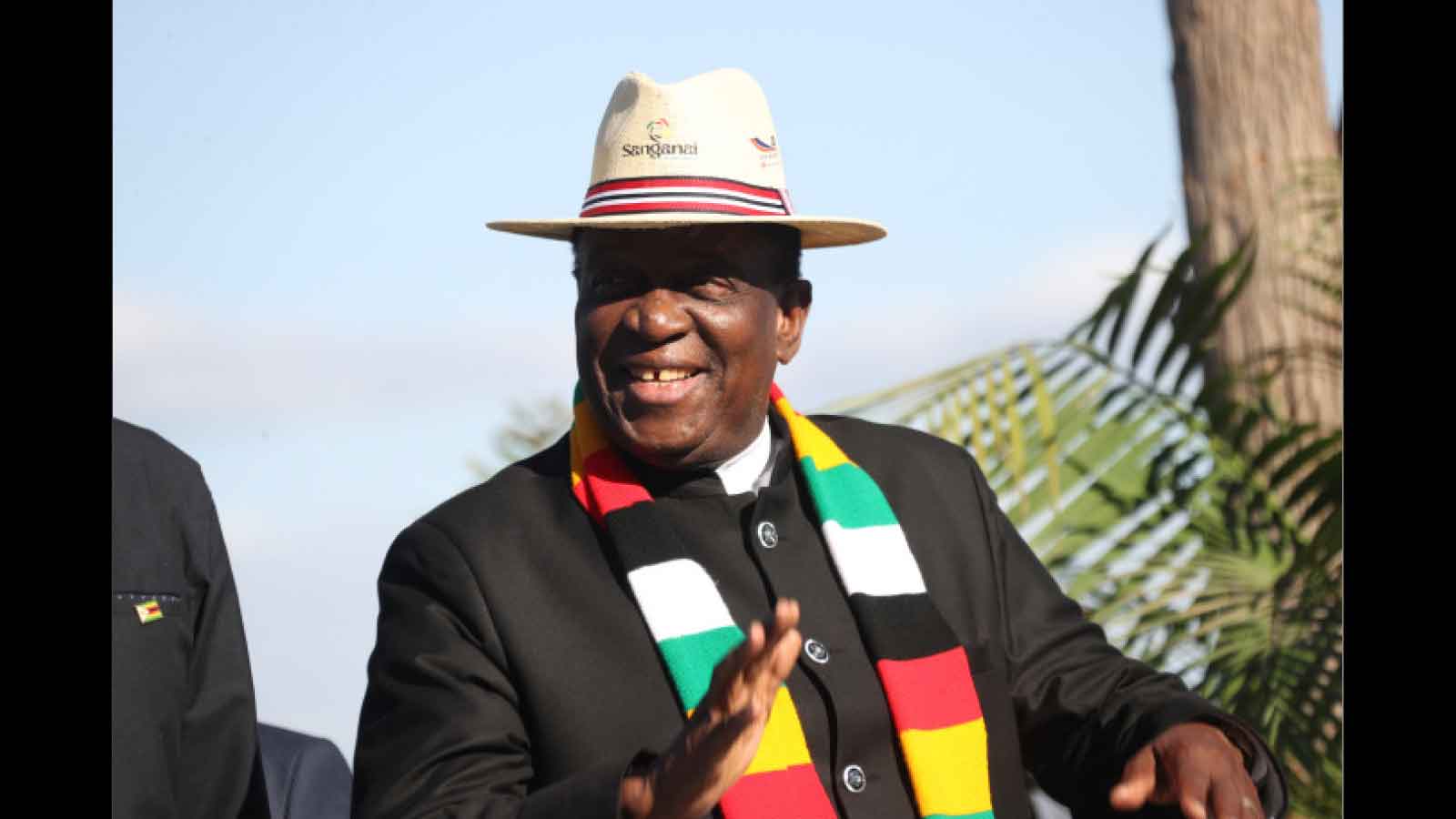
THERE were smiles, handshakes and a gift bag to the host as the United Kingdom Minister for Africa Lord Ray Collins of Highbury met President Mnangagwa at State House on Wednesday.
The visitors included Lord Collins, the UK Ambassador to Zimbabwe, Mr Peter Vowles and the two parties exchanged pleasantries.
Lord Collins emerged from his engagement with the President with a new optimism on the future relations between his country and Zimbabwe.
“We are absolutely committed to building a partnership, a partnership based on equality and respect, but on a simple mission, a mission for economic growth, growth that support both of our people, creating a win-win situation,” said Lord Collins wearing a warm smile.
It sounded more like a plea from a partner conscious of past challenges that had soured “the marriage”, but now conscious of the need to reset relations based on “equality and respect.”
While students of international relations are trained never to take anything at face value, Lord Collins’ call for a “win-win” partnership sounded sincere given the fact his visit coincided with the celebration of his King’s Birthday.
Celebrating the King’s birthday in Zimbabwe holds a historical significance in that it was the young Prince Charles who lowered the Union Jack in 1980 to give rise to a new independent Zimbabwe.
Beyond celebrating the King’s Birthday, Lord Collins’ sincerity in wanting to recalibrate relations between his country and Zimbabwe is derived from the UK’s foreign policy shift and its “New Approach to Africa”.
In pursuance of this new approach, Lord Collins has been to several African countries. His first Africa visit since his appointment as Minister for Africa was to Luanda, Angola where he met President Joao Lourenco.
He has also been to Seychelles, Ghana and Senegal. His message has been the same, the UK Government is seeking a new relationship with Africa based on genuine partnerships rooted in mutual respect and reflecting how Africa, the UK and the world have changed.
For Zimbabwe, Lord Collins’ visit is different. Zimbabwe is the only country in Africa that has been under EU sanctions imposed at the instigation of Britain.
It is the only country in which the current King of England actively and symbolically participated in “bestowing” its independence.
Unlike other African countries visited before, Zimbabwe is different in that like Britain it is also under a new leadership headed by President Mnangagwa, whose foreign policy thrust seeks to re-engage even with erstwhile adversaries.
Credit must also go to the UK Ambassador to Zimbabwe, Mr Vowles, for his relentless efforts in building bridges between the two countries. We may not be privy to the behind the scenes diplomatic engagements, but his public disposition has been well received by both ordinary citizens and state players.
As a man who once lived and worked in Zimbabwe, Ambassador Vowles understands certain nuances of the country’s sensibilities better than any other “greenhorn” to the country.
His use of soft diplomacy through engagements in social activities like the Ambassador Cook Off Challenge, have humanised his personality and his work as the King’s representative.
Further to the Ambassador’s amenable disposition, the recent Zimbabwe Cricket’s Tour of England, which took place after many decades of non-interaction also helped in thawing frosty relations between the two countries.
Again, Ambassador Vowles publicly attended the matches including publicly wearing a shirt bearing flags of Zimbabwe and Britain.
One thing that stands out in the context of Brexit is the shift to enhance new economic cooperation with Africa. This is the main mandate of the UK’s Minister for Africa, which was apparent during his courtesy call on President Mnangagwa.
Britain wants to mend fences and has been doing this since the arrival of the new Ambassador.
Lord Collins himself is an old time activist for Liberation Movements in Southern Africa. It is therefore not surprising that he finds himself well at home in Zimbabwe.
There is huge potential for growth and cooperation in the areas of tourism, an area that Lord Collins is very passionate about.
Education is another area that the two countries could also cooperate. Hopefully, Zimbabwe’s application to be re-admitted into the Commonwealth will get the nod of Britain so that it fully exploits opportunities available for other member countries.
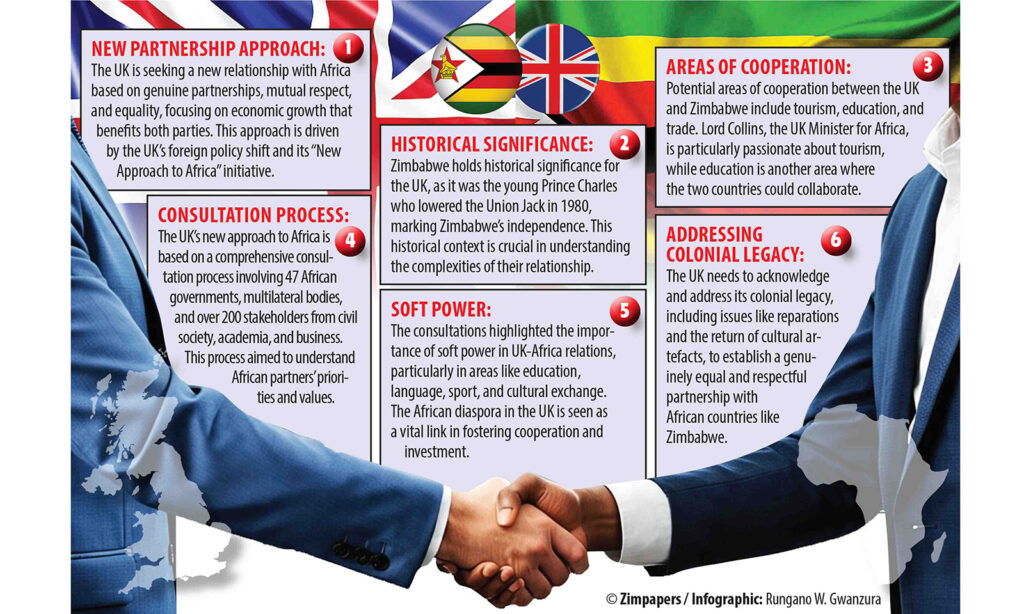
The most endearing aspect of the UK’s new approach to Africa is that it’s a product of wide-consultation. In November 2024, the Foreign Secretary, David Lammy, launched a five-month consultation to get views from the UK’s African partners on the relationship with UK.
In the period from November 2024 to May 2025, 51 UK High Commissions and Embassies conducted in-country consultations, 40 in Africa and 11 in other countries. These included discussions with 47 national governments and 25 multilateral institutions and UN agencies. The in-country consultations were supported by 25 UK ministerial visits.
In all the UK consulted over 90 civil society organisations, academics and experts from over 70 universities and think tanks, British and African businesses including 10 from the creative industries and 35 diaspora organisations in England.
The responses from the consultations have been varied, but underpinned by a common thread. UK’s Foreign, Commonwealth and Development Office says “a common theme across responses was to welcome the UK’s new emphasis on listening, respect and equality as values underpinning our new approach to partnerships.”
The office says the consultations deepened the UK government’s understanding of what African partners value from the UK.
“They want to work with the UK on issues ranging from trade to security to soft power. They want the UK to act in support of priorities set by Africans, such as the African Union’s Agenda 2063.”
It is on soft power that the consultations revealed that the UK needed to exploit its strengths in this area especially with regards to access to UK universities and education, the English language, sport, especially the Premier League.
The African diaspora in the UK is viewed as an underutilised “living bridge” in turning soft power into tangible benefits. Some respondents indicated that dual nationals are responsible for significant remittance flows and are often able and willing to facilitate investment both ways by drawing on their local knowledge and networks to make informed business decisions that boost mutual growth.
Anyone reading the UK’s Foreign Office report would be convinced of Britain’s sincerity in resetting relations with Africa especially in the ever evolving global order.
But unlike other countries seeking similar engagements with Africa in general and Zimbabwe in particular, the UK has a historical colonial legacy baggage that it needs to exorcise.
There is need for the UK to acknowledge its sordid colonial history, recognise and engage on it in the spirit of honest partnership.
The issue of the return of cultural products, artefacts and skulls of Zimbabwe’s early struggle martyrs needs to be addresses.
Similarly, the reparations issue, which is part of the Africa Union’s annual theme must never be brushed aside if the UK is sincere about resetting with Africa a clean and mutually beneficial slate.