Online Reporter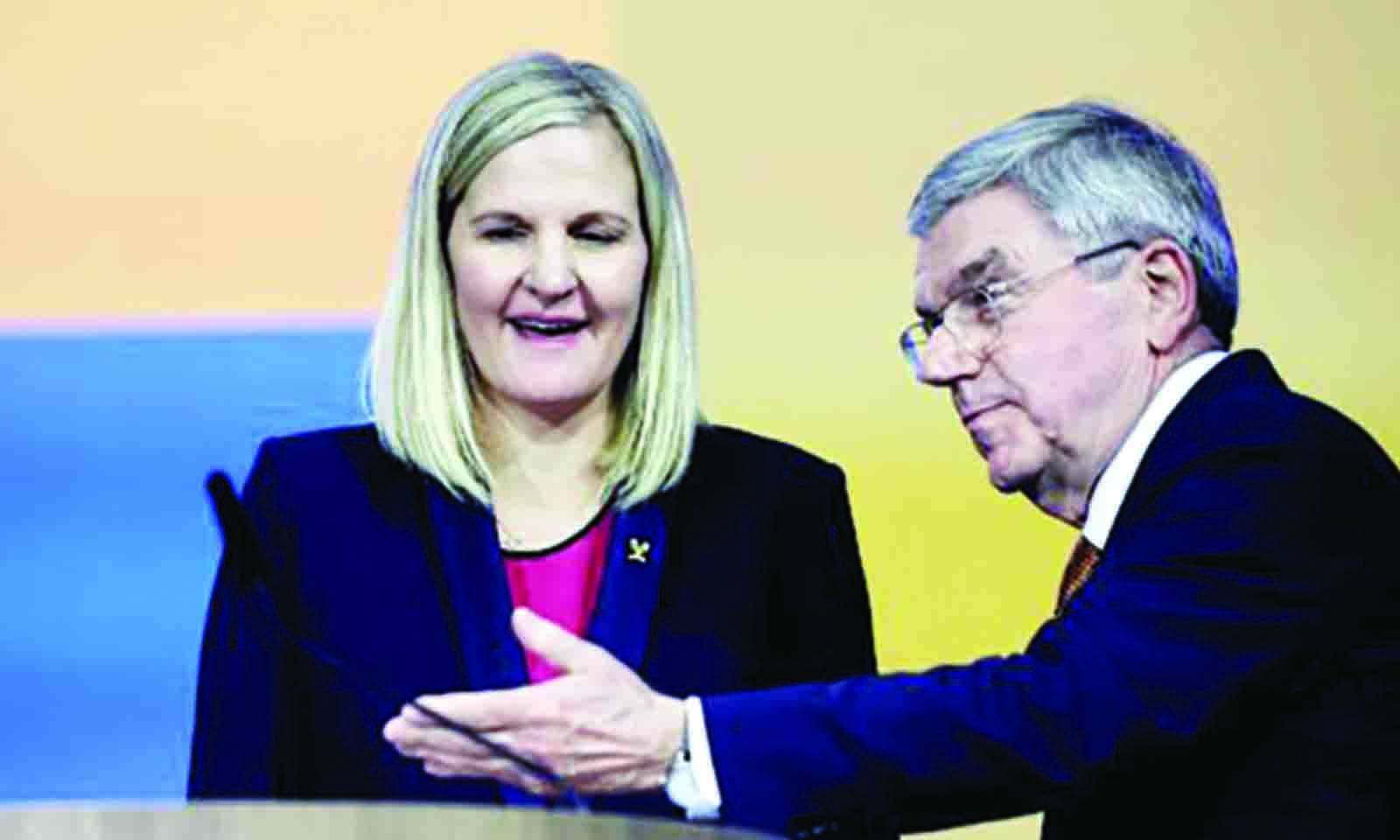
THE International Olympic Committee will mark a historic moment on June 23, as outgoing president Thomas Bach officially passes the baton to his successor Kirsty Coventry during a special handover ceremony at Olympic House in Lausanne, Switzerland.
Bach, who became the ninth IOC president following his election at the 125th IOC Session in Buenos Aires in 2013, will conclude 12 years of service at the helm of the Olympic Movement.
He served a first eight-year term and was re-elected unopposed for a second four-year term in March 2021.
During the 144th IOC Session in Greece in March 2025, he was elected IOC Honorary president for life.
Coventry of Zimbabwe was elected in March 2025, and will become the 10th President of the IOC.
The handover ceremony will be livestreamed on the IOC Media YouTube channel.
Coventry is ready to make history as the first woman and African to lead the International Olympic Committee.
The inauguration ceremony will be a highly symbolic moment for the 131-year-old organisation, which has only ever been led by males, eight Europeans and one American, since its foundation in 1894.
Coventry’s election in March marked a decisive generational shift.
The 41-year-old Zimbabwean Olympian is not only the youngest IOC president in decades, but also one of its most decorated athletes.
A two-time Olympic gold medallist in backstroke and Africa’s most successful Olympian, she competed in five Games and has been involved in global sports governance ever since retiring from competition.
Her rise to the IOC’s highest office comes at a pivotal time, as the Olympic Movement seeks to project a more inclusive and modern image in the face of growing political, environmental and ethical pressures.
“The International Olympic Committee will mark a historic moment on 23 June 2025,” the organisation said in a statement, “as IOC President Thomas Bach officially passes the presidency to President-elect Kirsty Coventry during a special handover ceremony.”
During the same IOC session in March that saw Coventry elected with a commanding 49 votes in the first round, defeating six other candidates, Bach was named Honorary president for life.
As the Olympic Games prepare to enter a new era, the IOC will do so under the leadership of someone with experience in both elite sport and African governance, and who is determined to make waves far beyond the pool.
Born in 1983, Coventry was introduced to swimming by her mother and grandfather and joined her first club at the age of six. Without access to indoor pools, she trained outdoors year-round and played field hockey and tennis during the winter months.
This early versatility, combined with a fierce competitive streak, carried her all the way to the Olympic stage.
She first competed in Sydney in 2000, but it was in Athens four years later that she became a household name, winning three medals and securing Zimbabwe’s first individual Olympic gold. She followed this with four more medals in Beijing, thus cementing her place in sporting history.
However, Coventry’s most enduring legacy may lie outside the pool.
Since joining the IOC in 2013, she has chaired the Athletes’ Commission, sat on the Executive Board and led reforms aimed at improving athlete representation and safeguarding.
She has also worked to increase sporting opportunities in the country by founding the Kirsty Coventry Academy, which teaches children to swim, and by co-developing the “HEROES” programme, an initiative focused on ensuring the safety of Zimbabwean young people taking part in sport. In 2018, she entered government as Zimbabwe’s Minister of Youth, Sport, Arts and Recreation, tackling issues including sexual abuse in sport and match-fixing. Coventry’s election has been welcomed as a watershed moment for the IOC, who have faced criticism in recent years over their lack of gender diversity and slow pace of reform.
Many observers see her arrival with both elite sporting experience and a background in policy-making as a significant advantage.
She also represents a geographical and cultural departure from IOC tradition.
For the first time, her leadership will bring an African perspective to the role, something that advocates of global sporting equity have long demanded.
Although Coventry has offered few specifics about her presidential priorities so far, her track record suggests a focus on youth development, athlete protection and improving grassroots access to sport, particularly in under-represented regions.
For now, she is preparing to take on one of the most powerful roles in international sport.
For millions of young athletes in the Global South, her rise offers more than just a change of face at the top, it shows that the Olympic Movement is slowly catching up with the world it claims to represent.
Meanwhile, Nawal El Moutawakel, an African pioneer both on the track and in Olympic offices, revealed in an interview yesterday her enthusiasm for the transformation of the International Olympic Committee and the election of Coventry as leader of the organisation.
“It’s a dream come true,” she said.
In the exclusive with Mundo Deportivo last week, IOC vice-president El Moutawakel, herself a trailblazing icon for women in sport, reflected on this historic turning point and its global significance.
For the former Moroccan athlete, who shattered barriers by claiming gold in the 400m hurdles at the Los Angeles Games in 1984, becoming the first African woman and the first from an Islamic country to do so, Coventry’s rise represents the climax of a struggle that began more than two decades ago.
“I saw up close how hard it was for a woman to even dream of leading this institution. In 2001, when Anita DeFrantz ran, we simply weren’t ready. It was too soon. But that attempt planted the seed,” she confessed.
The 61-year-old El Moutawakel hasn’t forgotten the whirlwind of her own Olympic moment. That gold medal was not just a sporting triumph, but a cultural shockwave. “I was the only woman in my country’s entire delegation.
“I kept asking myself: where are the female coaches, doctors, journalists? There weren’t any. That’s when I realised I had a role to play in changing that,” she explained.
A member of the IOC since 1998, she has served under four presidents, Juan Antonio Samaranch snr, Jacques Rogge, Bach, and now Coventry, and witnessed what she calls a “miraculous” evolution from within.
“When I joined, there were so few women. Today, nearly 45 percent of IOC members are women. That’s an extraordinary change, the result of relentless work by many, like DeFrantz, who never tired of raising their voices,” she noted. El Moutawakel especially points to her leadership roles, such as chair of the evaluation commission for London 2012 and the coordination commission for Rio 2016, as historic breakthroughs, being the first woman to hold such posts.
Speaking on Coventry, she said, “She’s got the experience, the courage, and the foresight to tackle today’s Olympic challenges. She can truly raise the bar.”
There are several challenges ahead: doping, illegal betting, geopolitical tensions, and the upcoming Winter Games in Milano-Cortina 2026 will all pose significant tests.
Also approaching is the Youth Olympic Games, set to take place in Dakar, Senegal, in 2026, the first time the event will be held in Africa, an initiative the Casablanca native describes as “a dream shared by an entire continent.” Dakar’s selection, in her view, stands as one of the most significant legacies of outgoing IOC chief Bach.
“He always wanted Africa to be woven into the Olympic fabric. We can’t move forward while side-lining a continent with such vast potential,” she argues.
But this, she stresses, is just the beginning. Africa, she insists, is “ready” to host a full Olympic Games in the future.
“Dakar 2026 will be the test. And I’m confident it will shine,” she added. — Insidegames.com