Online Reporter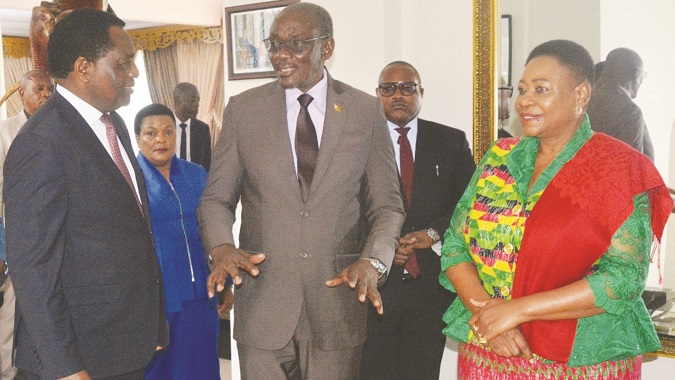
Africa Moyo in LUSAKA, Zambia
ZIMBABWE and Zambia are “truly one country” and that togetherness, which has been cultivated over several years, must be maintained by leaders and citizens of the two neighbourly nations going forward, President Hakainde Hichilema has said.
He further reiterated Zambia’s support for the lifting of all sanctions imposed on Zimbabwe by the West and called on the two countries to do more to manage their common assets such as Kariba Dam and develop critical infrastructure for the benefit of citizens.
Speaking during Vice President Kembo Mohadi’s courtesy call on him at State House here yesterday, President Hichilema said the two countries should find a way of sending a message to young people that Zimbabwe and Zambia are one country.
“Vice President Mohadi, I want to reiterate what you have said and what the Minister of Foreign Affairs (and International Cooperation Mulambo Haimbe) has said that Zambia and Zimbabwe are truly, truly one,” said President Hichilema.
“Those that led our two countries before us have carried on that tradition, that recognition, not just bonded by history, colonial heritage, but truly, having been one country at some point, the Federation of Southern Rhodesia, Northern Rhodesia and Nyasaland.
“But before that, our people have always been one. If you look at the trading routes for us in Siavonga, around Chirundu, the route was cutting through across the river into Zimbabwe. It’s a route that is well known in history. It’s a route walked on for centuries.
“So, we are truly one and we share a lot in common, in addition to people, even bloodlines, and education. You have just mentioned of the Zimbabwean students studying in Zambia, but there is a number of Zambians studying in Zimbabwe.”
President Hichilema added that before Zimbabwe’s independence, the University of Zambia enrolled many Zimbabweans including President Mnangagwa.
“President Mugabe was also a lecturer at Chalimbana College for many years, somewhere close to where you (VP Mohadi) lived in Chongwe.
“(The late VP) Joshua Nkomo lived around there. So, the story goes on, but for the younger Zimbabweans, younger Zambians, these two countries are like Siamese twins, and we ought to manage them like that.
“The two countries are inseparable. Where I grew up, we called the two countries by one name, Zim-Zam,” he said.
President Hichilema then joked that at one point after his election, he found himself among President Mnangagwa, the late Namibian President Hage Geingob, former Botswana President Mokgweetsi Masisi, and he said, “there is one anomaly here, only President Masisi didn’t learn at the University of Zambia”.
He added that even Namibian President Nandi Netumbo-Ndaitwah once lived in Zambia, underscoring the interconnectedness of the people of Southern Africa.
VP Mohadi made his presentation first, conveying his condolences to President Hichilema and Zambians following the death of former President Dr Edgar Chagwa Lungu on June 5.
He then praised the strong bond between Zimbabwe and Zambia cemented by blood, which saw Lusaka suspending its independence celebrations in 1964, to help Harare’s fight against the racist Ian Smith regime that had colonised the country.
Zimbabwe has since constructed mass graves in many parts of Zambia including Nampundwe, Mkushi, Mulungushi, Freedom Camp/ Chikuti and Kavalamanja, some of which VP Mohadi has come to assess their state and find ways of keeping them in good shape.
Turning to economic relations, VP Mohadi called on Zimbabwe and Zambia elevate their bilateral relations from a Joint Permanent Commission on Cooperation (JPCC) to Bi-National Commission (BNC).
A JPCC is an older framework for bilateral cooperation between two countries, while a BNC is a more advanced, higher-level structure that often transforms or replaces a JPCC, involving direct collaboration at the Heads of State and/or Government level and comprising more specialised committees for various sectors.
Said VP Mohadi: “I commend the strides made over the years in terms of cooperation and express optimism that the proposed elevation of the Joint Permanent Commission to a Bi-National Commission will inject impetus into the implementation of our programmes.”
He also spoke about the strategic importance of Africa’s Agenda 2063 and the African Continental Free Trade Area, adding that local production and regional collaboration will be key to building resilient economies.
The VP said he appreciates Zambia’s unwavering support in the call for the removal of illegal sanctions.
VP Mohadi also called on the two nations to continuously nurture the spirit of Pan-Africanism and regional cooperation, working together to build a brighter future for the people.
Turning to the death of President Lungu, President Hichilema expressed gratitude for the messages of condolence from Zimbabwe.
“When he passed on, shortly afterwards, my elder brother, President Mnangagwa, sent Vice President Chiwenga to deliver his message of condolence. Please pass on our appreciation to President Mnangagwa for consoling us.
“We are hoping that, as you know, we have some impasse going on around our sixth President.
“We have a tradition here, a legal one as well, established by the people of Zambia through different pieces of legislation, and also practice, that all Presidents, whether we like it or not, those of us who sit in this chair, get buried at the Embassy Park (in central Lusaka).”
The courtesy call was also attended by Deputy Chief Secretary to the President and Cabinet responsible for Social Services Reverend Paul Damasane, Deputy Minister of Information, Publicity and Broadcasting Services Dr Ompile Marupi, Deputy Home Affairs and Cultural Heritage Minister Chido Sanyatwe, Zimbabwe’s Ambassador to Zambia Charity Charamba, Institute of African Knowledge chief executive officer Ambassador Kwame Muzawazi and other senior Government officials.


 Online Reporter