Oliver Kazunga, Senior Reporter
ZIMBABWE has assumed the chairmanship of the Common Market for Eastern and Southern Africa (COMESA) Council of Ministers of Foreign Affairs, with Foreign Affairs and International
Trade Minister Professor Amon Murwira calling on African countries to prioritise peace, economic development and home-grown solutions to the continent’s challenges.
The chairmanship places Zimbabwe at the centre of regional efforts to strengthen peace and security, deepen economic integration and accelerate poverty eradication across member States.
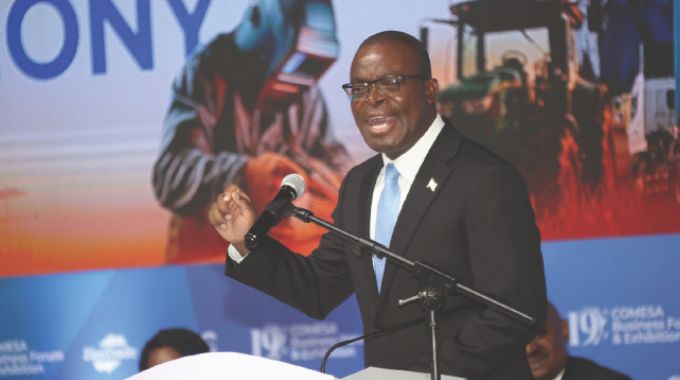
Addressing the opening session of the 21st Meeting of COMESA Ministers of Foreign Affairs in Mt
Hampden yesterday, Prof Murwira urged African countries to resist being drawn into geopolitical rivalries and focus instead on addressing their people’s development needs.
He warned that conflicts and insecurity continued to undermine regional integration, disrupt economic activity and deepen poverty.
“We are Africa. And as Africa, we should resist being part of geopolitical contestations,” he said.
“We have a continent to manage. We have our people to feed. We have our people to keep. We have our people to give respect to.
“We neither look east, nor look west, nor look south, nor look north. We look at ourselves and we must help ourselves.”
Prof Murwira said sustainable development depended on peace and security, urging African countries to strengthen their capacity to resolve conflicts through dialogue, preventive diplomacy and cooperation among regional institutions.
He said COMESA’s integration agenda should ultimately improve livelihoods, with poverty
eradication remaining the bloc’s central objective.
“COMESA is a strategy to eradicate poverty. Poverty is our enemy and prosperity is our objective,” said Prof Murwira.
He said armed conflicts were destroying infrastructure, disrupting trade, discouraging investment,
displacing communities and weakening productive capacity, creating a cycle in which insecurity fuels poverty while poverty deepens instability.
“Peace and security are the bedrock for sustainable development, economic integration and shared prosperity,” he said.
Prof Murwira called for greater investment in early-warning and early-response systems, mediation and preventive diplomacy to address the underlying political, social and economic causes of conflict before they escalate.
He also questioned the continued flow of weapons into conflict-affected areas, arguing that Africa needed resources and equipment for production rather than destruction.
“We don’t need guns, but ploughs,” he said.
Prof Murwira challenged African leaders to confront the sources of weapons fuelling conflicts and establish who was supplying and supporting the fighting.
He urged parties involved in conflicts to cease hostilities, protect civilians, embrace dialogue and allow unhindered humanitarian access to affected communities.
“We already fought our wars of liberation. That was it. That must be the end. Now it’s time for peace, not to turn against each other,” he said.
Prof Murwira said regional integration should extend beyond expanding markets, facilitating trade and attracting investment to deliver tangible improvements in people’s living standards, particularly for young people.
He called for a continent where people could work, trade, invest and reside freely across national borders, with boundaries serving administrative purposes rather than obstructing economic activity.
“Let our borders be administrative, not trade borders. One market, one future,” he said.
Turning to COMESA member States, Prof Murwira said they needed to deepen intra-African trade, strengthen regional value chains, improve infrastructure connectivity and expand energy cooperation and food security to reduce vulnerability to external economic shocks.
He said no country could adequately protect itself from global disruptions by acting alone, making collective regional responses increasingly important.
Prof Murwira also warned that Africa’s security environment was becoming more complex, with terrorism, violent extremism, organised crime, human and drug trafficking, cyber threats, illicit financial flows and climate-related insecurity increasingly crossing national borders.
He called for stronger intelligence and information-sharing mechanisms, improved border management and measures to address socio-economic vulnerabilities, particularly among young people.
The Minister said peace initiatives must be directly linked to economic development so that citizens experience tangible benefits through improved livelihoods and greater opportunities.
“Peace must ultimately deliver tangible dividends to our people.
“Our citizens must experience peace not only as the absence of conflict but as a driver for prosperity,” he said.
He called for closer cooperation between COMESA, the African Union, regional economic communities and other partners to resolve conflicts and strengthen Africa’s collective response to insecurity.
Invoking the legacy of African liberation leaders and founding fathers, including Julius Nyerere, Kwame Nkrumah and Kenneth Kaunda, Prof Murwira urged current leaders to pursue their vision of a more integrated and prosperous continent.
“Let’s manage our anger. Let’s manage our emotions.
“Let’s give in to the demands of our people for peace and let’s lead from that perspective,” he said.
COMESA Secretary-General Ms Chileshe Mpundu Kapwepwe said the meeting came at a critical time, as the region faced an increasingly complex security environment characterised by armed conflicts, political instability, electoral contestations, piracy, climate-related insecurity, irregular migration and economic shocks.
She said Article 3(d) of the COMESA Treaty recognised peace and security as fundamental prerequisites for sustainable regional integration and economic development.
Ms Kapwepwe said the meeting provided an opportunity for ministers to assess the evolving security situation, review progress and agree on practical measures to prevent and manage conflicts.
She warned that the regional security situation remained volatile, with progress in some areas accompanied by renewed violence and unresolved political and security challenges elsewhere.
In eastern Democratic Republic of Congo, persistent armed conflict and its humanitarian consequences continued to affect regional stability, population movements and cross-border economic activity.
She also highlighted the need to consolidate peace in Ethiopia, address political transition and security challenges in Somalia, and resolve persistent political fragmentation and insecurity in Libya.
The conflict in Sudan remained one of the region’s most devastating challenges, with large-scale displacement and humanitarian consequences extending beyond its borders. “Conflicts within our region rarely remain confined within national borders,” Ms Kapwepwe said.
She said COMESA should complement the efforts of member States, the African Union, other regional economic communities and international partners while promoting African ownership of solutions to the continent’s challenges.
Ms Kapwepwe said emerging security threats required a broader response that considered economic shocks, climate change, food and energy insecurity, organised crime, terrorism, cyber threats and geopolitical competition.
She warned that the United States-Israel war against Iran, although outside the bloc’s immediate geographical area, had demonstrated how global developments could affect regional economies through higher fuel and fertiliser prices, increased freight costs, insurance premiums and exchange-rate pressures.
She urged member States to diversify energy sources, reduce excessive dependence on single sources of critical imports, expand intra-COMESA trade and improve transport and logistics corridors.
At the close of the meeting, incoming vice-chairperson of the COMESA Council of Ministers of Foreign Affairs and Zambia’s Minister of Foreign Affairs and International Cooperation, Mr Mulambo Haimbe, thanked Zimbabwe for hosting the gathering and extending hospitality to visiting delegations.
He also thanked President Mnangagwa, whom he identified as the incoming chairperson of the COMESA Authority, and Prof Murwira for their leadership during the meeting.
Mr Haimbe said the deliberations had demonstrated the importance of unity, mutual trust and decisive action in addressing regional challenges. He said peace and regional integration reinforced each other, adding that citizens’ aspirations for prosperity, dignity and improved livelihoods could not be fully realised amid conflict and instability.
“As COMESA, we must therefore continue to strengthen our collective capacity to prevent and resolve conflicts, promote democratic governance, support peaceful political transitions, and address the underlying drivers of instability,” he said.
Mr Haimbe said terrorism, violent extremism, irregular migration, climate-related security risks and economic shocks could not be effectively addressed by individual member States acting in isolation.
He called for stronger regional cooperation, enhanced information-sharing, preventive diplomacy and timely, coordinated responses.
Mr Haimbe reaffirmed Zambia’s commitment to a peaceful, stable, prosperous and integrated COMESA region, saying the bloc should remain an effective platform for consultation, solidarity and collective action.
The 21st Meeting of COMESA Ministers of Foreign Affairs brought together ministers and representatives from member States to deliberate on regional peace and security, democratic governance, conflict prevention and the bloc’s broader economic integration agenda.