

 Online Reporter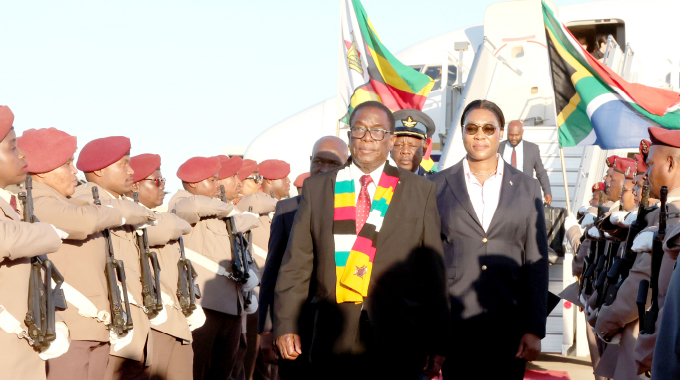
Kudakwashe Mugari in DURBAN, South Africa
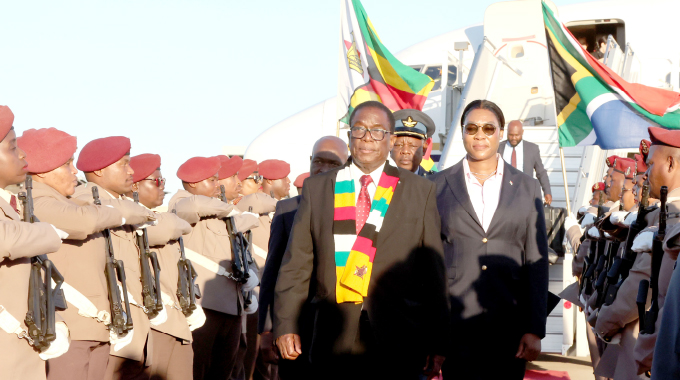
PRESIDENT Mnangagwa arrived in Durban, South Africa, yesterday ahead of today’s 46th Ordinary Summit of SADC Heads of State and Government, with Zimbabwe set to push for deeper regional integration, food self-sufficiency and industrialisation.
The summit, being held at the International Convention Centre, comes as the regional bloc marks 34 years since the transformation of the Southern African Development Coordination Conference (SADCC) into SADC on August 17, 1992, in Windhoek, Namibia.
The gathering is being held under the theme: “Resilient, Sustainable and Inclusive Industrialisation through Infrastructure Development, Agricultural and Critical Minerals Transformation in Pursuit of a Just World.”
Posting on his official X handle after arriving in Durban, President Mnangagwa said Zimbabwe remained committed to strengthening regional integration and unlocking the potential of SADC’s infrastructure, agriculture and mineral resources.
“I have safely arrived in Durban, South Africa, to participate in the 46th Ordinary Summit of Southern African Development Community (SADC) Heads of State and Government. . . . Zimbabwe remains deeply committed to driving regional integration,” he said.
“We look forward to fruitful deliberations that unlock the full potential of our shared infrastructure, agriculture and vast mineral wealth. Together, we are building a stronger, self-sustaining SADC ecosystem that leaves no one and no place behind.”
South African President Cyril Ramaphosa is expected to officially assume the SADC chairmanship today, after South Africa held the position on an interim basis following political disturbances in Madagascar.
As the supreme policy-making body of SADC, the Heads of State and Government Summit provides strategic direction and determines priorities for regional co-operation and development.
President Mnangagwa was accompanied by Chief Secretary to the President and Cabinet Dr Martin Rushwaya, Deputy Chief Secretary (Presidential Communications) Mr George Charamba, and Attorney-General Ms Virginia Mabhiza.
The President also attended a dinner hosted by President Ramaphosa last night.
Ahead of the summit, Foreign Affairs and International Trade Minister Professor Amon Murwira said Zimbabwe would advocate for a co-ordinated regional approach to food production, with SADC countries encouraged to specialise in commodities where they have a comparative advantage.
He said regional food self-sufficiency would require member states to complement one another rather than attempt to produce every commodity individually.
“For example, there are countries like Malawi, Tanzania and Madagascar which are very good at rice. We could have a rice programme. There are countries like Zimbabwe which are very good at winter wheat. We could be focusing on this for food self-sufficiency,” he said.
Prof Murwira said SADC should also reduce tariff and non-tariff barriers to facilitate the movement of agricultural products and other goods across borders.
“We want to bring down trade barriers, both tariff and non-tariff trade barriers amongst ourselves,” he said.
He called for the establishment of common agricultural programmes, transboundary special economic zones and regional industrial projects as part of the implementation of SADC Vision 2050.
“It’s now time for implementation. Enough talk of policies, the policies are there,” he said.
The food self-sufficiency agenda forms part of four key areas Zimbabwe is advocating within SADC: peace and security, industrialisation, infrastructure development, and social and human capital development.
Prof Murwira said agriculture should be viewed as a cornerstone of regional industrialisation as it provides raw materials for processing industries while reducing dependence on imports.
“Joint industrialisation is part of the integration agenda of SADC that we want, a common future, where industrialisation is there to provide the basic human needs that we need,” he said.
He said Zimbabwe’s growth in wheat production demonstrated the potential for SADC member states to leverage their respective strengths and collectively enhance regional food security.
Prof Murwira said deeper integration should ultimately make the movement of people and goods across the region more seamless.
“We want to move away even from one-stop border post to non-stop border post. That’s integration,” he said.
He said the success of SADC should ultimately be measured by improvements in the lives of ordinary citizens.
“SADC is now to go to the people. It has to be felt on the ground,” said Prof Murwira.
The summit is expected to deliberate on measures to accelerate regional industrialisation, infrastructure development, agricultural transformation and the beneficiation of critical minerals, while strengthening co-operation among member states.



Reading this makes one hopeful.No talks about liberation solidarity ,just plain economics.This is as it should be as it will ultimately lead to :good governance