Online Reporter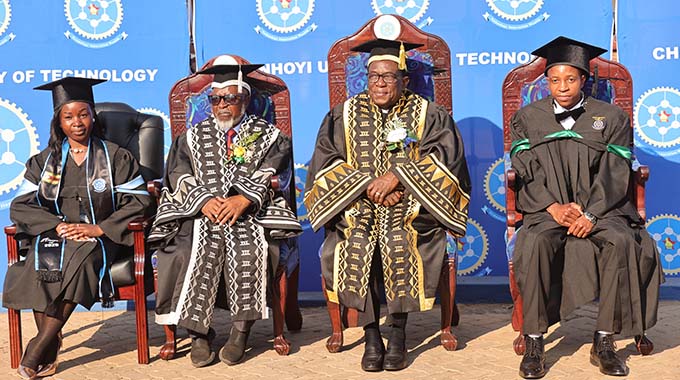
Walter Nyamukondiwa, Mashonaland West Bureau Chief
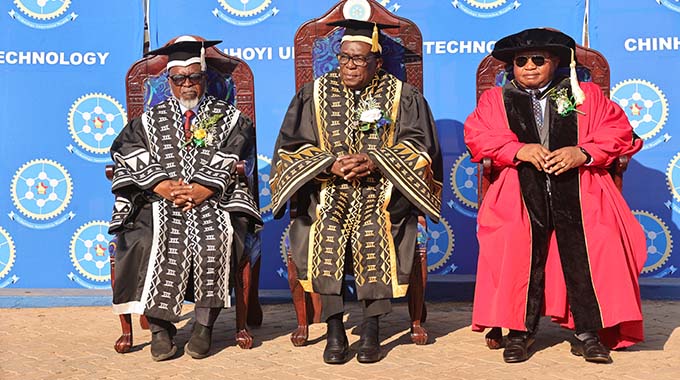
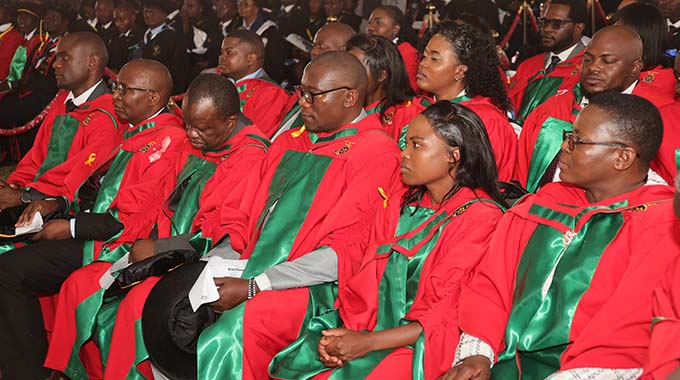
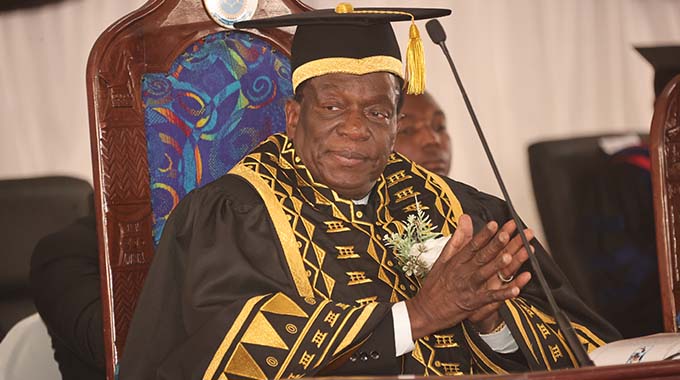
PRESIDENT Mnangagwa has capped 3 130 diploma, undergraduate, master’s and doctoral students at the 21st Chinhoyi University of Technology (CUT) graduation ceremony amid strategic moves to increase the number of STEM students.
Science, Technology, Engineering and Mathematics (STEM) are in demand to drive the country’s industrialisation and development thrust anchored on innovation in line with Education 5.0.
The resonance of the Education 5.0 masterstroke has spread beyond the country’s borders to the region, as academic pursuits are now producing tangible goods and services.
In his address, Vice Chancellor Professor David Simbi said the realignment of the country’s education system had revolutionised output from the country’s education system.
“Your Excellency, your broader definition of Education 5.0 has assumed greater meaning and impact across the nations and regions,” said Prof Simbi.
“Our understanding as institutions of higher learning of our role in using research, innovation, science and technology development to drive and develop industrialisation and modernisation of Zimbabwe to achieve middle-income status by 2030 has now assumed a higher state.”
Prof Simbi said CUT was undertaking investigations into the introduction of foundation programmes in engineering, science and technology before students enrol for university.
To that end, CUT has secured 40 hectares of land in Kadoma for the setting up of a university campus that will house the Institute of Materials, Process Technology and Engineering.
“This will accommodate the Chinhoyi University of Technology Centre of Excellence for Material Science and Engineering workshops,” he said.
“This will also house the intense teaching and learning laboratories to support the proposed pre-university basic technology education that will lead to an increase in undergraduate students in STEM programmes.”
The programme, he said, will target students who are not absorbed into polytechnics and those who would not have proceeded to A-level.
The new campus is also expected to have facilities for the manufacture of laboratory apparatus for schools, colleges and universities through reverse engineering of some equipment and use of locally available materials.
This approach, he said, was a common trend in many countries that included the United Kingdom, Singapore and Malaysia.
“Special stainless steel alloys required to make laboratory apparatus would be made from locally available materials that include macro and micro additions, ferrochrome alloys based on chromium, nickel, cobalt, among others,” he said.
He said reverse engineering and the train-the-trainer approaches will be used to meet the human capital and material needs of the country and the region.
Prof Simbi said the country needed to maintain momentum towards secondary use of minerals and materials coming out of large-scale mines such as Dinson Iron and Steel Company in Manhize.
He implored players in the corporate sector to fund research initiatives and support the foundational programmes to increase the number of STEM students.
This requires tailored graduate research, innovation and development programmes that feed into the National Development Strategy (NDS2), currently under formulation.
With the country on an industrialisation streak in the mining, agricultural and manufacturing sectors, competencies in science and technology have become the key.
The President capped the best graduating students and those with awards.
These included computer engineering, fuels and energy engineering, industrial electronics, mechatronics and production engineering, among others.
He said plans were at an advanced stage to establish a medical school that would turn Chinhoyi Provincial Hospital into a teaching hospital in partnership with CUT’s School of Health Sciences and Technology.
Enrolment will start next year for those who fail to get placement at the University of Zimbabwe Medical School.
“These will be admitted as a cohort into the clinical area. The programme will therefore start with a clinical lab,” said Prof Simbi.

Doctor of Philosophy in Engineering Sciences and Technology graduate Engineer Peter Munyanduri was one of two people who graduated with his thesis focusing on: “Design of a Concentrated Solar Thermal Power Plant for Integration with Coal-fired Power Station.”
The 59-year-old engineer said the Government had played a major role in his education journey and he would use it to serve the nation.
“I am quite grateful to the Zanu-PF Government policies through its various arms for facilitating my education from Form 1,” he said.
Another doctoral student, Martin Muduva, received the best Institute of Water and Sanitation Award for his thesis: “A Hybrid Cloud Computing and Machine Learning Adoption Model for Government 3.0 in Zimbabwe.”
Mr Garlard Kunodziya, who graduated with a Master of Science in Big Data Analytics with distinction, said Zimbabwe’s education system was becoming more responsive to its needs as shown by the fields of research being undertaken.
“Looking at the topics being studied now, one can see that people are responding to real-life challenges in the country and communities. We have students undertaking research in areas such as Makonde,” he said.