

 admin
admin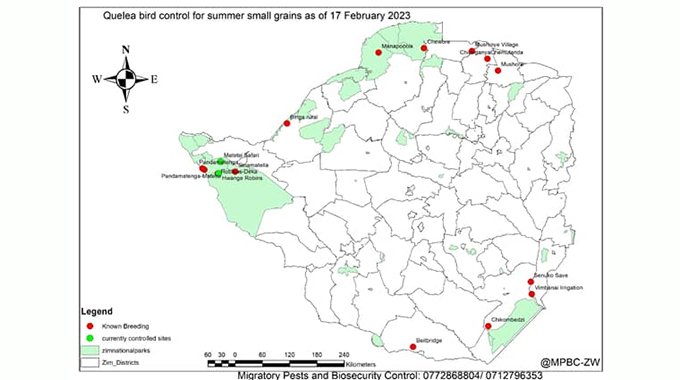
Sifelani Tsiko Agric, Environment & Innovations Editor
Government has intensified efforts to protect major crop growing areas from the ravage of quelea birds by targeting major breeding areas in various parts of the country.
Migratory Pests and Biosecurity Control (MPBC) acting Director Shingirayi Nyamutukwa told the Herald on Thursday that his department has partnered with the Problem Bird Control Unit to carry out surveillance of known quelea breeding grounds to control the pests and minimise traditional grain losses.
“Having celebrated and won war on quelea birds during the 2022 winter wheat crop production, the MPBC has intensified wide scale control in quelea breeding grounds to prevent traditional grain losses,” he said.
“We are looking at migratory birds that move into our national game parks mainly for breeding at this time of the year. It’s not going to be an easy operation to bring down the quelea populations.
“We want to save traditional grain crops and reduce losses for our farming communities.”
The chief government entomologist said they were targeting active breeding grounds in Malilangwe, Gonarezhou, Plumtree, Ramokgwebana, Mangwe, Hobodo, Matetsi, Mana Pools, Pandamatenga and Hwange.
“Plans are already in place to strike these breeding grounds at peak breeding time as we continue with our surveillance. As we speak, a major control operation was carried out this week in Hwange (Lukosi and Shangano village) where more than 180 000 breeding birds were killed,” he said.
“In addition to the adults killed, more than 300 000 eggs were destroyed. The birds were destroying sorghum and millet crops in the areas surrounding Hwange.”
A total of 67 600 birds were killed in the Save Valley Conservancy using both nets and chemicals.
“We are gearing up for more intervention strategies so as to bring the quelea populations to non-threatening levels,” he said.
“The MPBC department is also working closely with other organisations such as the UNDP to come up with non – chemical quelea control methods that are safe and do not harm the environment.”
Last season, the department managed to contain all outbreaks of quelea birds to protect the 2022 winter wheat crop.
Teams were working round the clock to contain all outbreaks to safeguard the country’s small grain crops.
If uncontrolled, quelea birds can worsen vulnerable farming households’ food and nutrition insecurity.
In Zimbabwe, traditional Quelea breeding grounds include Pandamatenga, Matetsi, Hwange, Chikombedzi, Gonarezhou, Checheche, Malilangwe, Beitbridge, Muzarabani and Mana Pools amongst low-lying areas.
The invasion of unusually large populations also threatens other countries in the SADC region including Botswana and Tanzania.
According to the Food and Agriculture Organisation (FAO) plant experts, an average quelea bird eats around 10 grams of grain per day and a flock of two million can devour as much as 20 tonnes of grain in a single day.
The red-billed quelea is a small weaver bird native to sub-Saharan Africa and renowned for its attacks on small-grain crops within Africa.
It is the most numerous bird species in the world, with a peak post-breeding population estimated at 1,8 billion.
Nomadic super-colonies can grow to millions of birds, making quelea not only the most abundant bird in the world but also the most destructive to cereal grains, especially sorghum and millets as well as wheat, rice and barley.
FAO has supported SADC countries to beef up response efforts in the urgent ground and aerial spray operations, surveillance and capacity building including alternative methods for controlling quelea birds in hardest hit parts of the region.
The red-billed quelea is an avian pest in Africa causing damage of approximately US$88,6 million annually, according to the FAO.



 Online Reporter