

 admin
admin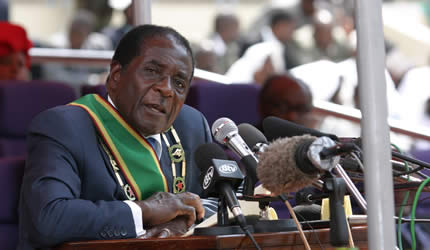
end. In its place will be a government formed exclusively by either Zanu-PF or MDC-T.
A March 16 referendum on a new constitution received a massive “Yes” vote, paving the way for elections in the next few months.
In the meantime, evidence recently published shows that the country’s controversial land reform programme has enabled black farmers to reach, in just 12 years, the same level of production white farmers achieved before the reforms.
As Zimbabwe prepares for crucial elections in the next few months, many people inside and outside the country are wondering why an 89-year-old man would still want to work a punishing schedule as President of Zimbabwe when his similarly-aged colleagues are now enjoying a comfortable retirement, and the unlucky among them, to put it brutally, are resting in their graves.
“Why can’t President Robert Mugabe, who celebrated his 89th birthday on February 21 2013, and who has been in power for 33 unbroken years, just go home and leave a younger head to continue from where he leaves?” has become the most popular question this side of the elections.
“Why is he running again?” is the obligatory second part of the question.
It is a legitimate question and a half whose answer, in normal circumstances, should not be difficult to give. Except that what has happened in Zimbabwe in the past 13 years — when the controversial land reform programme began in 2000 — has not been normal. Which means that the retirement of the man the Zimbabwean “nationalists” see as the “anchor of the country” has become a difficult proposition. It becomes even more complicated when viewed against the background of the actions taken in the past 13 years by certain Western nations — with Britain and the USA in the lead — to effect regime-change in Zimbabwe, whose sole goal has been to reverse the land reform programme and any gains achieved thereof.
In this regard, the antics of the governments of former British prime minister Tony Blair and the former American president George W. Bush, including supporting an abortive coup plot in Zimbabwe in 2007, effectively became a kiss of death for the locals seeking change in Zimbabwe, especially Morgan Tsvangirai’s MDC-T, which was the main beneficiary of the Western penetration actions.
To the “nationalists”, what has happened, and is still happening, in Zimbabwe since 2000 is a “war without guns” — a war, they say, which is being fought not only to safeguard the honour, integrity and sovereignty of the nation, but also a war to resolve once and for all the warped land question in the country in favour of the majority black people whose ancestral land was taken by force of arms by the white colonial governments in the century before Zimbabwe’s independence in 1980.
It is also a war to keep the ownership of the mineral and other resources of the country in the hands of its people — and that “war”, to them, is not yet over. As such the only man whose track record gives them comfort to lead the last charge and finish the job happens to be the man the opposition wants to retire — President Mugabe.
Thus, despite his great age — for an African — the “nationalists” say Mugabe is still needed for the last throw of the dice, at least for one more term of 5 years, in order to make absolutely sure that the gains of the “war” will not be reversed by outside forces using local agents. As one Zanu-PF insider told New African last year: “We want Mugabe to run again, because we don’t have a strong enough candidate to beat Morgan Tsvangirai.”
President Mugabe himself had hinted at it in an interview published by New African in July 2011: “The party needs me,” he said at the time, “and we should not create weak points within the party.
“We must remain solid and in full gear. Once you have a change, if we had it now for example, a new man or a new woman, that might destroy the party for a while as it goes through transition.
“Any new leader needs time to consolidate, so we don’t want to take risks at all. No risks at this time because there are people who have regime change as their objective. Blair was calling for it. His successors . . . we haven’t heard the voice of (Prime Minister David) Cameron yet. But there is that other man with a round head . . . what’s his name? Hague, William Hague (the current British foreign secretary). He seems very critical of us and seems to be on to regime change.”
Turning to what has become a major talking point in the last decade — his age and state of health, Mugabe said: “The body says what it says it is . . . I continue to have checks every six months.
“The doctors say that I am okay and some are surprised with my bone structure. They say they are the bones of someone who is 40. I suppose it is the exercise (he has been a gym fanatic all his life).
“I also take calcium every day. At this age you must take calcium, and I continue to exercise. I fall sick if I don’t exercise. You can see it when I don’t; you will say he is down today. For now, I feel as good as my age says I must be. My age says I am not yet old at 87 (two years ago when the interview was published). My body is saying the counting doesn’t end at 87 — at least you must get to 100.”
Which makes the coming election an interesting one. Like Mugabe, Morgan Tsvangirai will be running for the last time as leader of the MDC-T party, which will surely replace him if he loses again. He has already lost twice to Mugabe, in 2002 and 2008.
Unfortunately for him, conditions in the country today are not particularly in the MDC-T’s favour as they were in 2008, when Tsvangirai defeated Mugabe in the first round of the election, winning 47 percent of the vote to Mugabe’s 43 percent, and then boycotted the run-off.
That was Tsvangirai’s best chance to live in State House as 2008 was the highest point of the economic meltdown in Zimbabwe, when life was so hard to live and people were so prepared to vote with their stomachs that the former British foreign secretary Robin Cook’s earlier apocalyptic warning that if Zanu-PF did not “get rid of Mugabe, what will hit you will make your people stone you in the street”, appeared to be coming true.
This time round, conditions in the country have vastly improved, especially after the introduction of the US dollar as the medium of exchange in January 2009, a month before the inclusive Government was inaugurated. Since then, the economy has been on the up and up, and for most people, life is a lot easier now than in 2008, though unemployment is still high and wages are still too low.
A major disadvantage to the MDC-T is that the electorate has had the chance to see them in action in government, where they have been ensnared by the usual evils — corruption and self-aggrandisement. As their performance has not always been great, the novelty factor has worn out.
On the other hand, Zanu-PF has learnt its lessons from 2008. President Mugabe has since acknowledged that “2008 was our worst year of division . . . and so we lost a lot of votes. Anyway, we have done our post-mortem . . . It’s like football and cricket and all games. You don’t field anyone just to give them a chance. You field the best.” The period of the inclusive Government has also given Zanu-PF the chance to breathe, regroup, and refresh itself. The party is now in a better shape to contest an election than in 2008. Thus, the MDC will have to do more this time to defeat Mugabe and his Zanu-PF .
Land reform
A major selling point in the coming elections will be land reform and the gains achieved so far. Interestingly, April 6 2013 marks exactly 13 years since Zimbabwe’s fast track land reform began. On that fateful day, the country’s war veterans, long frustrated by what they saw as their government’s interminable feet-dragging over land redistribution, took matters into their own hands and forcibly seized some white farmlands.
That single action later snowballed into a fast track land reform programme that dragged the government, white farmers, and Western governments (led by Britain and USA) into a maelstrom.
In hindsight, it was perhaps impolitic for the Western countries to try to frustrate, even stop, the land reform programme the way they did, knowing that land reform is necessary if countries suffering from skewed land tenure systems are to achieve prosperity for all. So what is the score 13 years after that great event? Has Zimbabwe’s land reform been positive or negative? According to a new book, the answer is “yes”, it has been a success, and impressively so, considering the relatively short time it has taken black Zimbabwean farmers to come this far, in spite of the many hurdles thrown in their way.
The book, Zimbabwe Takes Back Its Land, published by Stylus (based in Sterling, Virginia, USA) was launched in London in late January. It is the work of three authors: Joseph Hanlon, Jeanette
Manjengwa, and Teresa Smart. Hanlon, author of Beggar Thy Neighbours and other books, was born in the USA and is now a visiting senior fellow at the London School of Economics. Jeanette Manjengwa is a black Zimbabwean woman and deputy director of the Institute for Environmental Studies at the University of Zimbabwe; while Teresa Smart, a white woman, is a visiting fellow at London University’s Institute of Education.
Together, the three authors have decades of experience of Zimbabwe. Their fieldwork for the book was done in the country’s Mashonaland Central and Mashonaland East provinces in 2010 and 2011. And their verdict is emphatic, a shot in the arm for Mugabe and Zanu-PF in the run-up to the elections. According to the authors: “Agrarian reform is a slow process and it takes a generation for new farmers to be fully productive.
“(However), a decade after (land reform began), Zimbabwe’s agricultural production has largely returned to the 1990s level (and) small-scale black farmers now produce together almost as much tobacco as the big white farmers once did.”
The authors add an important caveat: “Land reform will not be reversed,” they say matter of factly: “The Global Political Agreement [that set up the Inclusive Government between Zanu-PF and the two formations of the MDC in 2009] includes the phrase, ‘accepting the irreversibility of said land acquisitions and redistribution’, and 2 million new occupants would not allow any change now.”
This is what the Zimbabwean “nationalists” call “consolidation”, which has always been part of President Mugabe’s strategy — to spread land reform to the maximum number of Zimbabweans and make it impossible for any future government to reverse it. And this is exactly what has happened.
“It has been hard work,” says Hanlon and his two colleagues, “and the new farmers started out in conditions that were not always propitious . . . Post-land reform Zimbabwe has been subject to (economic) sanctions and a major cut in foreign aid, and the government managed its response badly, opting to print money, which led to hyperinflation in 2007 and 2008.”
Eddie’s view
Interestingly, contrary to what the authors found on the ground during their fieldwork, Eddie Cross, a white MP and policy co-ordinator general of the MDC-T party, claimed in April 2011 that white farms had been “invaded and occupied by (a) ragtag collection of people” who are just “squatters”, and that “the majority of these farms have become largely defunct, their homesteads and farm buildings derelict and their arable lands have returned to bush”. But Hanlon and his co-authors are categorical:
“We have seen something different.
“We visited A2 farmers who are major commercial farmers turning over more than US$100 000 per year, and A1 commercial farmers with a few hectares but who are making a profit of more than US$10 000 per year and who are more productive than the white farmers they replaced.
“To be sure, we have also seen both A1 and A2 farms that are unused or underused. Just as there was a spectrum of white farmers, some good, some bad, and most in the middle, there is also a spectrum of resettlement farmers.
“But, on average, in just a decade, the new farmers have caught up with the white farmers’ production. It is widely estimated that new farmers take a generation to reach full production, and this was the case with both the white farmers and the first land reform farmers (in the early 1980s), so the new farmers can be expected to develop significantly in the next decade.”
To press the point home, the three authors, in their book, implore Eddie Cross to visit Craigengower Farm. “Driving into the old white farm compound, one arrives at a hub of activity,” the authors say. “Every building is in use — grain and machinery stores, houses for some farmers, and a house for the agricultural extension officer who serves this and two other farms. Indeed, all he (Eddie Cross) needs to do is to use Google Maps satellite pictures to show how intensively Craigengower is used. But Eddie is right about one thing.
“One item in the compound is derelict: the old swimming pool is empty and filled with weeds.”
Putting it in context
To put Eddie Cross’s view in context, the authors provide statistics to show that “white farmers who were given land in the 1940s and 1950s were sent on courses by the colonial government or forced to do a one or two-year apprenticeship on a farm before they could occupy their land.
“(But) despite not having the support given to their white predecessors, land-reform farmers (since 2000) have made substantial investments using their own money rather than outside investment or loans,” the authors add. Zimbabwe now holds the record of implementing the largest land reform in Africa, in which “6 000 white farmers have been replaced by 245 000 black farmers,” say Hanlon et al. “These are ordinary poor people who have become more productive farmers … and (who) already grow 40 percent of the country’s tobacco, and 49 percent of its maize.”
According to the authors, what impresses most is “walking into living rooms of (black) farmers to find the furniture has been moved out and the room filled with sacks of maize and groundnuts, or noting that money has been used to buy machinery rather than new furniture or a fancy car.
They continue: “This is not a book about what might have been, could have been, or should have been. Instead, this is a book about Zimbabwe’s land reform in 2011 and about the new farmers on the ground –about their successes and failures, their hopes and prospects. Zimbabwe has taken back its land, and the new occupants will not allow that land reform to be reversed.”
Zimbabwe Takes Back Its Land, by Joseph Hanlon, Jeanette Manjengwa, and Teresa Smart is published by Stylus Publishing, Virginia, USA. ISBN: 978-1-56549-520-3. This article is reproduced from New African magazine.



 Online Reporter
 dyton mupawaenda