

 Online Reporter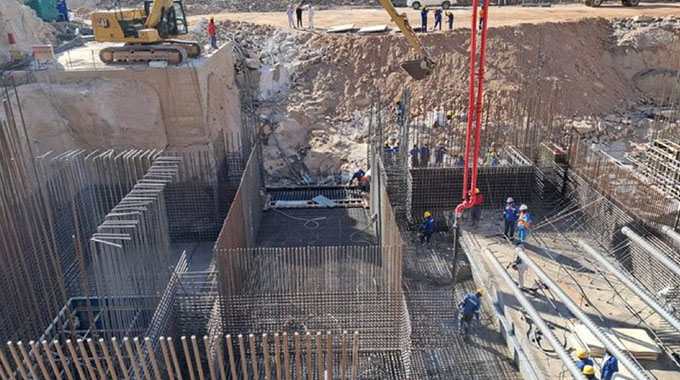
Patrick Chitumba, [email protected]
Zimbabwe’s Dinson Iron and Steel Company (Disco) is now supplying locally produced steel for the construction of the Lake Gwayi-Shangani Dam. This development marks a significant step in the nation’s efforts to use domestic resources for major infrastructure projects. Following a substantial US$1.5 billion investment, Disco’s Manhize Steel Plant in Mvuma began delivering steel to the dam site last month.
With contractors working around the clock following the release of funds by the Government, the project has entered an intensive phase, with Disco’s steel now a key component in the dam’s construction.
Treasury has already released US$5 million towards the dam’s construction and has committed to disbursing the same amount monthly until the project is completed.
Once completed, Lake Gwayi-Shangani, located in Hwange District, will become Zimbabwe’s third-largest inland water body, after Tugwi-Mukosi and Lake Mutirikwi, both situated in Masvingo.
The project, which had previously faced delays due to financial constraints, is set to deliver a reliable water supply to Bulawayo. In addition, it will support irrigation and hydroelectric power generation, significantly boosting regional development.
The Disco plant has made notable progress in production and beneficiation, employing over 2 000 people and now producing steel in various forms, including iron bars and deformed bars.
The plant also has the capacity to produce 1.8m diameter pipes, which may be required for transporting water from the lake to Bulawayo.
Notably, some of its output is being exported, generating much-needed foreign currency.
Disco is producing around 300 tonnes of steel per day, with an annual target of 600 000 tonnes. The Manhize Steel
Plant is one of the Tsingshan Group of China’s mining projects in Zimbabwe.
The investor is among the largest in the country, with other ventures including Afrochine Smelting (Pvt) Ltd in Selous, Mashonaland West, which focuses on chrome smelting, and Dinson Colliery (Pvt) Ltd in Hwange, Matabeleland North, which is involved in coke production.
All these projects are interlinked, as both ferrochrome and coke are essential in steel production. In an interview yesterday, Disco Public Relations Manager Mr Joseph Shoko said promising times lie ahead for both the company and the country in terms of affordable steel.
“Disco is selling quality steel to a contractor assigned by the Government to construct Lake Gwayi-Shangani, and we are proud to confirm that we now have more than enough steel for the purpose,” he said.
Mr Shoko stated that the company began supplying steel for the Lake Gwayi-Shangani project last month.
“For Disco, this means we have secured a significant customer and boosted our sales revenue. Since we are now producing finished steel products, including deformed bars suitable for construction, we are well-positioned to meet the demand from the Gwayi-Tshangani Dam project,” he said.
Mr Shoko added that having steel readily available within the country is a game-changer for the Lake Gwayi-Shangani project and the construction sector at large.
“It means the project can progress more smoothly and efficiently, without relying on costly imports. This should help expedite the completion of the dam, which is a critical project for the country—aiming to provide a reliable water supply to Bulawayo and surrounding areas, support agriculture, and even generate hydroelectric power,” he said.
Mr Shoko confirmed that Dinson has completed a plant with a capacity of 600 000 tonnes of steel per annum.
“Of the 600 000 tonnes, we have various products such as pig iron, steel billets sized 100 by 100, and deformed bars ranging from 10mm to 32mm. There will be further product expansion to include wire rods of different sizes and mining mill balls,” he said.
As an integral part of the National Matabeleland Zambezi Water Project (NMZWP), the dam will be linked to Bulawayo via a pipeline, enabling the city to access water from the Zambezi River.
The extensive project also includes a 10MW mini hydroelectric power station, a 252km pipeline with six booster stations from the dam to Cowdray Park in Bulawayo, a 220ML/day Cowdray Park water treatment plant, and irrigation schemes covering 10 000 hectares for communities situated along the pipeline.
Lake Gwayi-Shangani is regarded as one of the flagship projects of the Second Republic. It is expected to enhance food security, stimulate industrial growth, and significantly improve the livelihoods of communities across the nation.
The dam’s pipeline will not only supply water to Bulawayo but will also facilitate the creation of irrigation schemes along its route, ultimately fostering a new greenbelt.
Lake Gwayi-Shangani was first proposed in 1912, but implementation stalled under the Rhodesian administration.
The Government revived the project in 2012, and the Second Republic has since committed substantial resources to it and other initiatives aligned with the National Development Strategy 1 (NDS1) and Vision 2030.



This is a great development if true.Great development indeed