


 peter
peter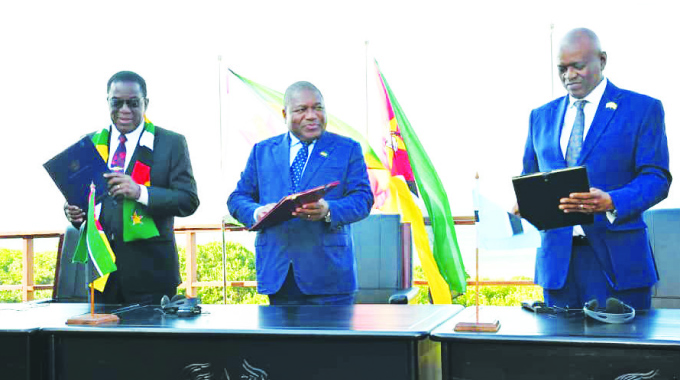
Sunday News Senior Reporter
IN a significant move towards regional economic integration, the Presidents of Zimbabwe, Mozambique, and Botswana convened a Tripartite Summit in Mozambique on Friday to discuss the development of the Ponta Techobanine Project.
The Technobanine Deep Water Port is a major project located in southern Mozambique, near the border with South Africa.
Construction on the port began in 2022 and is scheduled for completion by 2026.
The summit, attended by President Emmerson Mnangagwa, President Filipe Nyusi of Mozambique, and President Mokgweetsi Masisi of Botswana, focused on mechanisms to operationalise the Techobanine Port.
The Ponta Techobanine Project, initially a private sector-led effort, has now been elevated to the highest level of Government co-operation among the three nations. In his remarks, President Mnangagwa expressed Zimbabwe’s readiness to fulfil its financial obligations of contributing $1 million towards the feasibility study, underscoring the country’s commitment to the project.
The development of this key infrastructure aligns with the national development strategies and visions of the three countries, as well as the broader regional and continental integration goals outlined in the African Union’s Agenda 2063.
President Mnangagwa noted that the Tripartite Summit was preceded by high-level visits and bilateral commissions, further strengthening the co-operation among the nations.
The benefits of the deep water Techobanine Project for the three countries are immense. For landlocked Zimbabwe and Botswana, it provides direct access to maritime trade routes, reducing their reliance on ports in South Africa. This facilitates the movement of goods, raw materials, and commodities between the three countries and global markets, boosting regional trade.
Secondly, the port can accommodate larger cargo ships compared to older, shallower ports in the region. This allows for more efficient and cost-effective shipping, lowering logistics expenses for businesses in the three countries.
The port’s construction and ongoing operations have created thousands of direct and indirect jobs in the region. It has also attracted new investments in industries like mining, agriculture, and manufacturing in Zimbabwe, Mozambique, and Botswana that will use the port’s services.
In addition, the port is linked to an extensive network of roads, railways, and pipelines connecting it to major cities and economic hubs in Zimbabwe, Botswana, and Mozambique. This enhances the flow of goods, services, and people across the region.
There are key benefits of the Technobanine port for individual countries.
For Zimbabwe:
— Provides a new trade gateway for landlocked Zimbabwe to access global maritime trade routes
— Reduces Zimbabwe’s reliance on ports in South Africa, which have faced congestion issues
— Allows Zimbabwean goods easier access to international markets through the Indian Ocean
— Supports economic diversification by enabling Botswana to export a wider range of products
For Mozambique:
— Boosts Mozambique’s position as a regional trade and logistics hub
— Generates economic activity and jobs in the southern Mozambique region
— Expands Mozambique’s port infrastructure and capacity to handle larger cargo volumes
For Botswana:
— Offers a more direct, efficient route for Botswana exports and imports through the Indian Ocean
— Reduces Botswana’s dependence on ports in South Africa
— Lowers transportation costs for Botswana businesses accessing global markets
— Improves access to global markets for Botswana businesses and agricultural producers
Overall, the Technobanine port is a transformative project expected to strengthen regional economic integration, reduce logistics costs, and improve trade competitiveness for the countries of southern Africa. It represents a major infrastructure investment to boost economic development in Mozambique, Zimbabwe, and Botswana.
The Tripartite Summit’s successful outcome reflects the three countries’ shared vision for economic development and regional integration. The Ponta Techobanine Project, once operational, is poised to overcome logistical bottlenecks in the transportation of goods and services, bolstering trade and economic prosperity in the region.
The Summit stands as a testament to the strong diplomatic ties and the unwavering commitment of Zimbabwe, Mozambique, and Botswana to fostering regional integration and economic development through collaborative efforts.



 Blessing Chizhande
 Online Reporter