

 admin
admin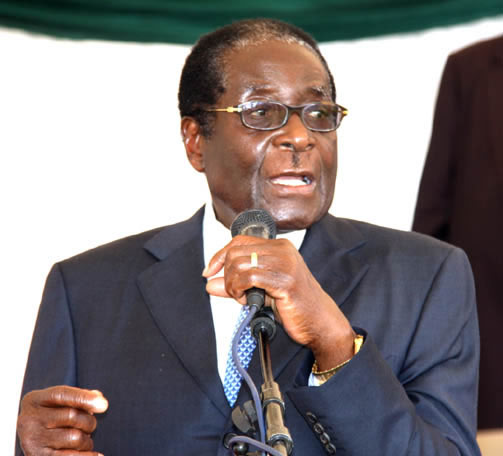

Mark P Fancher
NEWLY re-elected Zimbabwean President Robert Mugabe has again defied the imperial wrath of the US and Britain, with his announcement “that the government will seize foreign banks and mines and redistribute them to local investors.”
Such actions can get one killed, but President Mugabe is no easy target for the West’s secret services. He has a popular base, and a loyal armed forces.
Only a few short months ago, the US government expressed remorse for its longstanding campaign to isolate Zimbabwe. For years, the US has played a pivotal role in maintaining crippling sanctions against Zimbabwe as a response to alleged human rights violations.
Yet, a few months ago former UN Ambassador Andrew Young paid a fence-mending visit to Zimbabwe where he said: “The decision for me to come here was made by the Secretary of State and approved by the President of the United States.”
Young met with President Mugabe, and afterwards said: “President Mugabe received the message that we are prepared to remove the sanctions. He was quite understanding and he warmly welcomed us. We told him about how the US deeply values building closer partnerships with Zimbabwe and how we attach great importance to the restoration of positive relations between the two countries.”
Mr Young’s visit was actually just the beginning. A small parade of other notable visitors followed, and the US removed two Zimbabwean banks from the sanctions list. Not to be outdone, Europe sent a delegation from the European Parliament’s Development Committee to Zimbabwe to have high level discussions about prospects for western re-engagement.
Fast forward five months. President Mugabe emerged victorious from an election and a US State Department spokeswoman said the election had “serious flaws.” She added: “We have made clear to the government of Zimbabwe and the region that a change in US sanctions policy will occur only in a context of credible, transparent, peaceful reforms that reflect the will of the Zimbabwean people. If those changes are made, then we’ll certainly conduct a review.”
What happened to all of the flowery statements about “partnerships,” re-engagement and the lifting of sanctions? Apparently President Mugabe’s plans to pursue economic justice for his country are what happened. In the wake of the electoral victory, President Mugabe’s party, Zanu-PF announced that the government will seize foreign banks and mines and redistribute them to local investors. A party spokesman said the election was a “clear mandate to transform the economy through indigenisation and economic empowerment.”
The US has cited the election rather than planned seizures as the reason for its chilly posture. But given US objectives, the indigenisation plans cannot be welcome news, and President Mugabe charged that the decision to maintain sanctions is “harassment.” He said: “They should not continue to harass us, the British and Americans. We have not done anything to their companies here – the British have several companies in this country – and we have not imposed any controls, any sanctions against them, but time will come when we will say well, tit-for-tat, you hit me I hit you.”
Historically, leaders of underdeveloped countries who dare to assume such an aggressive posture in the face of US bullying tend to meet with untimely demise.
In his book, Confessions of an Economic Hit Man, author and former NSA operative John Perkins noted: “. . . (Progressive Ecuadorian President Jaime) Roldos warned all foreign interests, including but not limited to oil companies, that unless they implemented plans that would help Ecuador’s people, they would be forced to leave his country.
He delivered a major speech at the Atahualpa Olympic Stadium in Quito and then headed off to a small community in southern Ecuador. He died there in a fiery airplane crash, on 24 May 1981.”
Perkins went on to comment: “I had no doubt that Roldos’s death had not been an accident. It had all the markings of a CIA-orchestrated assassination. I understood that it had been executed so blatantly in order to send a message . . . The (Reagan administration) jackals were back and they wanted Panama’s Omar Torrijos and everyone else who might consider joining an anti-corporatocracy crusade to know it. But Torrijos was not buckling. Like Roldos, he refused to be intimidated . . . he adamantly refused to give in to the Reagan administration’s demands to renegotiate the Canal Treaty. Two months after Roldos’s death, Omar Torrijos’s nightmare came true; he died in a plane crash. It was 31 July 1981.”
Mysterious plane crash deaths were not limited to progressive Central American leaders. Africa shared in the experience when Mozambique’s President Samora Machel died in a plane crash on 19 October 1986.
If defiant conduct comparable to that of Roldos, Torrijos and Machel guarantees assassination, President Mugabe should have been dead long ago. He mocked and insulted Tony Blair, and he said of Condoleezza Rice that “the white man is the slave master to her.” And now he has announced plans to seize foreign banks and mines. When the National Conference of Black Lawyers drafted and published a model law for such seizures several years ago, there was little expectation that African governments would be willing in the then-foreseeable future to withstand the imperialist ire that the adoption of such a law would draw.
President Mugabe’s survival is due to several factors. First, his election and repeated re-election since Zimbabwe’s independence in 1980 demonstrate rather convincingly that he enjoys mass support among the people.
Second, as Black Agenda Report’s Glen Ford has noted, Zimbabwe is one of only two African countries that have avoided entanglement with US Africa Command (Africom). Loyal armed forces can be a significant deterrent to assassination attempts and other violent destabilisation efforts.
Third, President Mugabe is not a lone, isolated, vulnerable political figure. The protection he enjoys from Zanu-PF validates the All-African People’s Revolutionary Party’s mantra about the value of belonging to an organisation.
Finally, President Mugabe enjoys exceptional respect throughout Africa because of his profound contributions to the African liberation struggle. Even many of his political rivals regard him as a patriot.
While there may be a growing awareness of the importance of united African resistance to the isolation and demonisation of independent leaders, there must also be a frank acknowledgment that foreign corporate domination of Africa’s resources and a US military presence in Africa to protect that hegemony are absolutely incompatible with genuine African self-determination and the success of leaders who seriously pursue it.
President Mugabe apparently understands this very well, and as he begins his walk down the path to the indigenisation of Zimbabwe’s wealth, we must hope that the African world will have his back.
Mark P Fancher is an attorney who writes frequently about the US military presence in Africa. This opinion article was originally published by Black Agenda Report. He can be contacted at [email protected]


 Online Reporter
 derick.khumalo