Online Reporter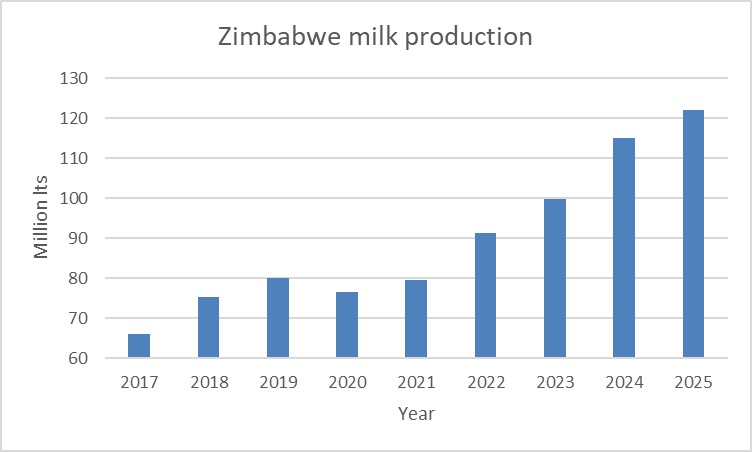
Edgar Vhera
Specialist Writer – Agribusiness
ZIMBABWE is targeting production of 400 million litres of milk annually in the long term to meet both domestic demand and export opportunities as commercial production reached a 23-year record high last year.
Raw milk production rose nine percent to 10,6 million litres in January against 9,8 million litres during the same period last year, statistics from the Dairy Services Unit (DSU) reveal.
Information, Publicity and Broadcasting Services Minister, Dr Zhemu Soda, confirmed that the dairy industry had registered an increase in milk production during the recent Post Cabinet media briefing.
He said the dairy herd had increased by 7,5 percent from 65 659 in 2024 to 70 584 in 2025.
“The growth contributed to a 6.2 percent rise in commercial raw milk production, from 114 699 440 litres in 2024 to 121 846 916 litres in 2025.
“The household milk production from dairy cattle was estimated at 33 100 927 litres, resulting in total milk production of approximately 154 947 843 litres,” he said.
Agricultural Marketing Authority (AMA) chief executive, Ms Alice Mapfiza said during deliberations with the dairy industry, stakeholders, it was noted that milk production remained low with current output still falling short of national consumption requirements.
The country requires 131 million litres of milk for self-sufficiency annually.
Zimbabwe Dairy Industry Trust (ZDIT), chairperson Mr Themba Mutsvairo, said with the country set to become a prosperous and empowered upper middle-income society by 2030, the demand for dairy products was expected to rise due to health awareness of dairy protein.
“In the 1990s per capita milk consumption was around 25 litres, now it’s on the lower side of between 10 to 12 litres.
“According to the World Health Organisation (WHO) milk per capita should be around 45 litres, though in East Africa it can reach 80 to 100 litres,” he said.
Milk has ripple effects in food and nutrition and rural livelihoods.
According to stakeholders in the industry, despite the positive outlook, several structural challenges continued to affect the dairy value chain, including high feed costs, expensive utilities and limited access to key raw materials required for fodder production.
Competition from illegal imports and the proliferation of counterfeit dairy products also affected the sector.
Livestock and Meat Advisory Council (LMAC) executive administrator, Dr Reneth Mano said the demand for dairy protein tended to increase when disposable family income rises.
“With imports included, Zimbabwe’s per capita dairy consumption is under 10 litres per year and highly concentrated with wealthy families consuming over 80 to 100 litres per person per year.
“According to WHO guidelines for low to middle-income countries, the target is 45 litres dairy milk equivalence per person per year.
“At the modest short-term target of 30 litres per person per year, Zimbabwe’s dairy sector ought to quadruple its current efforts to increase domestic production four-fold to 480 million litres per year for the country to become 67 percent food secure in dairy products by WHO standards and 100 percent national self-sufficiency in commercial dairy production,” he said.
Dr Mano said to produce 480 million litres of milk per year, the dairy sector of Zimbabwe would have to upgrade and increase the national commercial dairy herd of lactating cows to 100 000.
Statistics from the Dairy Services Unit show that the country produced a peak of 262 million litres of milk in 1990 from a dairy herd of 119 220.
The dairy herd averaged 115 143 between the period 1987 and 1993 with milk production averaging 241 million litres in the same period.
After declining to its lowest figure of 37 million litres in 2009, milk production rose 229 percent to 122 million litres last year as a result of Government, private sector and development partner interventions.
The ushering in of the Second Republic saw milk production rising 85 percent from 66 million in 2017 to 122 million litres last year.