

 Online Reporter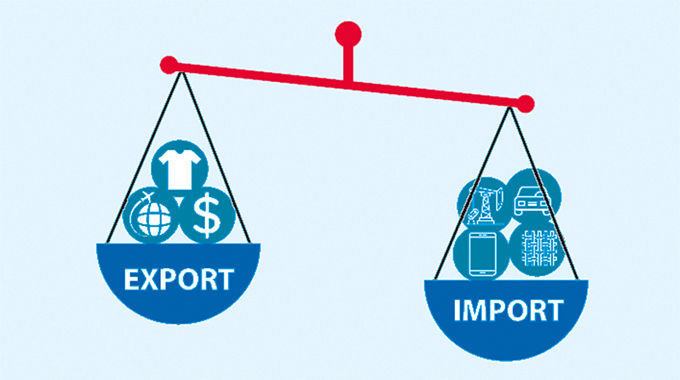
Oliver Kazunga
Senior Reporter
ZIMBABWE’S export earnings soared to US$1,68 billion in August, with three mineral products and three markets accounting for the bulk of the country’s foreign sales, official figures show.
Latest trade statistics from the Zimbabwe National Statistics Agency (ZimStat) show exports jumped 14,2 percent to US$1,679 million during the month, while imports increased by just 0,2 percent to US$1,152 million.
The figures reveal a highly concentrated export structure, with semi-manufactured gold, other mineral substances and ores and concentrates accounting for a combined 75,5 percent of total exports.
Semi-manufactured gold alone generated 44 percent of export earnings, followed by other mineral substances at 19,5 percent and ores and concentrates at 12 percent.
The strong export performance helped push Zimbabwe’s trade surplus to US$526,5 million, up 64,5 percent from US$320 million in July.
“The resulting trade balance amounted to a surplus of US$526,5 million, a 64,5 percent increase from the July 2026 surplus of US$320 million,” said ZimStat.
But the export figures also show that Zimbabwe’s trade with the rest of the world remains heavily concentrated in a handful of destinations.
“The country’s major export destinations in August 2026 were United Arab Emirates (US$749,6 million), China (US$540,3 million) and South Africa (US$218,3 million.
“The three countries accounted for about 90 percent of the total export value of US$1,68 billion,” ZimStat said.
The United Arab Emirates was the biggest destination, accounting for US$749,6 million, followed by China with US$540,3 million and South Africa with US$218,3 million.
Regional trade figures tell a similar story, with minerals and metals featuring prominently among Zimbabwe’s major exports.
In the Southern African Development Community (SADC), nickel mattes alone accounted for 48,2 percent of exports, while iron and steel products contributed 9,5 percent, coke and semi-coke of coal 6,6 percent and other ores and concentrates 5,4 percent.
The four products accounted for about 70 percent of Zimbabwe’s US$278,4 million exports to SADC.
The pattern was repeated under the African Continental Free Trade Area (AfCFTA), where nickel mattes accounted for 46,8 percent of exports.
Iron and steel products contributed 9,2 percent, nickel ores and concentrates 8,4 percent and tobacco, partly or wholly stemmed or stripped, 6,6 percent.
Together, the four products accounted for 71 percent of the US$286,7 million exported under AfCFTA.
Zimbabwe’s exports to the European union were similarly concentrated, although tobacco rather than gold was the dominant product.
Tobacco, partly or wholly stemmed or stripped, accounted for 66,3 percent of exports to the EU, followed by chromium ores and concentrates at 17,2 percent and ferrochromium at 11,3 percent.
The three products accounted for about 95 percent of the US$19,1 million exported to the bloc.
While exports were dominated by minerals, the import bill reflected Zimbabwe’s demand for fuel, machinery, industrial inputs and other manufactured goods.
Mineral fuels, mineral oils and products accounted for 22,2 percent of total imports, while machinery and mechanical appliances contributed 15,5 percent.
Vehicles accounted for 6,8 percent and electrical machinery and equipment 4,9 percent of the US$1,15 billion import bill.
SADC supplied US$568,2 million worth of imports, with machinery and mechanical appliances accounting for 14,6 percent, mineral fuels and related products 9,7 percent, fertilisers eight percent and iron and steel articles 5,9 percent.
Under AfCFTA, machinery and mechanical appliances accounted for 14,2 percent of imports, followed by mineral fuels, mineral oils and products at 9,5 percent, fertilisers at 7,8 percent and iron and steel articles at 5,7 percent.
Zimbabwe earned substantially more from exports than it spent on imports, but the export windfall was overwhelmingly driven by minerals and concentrated in a small number of international markets.
The US$526,5 million trade surplus was consequently an improvement of US$206,5 million on July’s US$320 million surplus, with the acceleration in exports providing the biggest boost.


