Online Reporter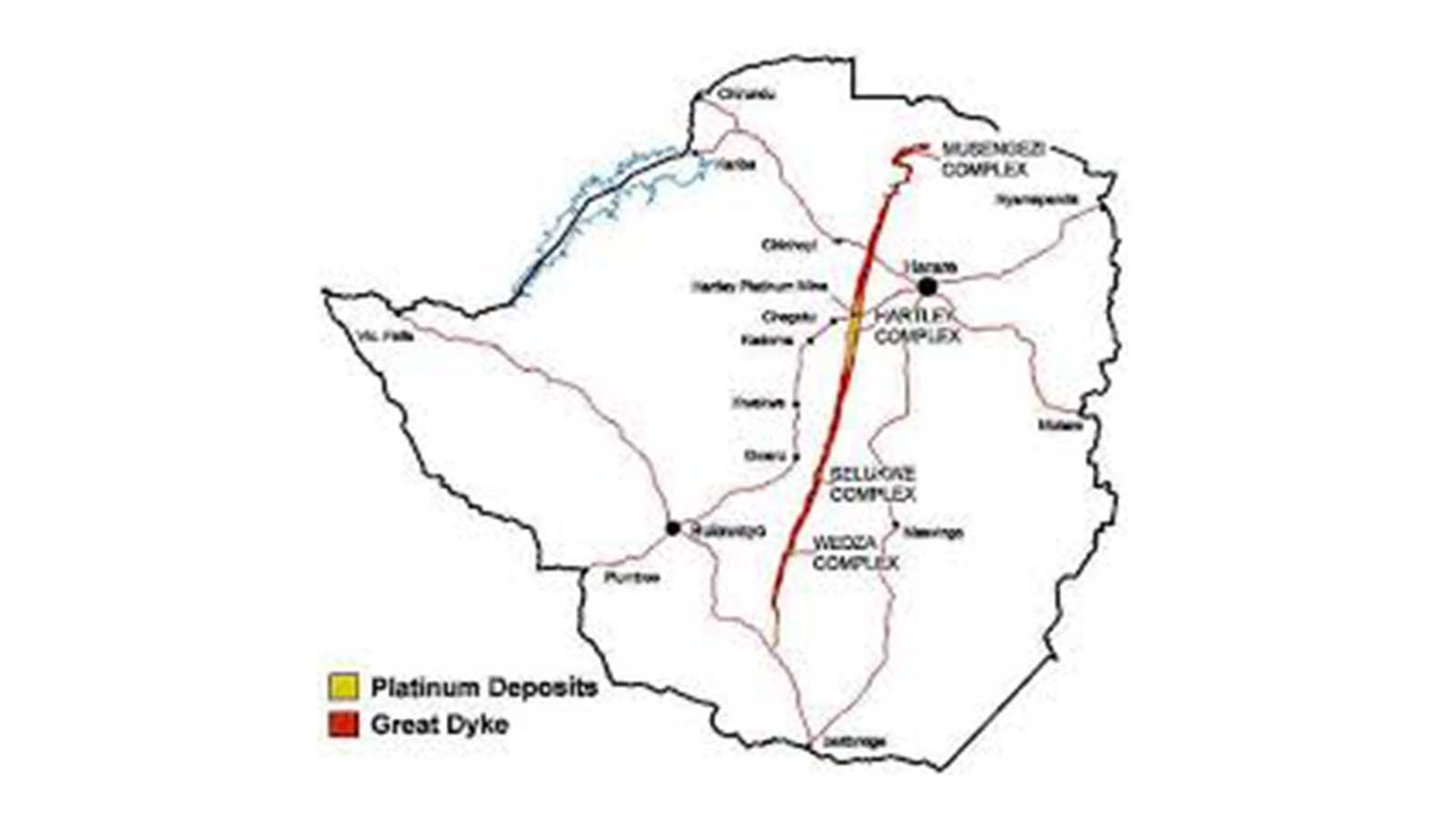
Sifelani Tsiko
Fact Check Editor
The 2,5-billion-year-old Great Dyke – a narrow series of long, low ridges and hills that straddles some 550km from the north to south of Zimbabwe is one of the most significant igneous structures on Earth, according to a new report by NASA’s Earth Observatory.
This major linear geological feature that trends from north to south through the heart of Zimbabwe has more than 10 minerals that include gold, platinum, chrome, nickel, mica and asbestos among other mineral deposits.
Latest images shared by NASA astronauts show that the Great Dyke of Zimbabwe is ‘among the most significant igneous structures on Earth.’
Media reports revealed that the dyke is visible from orbit as a long, nearly continuous line across the landscape.
NASA said this massive feature preserves a record of early planetary activity.
In addition, it said this major feature, which geological experts here say is the spinal cord of Zimbabwe, holds vast concentration of reserves of strategic minerals, making it both a scientific landmark and a significant economic and mining opportunity.
Experts say it has a width that varies between 3.2km and 13km, with hills rising to 1,500 feet above the surrounding plateau, forming a chain of elevated land that can be difficult to fully appreciate from ground level.
Geological experts say it’s a type of igneous intrusion that forms parallel to existing rock layers and takes on a broad, saucer-like shape.
Media reports say the astronaut image highlights the southern portion with striking clarity, revealing contrasts in colour and texture that hint at its deep and ancient origins, shaped by forces that operated billions of years ago.
NASA’s Earth Observatory said the Great Dyke was formed around 2,5 billion years ago, during a period when Earth’s internal dynamics were far more active than today.
“Molten rock from the mantle slowly moved upward through fractures in the crust, cooling over immense spans of time to create this continuous igneous body. The result is considered one of the longest such formations on the planet,” NASA experts noted.
Space and geological analysts said the images shared by NASA show that the Great Dyke is a “Treasure Trove Of Strategic Minerals” beneath its rugged surface.
They say beneath this geological spinal cord of Zimbabwe lies one of the richest mineral corridors on the planet.
“The Great Dyke hosts vast deposits of platinum, ranking among the largest globally, along with significant quantities of gold, nickel, copper, iron, titanium, vanadium, and tin,” said one analyst.
The dyke was observed to hold vast quantities of chromite, prized for its high chromium content, a critical component of stainless-steel production.
The Great Dyke region is the heart and lung of Zimbabwe’s mining hub, with giant mining companies that include Unki Mines, Mimosa, Implants, Zimasco, among others that mine gold, platinum and chrome.
Mining activities in this geological ridge have transformed millions of livelihoods and Zimbabwe’s economy.
“The concentration of such diverse and valuable minerals in a single geological structure is exceptionally rare, making the dyke not only a scientific curiosity but also a cornerstone of Zimbabwe’s economy,” said one space and geological analyst.
“Its mineral wealth originates from the same ancient magma that formed the structure, bringing deep-Earth elements closer to the surface where they could eventually be accessed.”
The Great Dyke holds vast deposits of untapped rare earth minerals.
The Great Dyke, said an Indian engineer and space analyst, stands as more than a geological structure.
“It is a preserved narrative of Earth’s internal evolution. Its age, scale, and composition provide scientists with critical insights into how continents formed and how valuable minerals became concentrated in specific regions,” he said in a report.
“The astronaut image reinforces its status as a global natural landmark, one that continues to reveal new details with each observation.
“As satellite and orbital imaging technologies advance, formations like this are being reexamined with increasing precision, uncovering patterns that deepen our understanding of planetary history.”
He said something that what once appeared to be a simple line across a map now emerges as one of the most significant geological features on Earth.
The Great Dyke is seen as a major mining magnet because of its vast untapped mineral wealth.
It has attracted substantial investment from Russia, China, India and South Africa for its iron, platinum, gold and chrome deposits.
“The Great Dyke of Zimbabwe is more than a line on a map – it’s a lifeline of economic opportunity, a geological marvel and a symbol of Zimbabwe’s wealth,” a mining expert told the Mining in Zimbabwe journal in 2025.