Online Reporter
Rutendo Nyeve
Online Reporter
THE Zimbabwe Parks and Wildlife Management Authority (ZimParks) in partnership with the International Fund for Animal Welfare (IFAW) has deployed technology to curb human wildlife conflict in communities surrounding the Hwange National Park.
This has been done through the fitting of GPS-enabled satellite collars to 16 strategic African savannah elephants roaming close to Hwange National Park and the neighbouring communities.
The GPS satellite collars are linked to “Earth Ranger” enabled technology, which will enable the elephants to be monitored around-the-clock as they traverse heavily populated surrounding community lands, providing rangers with the real-time data needed to prevent and respond to incidents of human-elephant conflict.

The collaring operation enables conservationists to monitor the interactions of up to 200 elephants, given each collared elephant typically belongs to a herd of around 10 individuals.
ZimParks Director General Professor Edson Gandiwa said the operation is grounded on the authority’s strong belief that conservation should be science-driven.
“Together with our partner, IFAW, we strongly believe that conservation should be grounded in solid science. We are confident that this initiative will ensure that conservation decisions are informed by robust scientific data, allowing for more effective protection strategies and fostering a harmonious coexistence between people and nature,” said Prof Gandiwa.
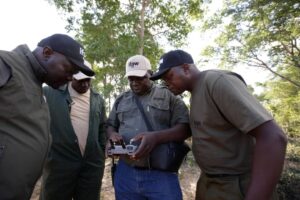
The Senior Director of Conservation Programs at IFAW, Mr Phillip Kuvawogasaid,
“The Hwange-Matetsi-Zambezi landscape is key part of the landscape for IFAW’s Room to Roam initiative, which aims to reconnect fragmented habitats and allow wildlife to migrate along their ancient routes. With the information set to be generated from the GPS collars, we can now focus our efforts on protecting areas where elephants need to be and developing informed interventions to guide human-wildlife mitigation interventions.”