Tawanda Musarurwa
Check Point Desk
WHEN a chartered plane carrying deportees from the United States touched down in Harare last month, one man stood out.
Identified only as Mabugu, he told local broadcaster ZBC that he could not remember any family members, having left Zimbabwe as a nine-year-old.
Now 30, he said he had also lost comprehension of his mother tongue. “I cannot speak Shona anymore. I don’t understand it. I forgot it. I was born here, in Masvingo. I grew up in the United States, in Pennsylvania,” he said quietly.
Mabugu’s story captures a deeper reality about Zimbabwe’s vast Diaspora: Millions have left, some never to return; at least not as they once were. It also reflects a broader disconnection — emotional, cultural and financial — that complicates life after migration. Nearly a million Zimbabweans live abroad, according to the country’s latest census. But, emigration is rarely straightforward. Analysis of the 2022 Population and Housing Census emigration data shows just how unevenly it is spread across the country.
Some provinces have high levels of emigration, while others remain far less connected to the Diaspora. The 2022 Population and Housing Census counted 908 914 Zimbabweans abroad.
Of that total, 59 percent were males and 41 percent were females. About 13,6 percent of households (520 240) had at least one emigrant.
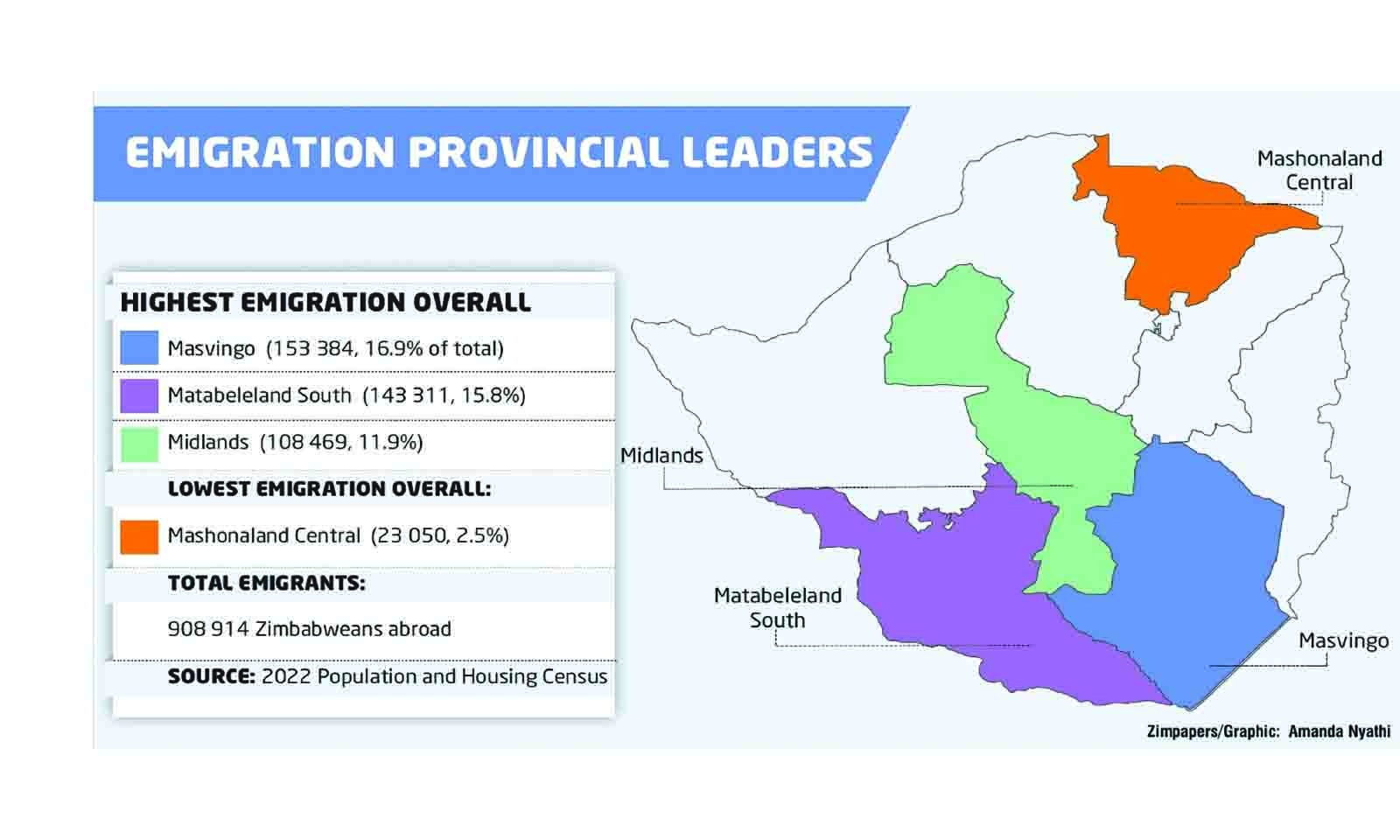
The data reveals sharp contrasts. Masvingo tops the list with 153 384 emigrants, followed by Matabeleland South (143 311) and Midlands (108 469). At the other end, Mashonaland West had 48 090 emigrants. And Mashonaland Central sent just 23 050, accounting for just 2,5 percent of emigrants.
Migration in the country is skewed towards the youth, with 28 percent of emigrants aged 20 to 24 at departure (149 273 males and 101 534 females).
Zimbabwe’s Diaspora map is dominated by South Africa. Out of the 908 914 emigrants, 773 246 (85 percent) live in South Africa, with 47 928 in Botswana and 23 166 in the United Kingdom. The United States (8 565), Australia (6 473) and Canada (3 420) also attract smaller, but significant flows.
Why they emigrate
The census found 84 percent migrate for work, 9 percent for family reasons and 5 percent for education. The International Organisation for Migration (IOM)’s fourth quarter 2024 survey echoes this: 59 percent cited economic reasons, with South Africa the top destination, while 35 percent moved for family reunification.
While the majority emigrated for employment reasons, the data shows different reasons for emigration between the provinces. The dominance of southern provinces (Masvingo, Matabeleland South, Midlands and Matabeleland North) indicates strong historical, cultural and economic migration links with South Africa and Botswana.
Urban centres (Harare and Bulawayo) show more varied reasons (education, health, family), suggesting their role as international gateways. For example, Harare’s education/training migration figure of 13 358 accounts for the bulk (14,5 percent) of the country’s education-related migration, followed by Bulawayo’s 6 215. “Emigrants from Masvingo and Matabeleland South migrated mostly for employment purposes. Harare and Bulawayo provinces had relatively more persons who emigrated for education or training reasons,” reads the 2022 Population and Housing Census report.
Factors, such as settlement, social displacement, disasters, health and “other” are relatively marginal (accounting for less than 3 percent each).
Zim’s remittance economy
The trajectory of Diaspora remittances into the country has been on an upward trend over the last few years. Reserve Bank of Zimbabwe (RBZ) statistics show that Diaspora remittances amounted to US$2,15 billion last year, up 19 percent from US$1,8 billion in 2023.
In 2022 the country’s Diaspora remittances stood at US$1,66 billion, rising 16 percent from US$1,43 billion in 2021. According to RBZ governor Dr John Mushayavanhu, “diaspora remittances have continuously supported the economy, accounting for 17 percent of the total foreign currency receipts.”
Policy issues
Migration brings both relief and strain. It sustains millions, but hollows out the country’s workforce, with the health sector particularly affected. Statistics from the Ministry of Home Affairs and Cultural Heritage show that between June 2023 and June 2024, 35 938 Zimbabweans had been granted working visas by the UK, mostly as health care workers.
Meanwhile, policy efforts, such as diaspora bonds, bilateral labour agreements and remittance formalisation, face challenges because many migrants mostly depend on informal networks.
Life after emigrating . . .
49-year-old Tafadzwa Mundonga (not his real name) from Kanengoni village in the Chiweshe communal area has spent decades building a life through odd jobs in Johannesburg, but now faces the unsettling question of where to grow old.
“This decision is a heavy blanket,” he says. “If I stay, I fear being alone as I grow older. If I come back, I don’t want to be a burden.”
For many Zimbabweans abroad, the biggest challenge is not just finding work, but planning for retirement. Social security, including pensions, is recognised as a basic right under both the Universal Declaration of Human Rights (Article 25 of 1948), and a constitutional right enshrined in the country’s Constitution. But, for emigrants, securing that right is far from simple.
Many leave in search of greener pastures, but retirement planning becomes complicated when they return home, voluntarily or under pressure.
The Covid-19 pandemic, which hit during the first quarter of 2020, highlighted how fragile migration can be. By August 2020, data from the United Nations Office for the Coordination of Humanitarian Affairs showed 14 044 migrants had returned to Zimbabwe from neighbouring countries, mostly after losing jobs during lockdowns.
In the past, pensions were not portable across borders. That changed with the Pensions and Provident Funds Act (Chapter 24:32), which came into effect in September 2022.
Section 17 of the law says that if someone leaves one pension fund and joins another that accepts transfers, the first fund must transfer the member’s benefits within 30 days (or longer if allowed by the regulator, the Insurance and Pensions Commission). But does this work across borders? Lawyer Nobert Phiri explains: “We must first appreciate that the Pension and Provident Funds Act regulates funds in Zimbabwe, and so would apply to funds in Zimbabwe. “In order for one to determine whether a migrant worker could have their benefits transferred into Zimbabwe, we would need to read the law of that particular country.”
Actuary Mr Gandy Gandidzanwa of Risk and Investment Management Consulting Actuaries is more optimistic. “Our reading of the Act is that it should be possible… we have reason to believe that it has been granted where it has been sought,” he said.
Even so, questions remain. The regulator needs to clarify whether transfers can go into public pension funds and how they would work under defined benefit (DB) or defined contribution (DC) plans.
Other countries provide models. Ireland allows overseas pensions to be transferred into approved schemes, provided the transfer happens before benefits are paid out, both schemes permit it, and tax authorities sign off. Irish workers can also move pensions into personal retirement savings accounts or buy-out bonds.
Zimbabwe faces an extra hurdle, because its largest Diaspora community is in South Africa, where many work informally. Because traditional pension systems are tied to formal employment, these workers are excluded entirely.
At the Organisation for Economic Co-operation — International Organisation of Pension Supervisors (OECD/IOPS) Global Forum on Private Pensions in Victoria Falls in 2023, experts pointed to global models Zimbabwe could learn from.
In the United Arab Emirates, for example, migrant workers are covered by a compulsory employer-funded defined contribution pension plan. In India and Mexico, partnerships with remittance providers allow workers abroad to channel money directly into their pension plans back home, ensuring they build retirement savings even while employed overseas.
Making pensions portable could unlock more diaspora funds for local investment. A 2021 paper by local think-tank the Zimbabwe Economic Policy Analysis and Research Institute, in partnership with the Zimbabwe Reconstruction Fund, found that remittances “tend to stimulate all categories of household expenditure in Zimbabwe.”
With remittances already topping US$2,15 billion last year, bigger pension pools could strengthen both household security and the wider economy.
But, the portability of pensions cannot happen in isolation.
It will require bilateral and multilateral agreements to ensure that a Zimbabwean worker’s pension rights follow them across borders.
Without this, many emigrants, especially those in informal work, face old age without the safety net they deserve.