malvernmugadzikwa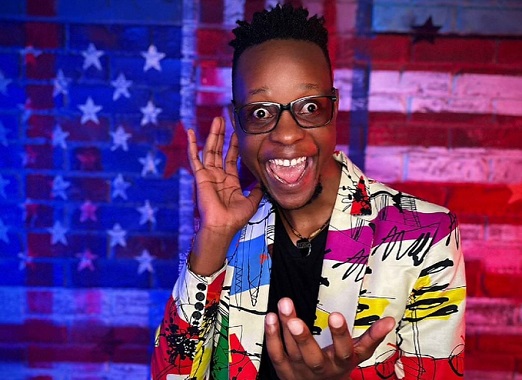
Tinashe Kusema
THE golden buzzer blared, a siren song echoing through the cavernous auditorium.
For Learnmore Jonasi (30), it was years in the making.
From the plains of Chimanimani, moving to Harare, then South Africa and eventually to the glittering lights of “America’s Got Talent (AGT)”, his journey was a testament to unwavering ambition.
Hailing from the small town, his path to international stardom is a captivating tale of overcoming adversity, pursuing one’s passion and representing the country on a global stage.
Jonasi’s victory, a month or so back, was the realisation of a childhood dream, as his idol Terry Crews gave him the highest honour a prospective contestant can get on the long-running variety television talent show.
The Zimbabwean stand-up comedian received Season 19’s very first Golden Buzzer, the nod coming from AGT host and his own personal idol Crews.
Jonasi grew up watching Crews’ movie “White Chicks” and it was the 55-year-old American actor’s performance as Latrell Spencer that inspired him to become a jester.
“I am here because of you,” bellowed Jonasi, as confetti rained down on the AGT stage.
“I feel like this is a dream. Is this actually happening? Punch me!”
Jonasi has since made it all the way to the final eight. He remains an outside favourite to make it to the final and even win it.
Fingers crossed
His is a story still being written. The comedian has literally become an overnight sensation in the United States.
However, Jonasi’s appearance and run on the show is nothing new. The likes of Gamuchirai Nhengu, Brian Nhira, Blessing Chitapa and Donel Mangena have already walked down a similar path.
The above-mentioned artistes sent shockwaves on AGT-equivalent shows like Britain’s Got Talent (Nhira), X-Factor (Nhengu) and The Voice (Mangena).
However, what sets Jonasi apart from his contemporaries is that his appearance and run have brought the spotlight on the fledgling art of stand-up comedy — back home and abroad.
“Stand-up comedy is leisure back home,” reckons US-based stand-up comedian Ian Phiri.
“For people to attend shows in Zimbabwe, they need to have disposable income as the average ticket is US$10, depending on the act. The figure could be higher sometimes.
“Until such a time when people from the hood (high-density suburbs) can afford those charges, we are still going to lag behind. It is a numbers game.
“The more people we get to fill seats in arenas, the more growth we will see in stand-up comedy. Zimbabwe has a lot of talent, but we suffer when it comes to the audience.”
Phiri, one of a handful of stand-up comedians, is currently making waves abroad. He is joined on the US circuit by the duo of Jonasi and Mukudzei “King Kandoro” Majoni.
The three represent a fresh start for the art form, with some calling them Zimbabwe kings of stand-up comedy.
They have of late been on a tear and a day shall come when Jonasi, whose stage name is Long John, King Kandoro and Phiri will headline the same show.
The comedians come from contrasting backgrounds but are united by the niches of storytelling.

Culture shock
Phiri is the youngest among them and is currently in the US for school and the stand-up comedy dream.
“My name is Ian Phiri but was born Ian Chigada after taking my mother’s maiden name since my father’s family has not been in the picture,” said the 27-year-old comedian.
“I was born and bred in Zimbabwe but both my parents are originally from Zambia and this is part of the story I am telling in my stand-up set.”
Phiri is currently studying towards a master’s degree in Mathematics. At the same time, he is working towards becoming a chartered financial analyst.
His journey has largely been shaped by his mother, who introduced him to Martin Lawrence and, more specifically, the movie “Blue Streak”.
“It was my mother’s favourite movie and she talked about it incessantly. By the time we could afford a DVD player, it was one of the films I watched repeatedly,” he said.
But it is through studies that he finds himself in the US, with the vibrant comedy scene in New York nurturing his talent for stand-up comedy.
“Growing up, you are told that things are cheap in America but that could not be further from the truth.
“Something as simple as bread costs as much as US$3 yet we bought it for US$1 in Zimbabwe.
“Things are so fast here. I have quadrupled my intake of coffee just to catch up. There is no such thing as a celebrity as they are all over the city. I recently found out that I go to the same church as Lovell Adams-Gray, who plays Dru Tejada in the television show “Power: Book 2”.
“I also once performed at the same club as Jerry Seinfeld. I was one of the amateurs who opened the night,” revealed Phiri.
The comedian’s storyline is chiefly based on juxtaposing life in Zimbabwe and the US. He also explains the complexities of his Zambian and Zimbabwean roots.
Comedy is big in New York as comics perform daily. Some of the shows start as late as 10pm and stretch into the wee hours.
Phiri dreams of performing at the Apollo Theatre and becoming a correspondent on the “Daily Show”.
The “Daily Show” is an American late-night talk and satirical news television programme, which airs on Comedy Central. Of late, the show seems to have become a launching pad for comics to hit the big time.
Some of the well-to-do former correspondents are Steve Carell, Michael Che, Stephen Colbert, John Oliver and Oliver Munn, most of whom have either gone to host their own shows or break into Hollywood.
Trevor Noah is a former host of the show.

Revolutionary comedian
King Kandoro is arguably a revolutionary comedian, making the most of social media and other digital technologies.
A podcast appears to be his “weapon” of choice.
“Sadza in the Morning”, a show he co-hosts with fellow comedian Nickk Titan, has become popular.
Their podcast was established around 2017.
“The growth of the podcast has been largely organic and we owe this mainly to our authenticity. We still sound the same way we did in the first episode — raw, loud and for the most part funny,” said Kandoro.
“Another reason we have one of the biggest podcasts in Zimbabwe is that, to a greater extent, everyone feels represented.
“Kandoro is the loud ghetto kid, who throws stones at Zimdancehall concerts. He did his Advanced Level kumusha (rural areas).
“Conversely, Titan is the kid from the suburbs, who does not use commuter omnibuses. He went to Peterhouse from crèche.”
On his comedy origins, Kandoro said: “I come from an extremely funny family, so it was always in me; I was the class clown growing up.
“It was only until recently that I realised making people laugh was my passion and that it was something I could do professionally.”



 Online Reporter